




Table of Contents
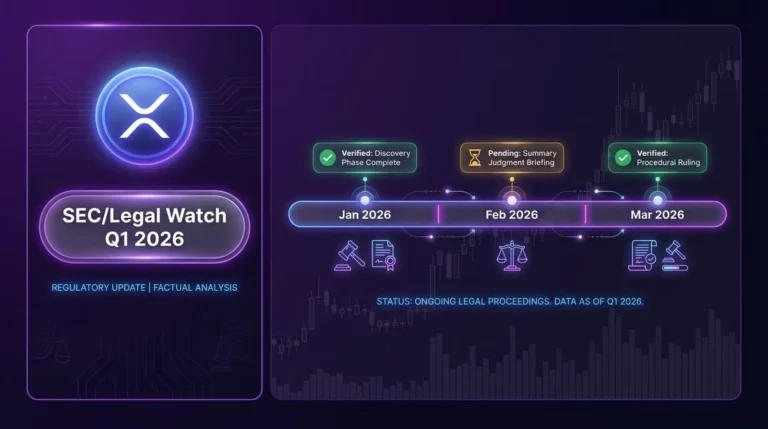
XRP SEC/Legal Watch Q1 2026
What is the latest XRP SEC lawsuit and regulatory status?
XRP’s regulatory outlook depends on verified filings, rulings, and clear timelines—not headlines. This Q1 2026 tracker summarizes confirmed legal updates, the next decision points, and how different outcomes can shift liquidity, risk premium, and price scenarios.
Quarter Window: Q1 2026 (January 1 – March 31, 2026 UTC)
Last Updated: January 28, 2026, 16:00 UTC
Status Snapshot:
- SEC vs Ripple Case: Settlement reached August 2024; case effectively concluded
- XRP Classification: Court ruled XRP not a security in programmatic sales (July 2023)
- Regulatory Environment: New administration signals pro-crypto policy shift (Jan 2026)
- Market Impact: Legal clarity has improved exchange access and institutional participation
⚠ VERIFIED VS UNVERIFIED
VERIFIED: Settlement filed with court (Aug 2024); Judge Torres ruling on programmatic sales (July 2023); SEC dropped appeal of programmatic sales ruling (Oct 2024); Multiple US exchanges relisted XRP; ETF S-1 filings submitted.
UNVERIFIED: Claims of ‘full regulatory clarity’; predictions about specific ETF approval dates; speculation about future enforcement actions. Social media commentary is not regulatory guidance.
Impact Channels (How Legal Clarity Affects Price):
- Exchange Access: Improved; major US exchanges have relisted XRP
- Institutional Participation: Increased; custody solutions expanded; ETF filings enabled
- Risk Premium: Reduced; regulatory overhang largely removed
- Liquidity: Deepened; spreads tighter; order book depth improved
Scenario Strip:
| Scenario | What It Means | Forecast Impact |
| Negative Legal | New enforcement action; adverse ruling; appeals | Risk premium rises; ranges widen; bear bias |
| Neutral (Current) | Status quo maintained; no major changes | Other drivers dominate; legal not primary |
| Positive Legal | Further clarity; favorable guidance; ETF progress | Risk premium compresses; bull bias; access expands |
Navigate: SEC/Legal hub | XRP catalysts hub | Forecast methodology | XRP ETF hub
What’s New in Q1 2026 (Verified Legal/Regulatory Developments)
| Event | Jurisdiction | Date | Current Status | Next Step | Source |
| SEC vs Ripple Settlement | US (SDNY) | Aug 2024 | Settled; case closed | None (resolved) | Court |
| Programmatic Sales Ruling | US (SDNY) | July 2023 | XRP not security in prog. sales | Precedent set | Court |
| SEC Appeal Dropped | US | Oct 2024 | No appeal filed | None (finalized) | SEC |
| New SEC Leadership | US | Jan 2026 | Pro-crypto signals | Policy guidance | Official |
| Exchange Relistings | US | 2024-2025 | Coinbase, Kraken, others relisted | Additional venues | Exchange |
Court/Case Updates
The SEC vs Ripple case has reached effective conclusion. The August 2024 settlement resolved outstanding matters including the institutional sales claims. The landmark July 2023 ruling by Judge Torres—that XRP is not a security when sold programmatically on exchanges—remains the operative legal precedent. The SEC chose not to appeal this ruling, which became final in October 2024. No new litigation has been filed in Q1 2026.
SEC and Regulator Statements/Actions (Policy/Enforcement)
The January 2026 administration change brought new SEC leadership with stated intentions to provide clearer regulatory frameworks for digital assets. While no formal policy guidance has been issued yet, early signals suggest a more constructive approach to crypto asset classification and product approvals. No new enforcement actions targeting XRP or Ripple have been announced in Q1 2026.
Exchange Access or Listing Changes
Legal clarity from the case resolution enabled major US exchanges to relist XRP. Coinbase, Kraken, Gemini, and Bitstamp have restored XRP trading. This expanded access has improved US market liquidity and enabled participation by US-based investors who were previously restricted. Custody solutions have also expanded, supporting institutional adoption and ETF filing requirements.
XRP Legal Landscape (Explainer)
How Legal Clarity Impacts Market Access and Risk Premium
Legal clarity affects XRP through multiple channels:
- Exchange Access: Exchanges require legal clarity before listing. The Torres ruling enabled US relistings.
- Institutional Participation: Compliance departments need legal certainty. Settlement removed a key barrier.
- Risk Premium: Regulatory uncertainty commanded a price discount. Clarity compresses this premium.
- Product Development: ETFs, derivatives, and structured products require regulatory clarity to proceed.
- Liquidity Depth: Market makers and liquidity providers need legal certainty. Clarity improves depth.
What Counts as ‘Material’ Legal Development
Material legal developments are those that change market access or perceived regulatory risk:
- Court rulings: Binding decisions that set precedent or resolve disputes
- Settlements: Resolution of litigation that removes ongoing uncertainty
- Formal guidance: Official regulatory statements, no-action letters, or rulemaking
- Enforcement actions: New cases or charges that increase regulatory risk
- Exchange/custody changes: Policy changes that affect market access (listings, delistings)
Timeline & Decision Points (Q1 2026)
| Date/Window | Event | What It Means | Forecast Impact |
| Jan 2026 | New SEC leadership takes office | Potential policy shift on crypto | Sentiment positive; reduced risk premium |
| Q1 2026 | Policy guidance watch period | New framework signals expected | Clarity improves; bull bias if positive |
| Q1-Q2 2026 | ETF-related regulatory reviews | SEC engagement with ETF applications | Progress = bullish catalyst |
| Ongoing | Enforcement action monitoring | Watch for new cases/charges | New action = negative catalyst |
Known Deadlines and What They Represent
As of late January 2026, no fixed legal deadlines exist for XRP specifically—the case has concluded. Q1 monitoring focuses on: (1) new policy guidance from SEC leadership, (2) ETF-related regulatory reviews (separate from the concluded lawsuit), and (3) any new enforcement signals. The primary timeline to watch is ETF-related rather than litigation-related. For ETF tracking, see the XRP ETF hub.
What Would Count as Meaningful Progress or Setback
Progress signals:
- Formal SEC guidance clarifying digital asset classification frameworks
- No-action letters or safe harbors for crypto products
- ETF approval progress (see ETF hub for details)
Setback signals:
- New enforcement actions against XRP or Ripple
- Policy statements contradicting the Torres ruling
- Exchange delistings citing regulatory concerns
How Legal Outcomes Affect XRP Price (Mechanism Map)
| Outcome Channel | How It Works | Metric to Watch |
| Market Access | Legal clarity enables/restricts exchange listings and trading | Exchange announcements; trading pairs |
| Custody | Institutional custody requires regulatory clarity | Custodian support; institutional flows |
| Risk Premium | Uncertainty = discount; clarity = premium compression | XRP vs market beta; relative performance |
| Liquidity/Spreads | Market makers need legal certainty to commit capital | Bid-ask spreads; order book depth |
| Product Development | ETFs, derivatives require regulatory approval pathway | Filing status; approval announcements |
Market Access: Listings, Custody, Institutional Channels
Post-settlement, XRP market access has significantly improved. Major US exchanges (Coinbase, Kraken, Gemini) have relisted XRP, restoring access for US investors. Qualified custodians now support XRP with institutional-grade security, enabling participation by funds, advisors, and other regulated entities. This expanded access contributed to the January 2026 breakout. For liquidity tracking, see the sentiment and liquidity hub.
Liquidity and Spreads (Risk Premium Compression/Expansion)
Legal clarity affects liquidity through market maker participation. During peak uncertainty (2021-2023), XRP spreads widened and depth thinned as market makers reduced exposure. Post-ruling, spreads have tightened and depth improved. The risk premium—the discount XRP traded at due to regulatory uncertainty—has largely compressed. New uncertainty (enforcement actions) would reverse this.
Flow Dynamics and Volatility Around Rulings
Legal events create flow dynamics and volatility. The July 2023 ruling triggered significant inflows and a price spike. The settlement announcement produced a second leg. Future legal events (positive or negative) would likely create similar volatility spikes as positioning resets. Traders should widen expected ranges around legal catalysts.
Forecast Implications (Scenario Requirements + Triggers)
| Scenario | Trigger | Confirmation | Invalidation | Market Behavior |
| Base (Neutral) | No major legal changes | Status quo maintained | New action or guidance | Other drivers dominate |
| Positive | Favorable guidance; ETF progress | Official announcement | Negative action | Risk premium compresses |
| Negative | New enforcement; adverse ruling | Formal filing/charge | Case dismissed/settled | Risk premium expands; sell-off |
Base Case: No Major Legal Changes (What Matters Instead)
With the SEC case concluded and legal clarity established, the base case assumes no major legal changes in Q1 2026. Other drivers become primary: BTC regime, overall crypto liquidity, Ripple adoption metrics, and ETF progress. Legal status acts as background context rather than active catalyst. This is the current operating assumption for weekly and monthly forecasts. For weekly context, see this week’s XRP outlook.
Positive Case: Clarity Increases Access (What to Watch)
The positive case activates if regulatory clarity improves further—formal SEC guidance, no-action letters, or ETF approval. This would compress risk premium further, expand institutional access, and support the bull scenario. Watch for: official policy statements, ETF filing progress, and additional exchange/custody announcements. For monthly planning, see the next month forecast.
Negative Case: Renewed Uncertainty (Risk Controls)
The negative case activates if regulatory uncertainty returns—new enforcement actions, adverse policy statements, or market integrity concerns. This would expand risk premium, potentially trigger delistings, and support the bear scenario. Risk controls: monitor SEC announcements, watch for litigation filings, and maintain defensive positioning if signals emerge.
Risks & Misconceptions
Confusing Commentary with Rulings
Social media frequently amplifies commentary, opinions, and speculation as if they were legal developments. Verified legal developments are court filings, official rulings, regulatory announcements, and formal guidance. Lawyer opinions, analyst predictions, and unnamed sources are not legal facts. This tracker only includes verified developments from primary sources.
Assuming One Headline Permanently Resolves Regulatory Risk
While the SEC case settlement significantly reduced regulatory risk, it does not guarantee permanent clarity. Regulatory environments evolve. New enforcement theories, policy shifts, or market events could introduce new uncertainty. The current legal clarity is favorable but not absolute. Ongoing monitoring remains necessary.
Ignoring Jurisdiction Differences (U.S. vs Global)
The Torres ruling and SEC settlement are US-specific. Other jurisdictions have different regulatory frameworks. XRP may be treated differently in the EU, UK, Japan, Singapore, and elsewhere. While US developments influence global sentiment, local regulations determine actual market access in each region. Do not assume US outcomes automatically apply globally.
How VTrader Incorporates Legal Developments (Method Excerpt)
Legal developments enter VTrader forecasts through the catalyst framework:
- Verified updates: Court filings, rulings, and official statements are tracked in this quarterly watch
- Scenario mapping: Legal outcomes map to base/positive/negative scenarios with probability adjustments
- Range expectations: Legal events justify wider ranges; volatility expectations adjust
- Background vs active: Legal status is currently ‘background context’; would become ‘active catalyst’ on new developments
For the full methodology on how catalysts affect forecasts, see the forecast methodology hub. For the complete XRP forecast framework, see the XRP price prediction pillar. For 2026 context, see the XRP 2026 outlook.
Frequently Asked Questions
What is the current legal and regulatory status of XRP?
VERIFIED: The SEC vs Ripple case has been settled (August 2024). Judge Torres ruled that XRP is not a security when sold programmatically on exchanges (July 2023). The SEC did not appeal this ruling. Major US exchanges have relisted XRP. New SEC leadership has signaled a more constructive approach to digital assets. UNVERIFIED: Claims of ‘complete regulatory clarity’ or specific future actions.
What are the key dates and deadlines to watch in Q1 2026?
No fixed litigation deadlines exist for XRP—the case has concluded. Q1 monitoring focuses on: new SEC leadership policy signals, potential regulatory guidance, ETF-related timelines (separate from litigation), and any new enforcement actions. The primary catalysts to watch are policy-related rather than court-related.
What counts as a material legal development for XRP price?
Material developments change market access or perceived regulatory risk: court rulings, settlements, formal regulatory guidance, enforcement actions, or exchange/custody policy changes. Commentary without procedural effect (lawyer opinions, analyst predictions, social media speculation) is usually lower signal.
How could legal clarity affect XRP price and liquidity?
Legal clarity reduces risk premium (the discount for regulatory uncertainty), improves exchange/custody access, increases institutional participation, and deepens market liquidity over time. The post-settlement environment has already produced tighter spreads, more exchange listings, and increased institutional interest. Further clarity (guidance, ETF approval) would continue this trend.
Can regulatory headlines move price without a ruling?
Yes—markets reprice probabilities on news, not just final outcomes. However, the highest-quality signals are verifiable documents and official statements. Social media rumors and speculation often create noise without lasting impact. This tracker separates verified developments from unverified claims to improve signal quality.
How do U.S. regulations differ from global treatment of XRP?
Regulatory treatment varies by jurisdiction. The Torres ruling is US-specific and does not automatically apply elsewhere. XRP may be classified differently in the EU, UK, Japan, Singapore, and other markets. While US developments influence global sentiment, actual market access depends on local regulations. Do not assume uniform global treatment.
What risks could increase regulatory uncertainty again?
Potential risks: new SEC enforcement actions (different theories or parties), policy shifts contradicting the Torres ruling, market integrity concerns triggering regulatory response, or adverse developments in other jurisdictions affecting US policy. While current conditions are favorable, regulatory environments evolve. Ongoing monitoring is essential.
How does the legal outlook affect weekly and monthly forecasts?
Currently, legal status is ‘background context’—favorable but not driving active price moves. Other drivers (BTC regime, liquidity, ETF progress) are primary. If new legal developments occur, they would become active catalysts expanding ranges and potentially switching scenarios. Weekly forecasts would widen ranges; monthly forecasts would reassess scenario probabilities.
Where can I track the latest XRP legal updates on VTrader?
This quarterly SEC/Legal Watch post tracks verified developments. The SEC/Legal hub provides evergreen context on legal history and implications. The Catalysts hub includes legal status alongside other drivers. Weekly and monthly forecasts incorporate legal outlook into scenario assessments.
Update Log (Q1 2026)
| Date/Time (UTC) | Update Notes |
| Jan 1, 10:00 | Q1 2026 Legal Watch published. Status: Case settled; new administration incoming. |
| Jan 20, 18:00 | Updated: New SEC leadership confirmed; pro-crypto policy signals noted. |
| Jan 28, 16:00 | Updated: Confirmed no new enforcement actions in January. Policy watch continues. |

Steve Gregory is a lawyer in the United States who specializes in licensing for cryptocurrency companies and products. Steve began his career as an attorney in 2015 but made the switch to working in cryptocurrency full time shortly after joining the original team at Gemini Trust Company, an early cryptocurrency exchange based in New York City. Steve then joined CEX.io and was able to launch their regulated US-based cryptocurrency. Steve then went on to become the CEO at currency.com when he ran for four years and was able to lead currency.com to being fully acquired in 2025.