Table of Contents
Can XRP Reach $5? Feasibility, Market Cap Math, and Scenarios
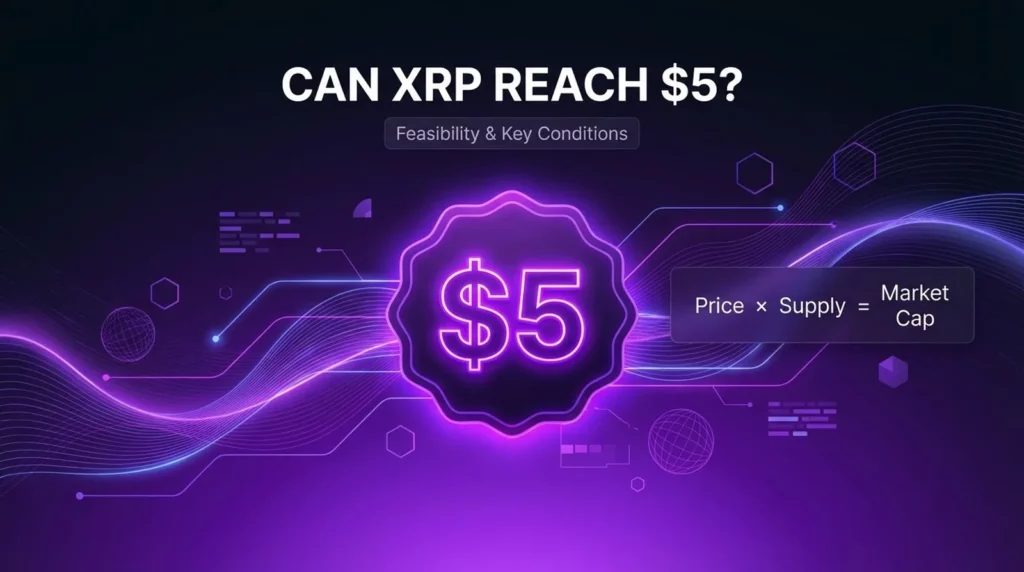
What market cap would XRP need to reach $5?
At $5, XRP’s market cap equals $5 × supply: ~58B circulating XRP implies ~$290B; the full 100B max supply implies ~$500B. Reaching $5 typically requires a strong risk-on liquidity regime, broad market access, and supportive catalysts — plus the ability to hold above key levels.
XRP at $5 would represent roughly a 3× move from its mid-2025 all-time high of approximately $3.65 — a significant but not historically unprecedented multiplier for a top-five cryptocurrency during a sustained bull regime. The critical question is not whether $5 is “possible” in the abstract, but whether the conditions required to sustain that price level are plausible within a defined time horizon. This page breaks down the market-cap math, identifies the constraints beyond simple arithmetic, maps the preconditions, and frames realistic base, bull, and bear scenarios so you can track the milestones that matter.
Explore the XRP Target Ladder and Forecasts
Target ladder: Can XRP reach $10 · Can XRP reach $20 · Can XRP reach $27 · Can XRP reach $50 · Can XRP reach $100
Timeframes: XRP price prediction 2026 · XRP price prediction 2027 · XRP forecast next month · XRP price prediction today
Hubs: XRP price prediction · XRP price targets · Methodology · Drivers and catalysts
Quick Answer — Is $5 XRP Realistic?
Feasibility Summary (Math-First)
The simplest test for any price target is market-cap math: price × circulating supply = implied market cap. With approximately 58–61 billion XRP in circulation as of early 2026, a $5 price implies a market capitalization of roughly $290–305 billion. If you use the full maximum supply of 100 billion XRP, the implied fully diluted valuation reaches $500 billion. For context, Bitcoin’s market cap has historically ranged from $400 billion to over $2 trillion during peak cycle conditions, while Ethereum has peaked above $500 billion. XRP reaching a $290–305 billion circulating market cap is ambitious but falls within the range that the crypto market has supported for its largest assets during strong risk-on environments.
However, market cap alone does not tell the full story. The actual price an asset can sustain depends on liquidity, order-book depth, marginal buyer flow, and how much supply is genuinely available for trading (the liquid float). These factors can make $5 either easier or harder to reach than headline market-cap numbers suggest.
Most Important Conditions (Top 5)
| # | Condition | Why It Matters |
| 1 | Risk-on macro regime with expanding liquidity | Crypto rallies are tightly correlated with global liquidity conditions. Without a supportive macro backdrop, large-cap crypto assets rarely sustain significant breakouts. |
| 2 | Regulatory clarity sustained post-SEC settlement | The Ripple-SEC case concluded in August 2025. Continued regulatory clarity reduces overhang and enables broader institutional participation. |
| 3 | Broad market access (ETFs, custody, derivatives) | Spot XRP ETFs launched in Canada and Brazil in 2025; U.S. spot ETF approval could unlock substantial new capital inflows and sustained buying pressure. |
| 4 | Sufficient order-book depth and persistent demand | Thin liquidity means large orders move price quickly — but can’t sustain it. Durable demand from multiple buyer cohorts is required. |
| 5 | Narrative durability and adoption momentum | XRP needs a compelling and persistent narrative (tokenization, payments, institutional adoption) that converts speculative interest into structural demand. |
Market Cap Math for XRP at $5
Formula and Definitions
Market capitalization is calculated as price per token × supply. Three supply definitions are commonly used for XRP:
- Circulating supply — the tokens currently available on the open market, approximately 58–61 billion XRP as of early 2026. This figure changes slowly as Ripple releases tokens from escrow.
- Max supply — the absolute cap of 100 billion XRP created at the XRP Ledger’s inception. No new XRP can ever be minted.
- Liquid float — a smaller, harder-to-measure subset of circulating supply: tokens actively available for trading, excluding long-term holder wallets, escrow, and dormant addresses. The liquid float is often significantly smaller than the headline circulating supply, which matters for short-term price dynamics.
Implied Market Cap Under Different Supply Assumptions
| Supply Assumption | Implied Market Cap at $5 | Commentary |
| ~30B XRP (estimated liquid float) | ~$150 billion | If price is driven primarily by active float, the effective market cap required is lower — but this metric is harder to verify and changes under selling pressure. |
| ~58B XRP (circulating supply, lower est.) | ~$290 billion | Conservative circulating supply estimate. This is the most commonly cited figure for XRP market cap calculations. |
| ~61B XRP (circulating supply, upper est.) | ~$305 billion | Accounts for recent escrow releases and ongoing supply growth. Margin of difference is modest. |
| 100B XRP (max supply / FDV) | $500 billion | Fully diluted valuation. Relevant for long-term analysis, but not what the market typically prices in the near term. |
What Level of Market-Cap Scale This Implies
A ~$290–305 billion market cap for XRP at $5 (based on circulating supply) would make it comparable to peak-cycle Ethereum market caps or roughly 15–20% of Bitcoin’s peak market cap. For comparative context:
- Bitcoin’s all-time market cap peaked above $2 trillion.
- Ethereum has peaked above $550 billion.
- The total crypto market cap has exceeded $3.5 trillion during peak-cycle conditions.
XRP at $5 would require it to capture a larger share of total crypto market capitalization than it historically has — but not an unreasonable share if the overall market is expanding during a strong cycle. The key question is whether XRP-specific catalysts can drive disproportionate demand relative to the broader market.
Constraints Beyond Market Cap
Liquidity, Depth, and ‘Marginal Buyer’ Dynamics
Market cap is a snapshot, not a measure of how much capital actually flowed into an asset. A token’s price is set at the margin — by the last trade — and sustained only if new buyers continuously match or exceed selling pressure. For XRP to reach and hold $5, the aggregate buying flow across spot and derivatives markets must absorb all selling at every price level between the current price and $5. This requires deep order books, tight spreads, and persistent demand across multiple exchanges and trading venues. Thin liquidity can produce sharp wicks to $5 without meaningful holding power.
Float Availability and Distribution (Who Sells Into Rallies?)
XRP’s supply structure is distinctive. Ripple Labs holds a significant portion of total supply in escrow, releasing tokens on a scheduled basis. Additionally, large early holders and institutional wallets control meaningful portions of the circulating supply. During rallies, these holders — particularly whales and early accumulators — may sell into strength, creating natural resistance. On-chain data from late 2025 showed whales offloading over a billion tokens during a correction period. Understanding who holds supply and at what price levels they are likely to sell is critical for assessing whether $5 is structurally sustainable or just a transient wick.
Time Horizon: Cycle Move vs. Multi-Year Structural Move
XRP reaching $5 as part of a single-cycle parabolic move (weeks to months) has different implications than reaching $5 as a multi-year structural price level. Cycle moves tend to be fast and mean-reverting — price overshoots, consolidates, and often retraces significantly. A structural move implies that the market has permanently revalued XRP based on changed fundamentals (adoption, utility, access). The distinction matters for how you interpret the target: $5 as a cycle peak is more plausible than $5 as a sustained floor, at least in the medium term.
What Would Need to Happen for XRP to Reach $5
Macro Risk Appetite and Liquidity Regime
Crypto assets, including XRP, are highly correlated with global liquidity conditions and risk appetite. A $5 XRP is far more plausible in an environment where central banks are easing, real yields are declining, and capital is rotating into risk assets. Conversely, tightening monetary conditions and elevated real yields create headwinds that make sustained large-cap crypto breakouts difficult. Key proxies to monitor include global M2 money supply trends, U.S. Treasury yields, the DXY (dollar index), and high-yield credit spreads.
Regulatory Clarity and Legal Milestones
The Ripple-SEC case concluded in August 2025 with both parties dropping their appeals, cementing the 2023 ruling that secondary-market XRP sales are not securities transactions. Ripple paid a $125 million penalty — well below the SEC’s original $2 billion demand — and received a “bad actor” waiver. This resolution removed a multi-year overhang that had weighed on XRP’s price and restricted institutional participation. However, sustained regulatory clarity — including favorable treatment under emerging frameworks like the GENIUS Act and FIT21 — remains important. Any reversal or new enforcement actions targeting XRP or similar assets could undermine the path to $5.
Access and Market Structure (Custody, Ramps, Derivatives)
Broader access to XRP through regulated investment vehicles is a significant potential demand driver. XRP ETFs launched in Canada and Brazil in mid-2025, and the ProShares Ultra XRP ETF (a leveraged futures product) received SEC approval in July 2025. Multiple asset managers — including Grayscale, Franklin Templeton, Bitwise, and 21Shares — have filed for U.S. spot XRP ETFs. Approval of a spot ETF would represent a structural access improvement, potentially channeling passive and institutional capital into XRP in a way that exchange-only access does not. Beyond ETFs, expanded custody solutions, fiat on-ramps, and liquid derivatives markets (futures, options, perpetuals) all contribute to the kind of broad access environment needed to support a $5 price.
Adoption Proxies and Narrative Durability
Ripple’s acquisition strategy in 2025 — including Hidden Road ($1.25B), GTreasury ($1B), Rail ($200M), and Palisade — signals an aggressive push into institutional financial services. The RLUSD stablecoin has expanded to multiple platforms and use cases, including Mastercard credit-card settlements. These developments support a narrative of XRP and the XRP Ledger as infrastructure for institutional payments and tokenization. For $5 to be sustainable, this narrative must convert into measurable adoption: growing transaction volumes on XRPL, increasing RLUSD market cap, expanding RippleNet usage, and demonstrable institutional demand for XRP as a bridge asset. Narrative alone can drive cycle peaks, but structural price levels require structural demand.
Preconditions Checklist
| Condition | Why It Matters | Proxy Metric | Threshold | Notes |
| Risk-on macro | Crypto rallies track global liquidity | Global M2, DXY, credit spreads | M2 expanding; DXY declining | Necessary but not sufficient |
| Regulatory clarity sustained | Removes overhang, enables access | SEC actions, legislative progress | No new enforcement; GENIUS/FIT21 progress | 2025 SEC settlement is foundational |
| Spot XRP ETF approval (U.S.) | Unlocks passive/institutional flows | SEC filing status, Bloomberg analyst odds | Approval + meaningful AUM inflows | Canada/Brazil ETFs already live |
| Order-book depth improvement | Price can’t sustain without depth | Bid depth within 2%, spreads, OI | Depth expanding into rallies | Watch for thin-liquidity wicks |
| Adoption and narrative durability | Converts speculation to structural demand | XRPL tx volume, RLUSD mcap, RippleNet usage | Growing QoQ | Ripple acquisitions support this |
Scenarios for XRP to Reach $5
Base Case (Cycle-Driven Move)
In the base case, XRP reaches $5 as part of a broad crypto bull cycle driven by favorable macro conditions, continued regulatory clarity, and general risk-on capital rotation. In this scenario, XRP benefits from its position as a top-five crypto asset by market cap without requiring extraordinary XRP-specific catalysts. The move would likely be fast (weeks to a few months at peak), correlated with Bitcoin and altcoin cycle peaks, and subject to significant retracement afterward. This scenario assumes no major adverse developments but also no exceptional new access events (e.g., a U.S. spot ETF might still be pending).
Probability framing: Plausible if the total crypto market cap exceeds $4–5 trillion and XRP maintains or grows its relative market share.
Time horizon: 6–18 months from onset of a sustained bull regime.
Bull Case (Access + Catalysts + Sustained Demand)
In the bull case, XRP reaches $5 and sustains above it for a meaningful period, supported by a confluence of cycle dynamics and XRP-specific catalysts. This scenario includes U.S. spot ETF approval with strong inflows, continued Ripple ecosystem growth (RLUSD adoption, institutional partnerships), and a broader market environment where tokenization and cross-border payment narratives attract sustained institutional interest. Order-book depth grows structurally, and XRP flips from being a speculative cycle asset to one with identifiable structural demand drivers.
Probability framing: Requires multiple catalysts to align. Less likely than the base case but represents the path to $5 as a sustained level rather than a transient peak.
Time horizon: 12–36 months, with $5 potentially holding as a floor if structural demand materializes.
Bear Case (Risk-Off / Adverse Developments)
In the bear case, XRP does not reach $5 within the current cycle. This scenario unfolds if macro conditions deteriorate (recession, liquidity tightening, geopolitical shocks), if new regulatory headwinds emerge (adverse rulings in related cases, restrictive legislation), or if XRP-specific issues arise (whale distribution overwhelming demand, narrative fatigue, competitive displacement by other payment/tokenization platforms). In this scenario, XRP may consolidate or retrace significantly from cycle highs, and $5 becomes a multi-cycle target rather than a near-term possibility.
Probability framing: Always the most likely scenario for any specific price target at any given time — most targets are not reached in any single cycle.
Time horizon: $5 deferred to a subsequent cycle (2+ years) or invalidated if structural conditions deteriorate permanently.
Sensitivity Tables (Assumptions)
Supply / Float Sensitivity
The table below shows how different supply assumptions affect the implied market cap at $5 and what that scale means in context.
| Supply Assumption | Supply (Tokens) | Implied Mcap at $5 | Comparable Scale |
| Estimated liquid float | ~25–35B | $125–175B | Mid-range large-cap crypto |
| Circulating supply (lower) | ~58B | ~$290B | Near peak-cycle Ethereum |
| Circulating supply (upper) | ~61B | ~$305B | ~15% of peak BTC mcap |
| Max supply (FDV) | 100B | $500B | Peak-cycle Ethereum territory |
Time Horizon Sensitivity (6–12 Months vs. 1–3 Years)
| Time Horizon | Scenario Path | Required Conditions | Likelihood Assessment |
| 6–12 months | Fast cycle-driven breakout | Strong bull cycle already underway; XRP participating; no major headwinds | Possible but requires favorable timing and momentum |
| 1–2 years | Catalyst-driven move within cycle | ETF approval + macro tailwinds + growing adoption metrics | More plausible; allows multiple catalysts to compound |
| 2–3+ years | Structural revaluation across cycles | Sustained institutional adoption; XRP becomes core portfolio asset | Most conservative path; depends on fundamental shifts |
What to Watch (Milestones and Metrics)
Legal / ETF Milestones
- SEC settlement finalized (August 2025) — Completed. Both parties dropped appeals, cementing the 2023 ruling. This milestone is resolved but its downstream effects (relisting, institutional access) are still unfolding.
- U.S. spot XRP ETF decisions — Multiple filings pending from Grayscale, Franklin Templeton, Bitwise, and 21Shares. Bloomberg analysts have assigned high probability to approval. Watch for SEC decision dates and initial AUM / inflow data if approved.
- Legislative developments — Progress on the GENIUS Act (stablecoin framework) and FIT21 (digital asset market structure). Favorable legislation reduces long-term regulatory risk for the entire XRP ecosystem.
- Ripple National Trust Bank charter — Conditional OCC approval received in December 2025. Full approval would further legitimize Ripple’s institutional positioning.
Liquidity Metrics (Depth, Spreads, OI, Funding)
- Order-book depth: Monitor bid/ask depth within 2% of spot price on major exchanges. Expanding depth into rallies suggests sustainable buying; thinning depth warns of fragile moves.
- Bid-ask spreads: Tightening spreads indicate improving market microstructure and lower transaction costs, which supports institutional participation.
- Open interest (OI): Rising OI in XRP futures and perpetuals indicates growing speculative and hedging activity. Watch for divergences between price and OI — rising price with flat/declining OI warns of thin conviction.
- Funding rates: Persistently positive funding rates indicate leveraged long positioning. Extremely elevated funding rates may signal overheating and precede corrections.
Adoption Proxies
- XRPL transaction volume: Growing on-ledger transaction activity suggests real usage beyond speculation.
- RLUSD market cap and velocity: Ripple’s stablecoin growing past its current ~$1B+ market cap and seeing integration with major platforms (Securitize, Mastercard) is a direct adoption metric.
- Institutional partnerships: New RippleNet integrations, banking partnerships, and enterprise XRPL deployments signal structural demand growth.
- Whale accumulation vs. distribution: On-chain data showing net accumulation by large holders supports bullish scenarios; sustained distribution (as seen in late 2025) signals caution.
Trigger Map
| Trigger | Metric | Threshold | Scenario Weight Change |
| U.S. spot ETF approved | SEC decision + AUM inflows | >$500M inflows in first quarter | Bull case probability increases significantly |
| Total crypto mcap >$5T | Total market capitalization | Sustained above $5T | Base and bull case both strengthen |
| XRP breaks and holds above ATH | Price action + volume | >$3.65 with expanding volume | $5 moves from target to plausible near-term range |
| Macro liquidity contraction | Global M2, DXY, yields | M2 declining; DXY rising; yields up | Bear case probability increases; $5 deferred |
| New regulatory action targeting XRP | SEC/DOJ filings, legislative language | Any new enforcement or restrictive legislation | Bear case dominates; reassess feasibility |
| Whale distribution accelerates | On-chain large-holder flows | Net outflows from top wallets into rallies | Limits upside sustainability; favors cycle peak over floor |
Level Logic: Confirm vs. Invalidate
Confirmation of $5 path: XRP breaks above its all-time high (~$3.65), retests that level as support with improving liquidity metrics (depth, spreads, OI), and continues higher on expanding volume with multiple catalysts in place.
Invalidation of near-term $5 path: XRP fails to hold key support levels (currently ~$2.00), macro conditions deteriorate, liquidity thins, or new adverse developments emerge. In this case, $5 becomes a multi-cycle target rather than a current-cycle objective.For detailed methodology on how key price levels are identified and tested, see the XRP price prediction methodology hub.
Frequently Asked Questions
What market cap would XRP need to reach $5?
Market cap equals price multiplied by supply. At $5, approximately 58 billion circulating XRP implies a market cap of roughly $290 billion, while the full 100 billion max supply implies $500 billion. The most important step in this calculation is specifying which supply measure you are using — circulating supply, max supply, or liquid float — since each produces a significantly different result.
Has XRP ever been close to $5 before?
XRP reached a new all-time high of approximately $3.65 in July 2025, surpassing its 2018 peak of around $3.40. At $3.65, XRP was roughly 37% below the $5 level. While XRP has never traded at $5, the distance-to-target narrowed significantly in the most recent cycle. For current cycle context and timing analysis, see the XRP 2026 and 2027 forecast hubs.
Can XRP reach $5 in the next bull run?
It is plausible as a scenario if a strong risk-on regime returns and XRP benefits from broad access improvements and supportive catalysts. The base case frames this as a cycle-driven move where XRP participates in a broad crypto rally. Achieving $5 within a single bull run requires favorable macro conditions, continued regulatory clarity, and ideally one or more access catalysts (such as U.S. spot ETF approval). Treat it as a conditional target with a trigger checklist rather than a certainty.
Does XRP need an ETF to reach $5?
An ETF is not strictly required, but it meaningfully improves the probability. ETFs expand access to investor cohorts (retirement accounts, wealth management platforms, passive allocators) that are difficult to reach through exchange-only access. XRP’s path to $5 depends more broadly on macro liquidity, market structure, and catalyst alignment — but a spot ETF could serve as a structural demand accelerator that makes the target more achievable and more sustainable.
What catalysts could push XRP toward $5?
Primary catalysts include U.S. spot XRP ETF approval with strong inflows, sustained regulatory clarity and favorable legislation (GENIUS Act, FIT21), continued expansion of Ripple’s institutional ecosystem (RLUSD, RippleNet, acquisitions), and a supportive macro environment with expanding global liquidity. Each catalyst can be mapped to observable proxy metrics — for example, ETF inflows, RLUSD market cap growth, XRPL transaction volumes, and global M2 trends. For a comprehensive view, see the XRP drivers and catalysts hub.
What would prevent XRP from reaching $5?
The primary barriers are extended risk-off macro conditions (recession, liquidity tightening), new adverse regulatory or legal developments, weak order-book liquidity that cannot sustain price advances, sustained whale distribution overwhelming buyer demand, and competitive displacement by other payment or tokenization platforms. Invalidation should be assessed using both catalyst outcomes and market-structure signals such as order-book depth, spreads, and on-chain flow patterns.
How long could it take for XRP to reach $5?
The time horizon depends on the scenario path. A cycle-driven move could occur within 6–18 months if macro conditions and catalysts align strongly. A catalyst-driven move within a broader cycle might take 1–2 years. A structural revaluation across multiple cycles could take 2–3+ years. It is more productive to track the milestones and triggers outlined in this page than to commit to a single date.
Which price levels matter on the way to $5?
Key levels are major resistance zones that must be broken and then held as support with improving liquidity. As of early 2026, the most significant level is the all-time high region near $3.65. Below that, the $2.00 area has served as a major support and cost-basis cluster. Above the ATH, round numbers ($4.00, $5.00) tend to act as psychological resistance. For detailed break/retest methodology, refer to the XRP price prediction methodology hub.
Does circulating supply change the $5 target math?
Yes, meaningfully. Different supply assumptions produce different implied market caps at $5. The sensitivity table in this article shows a range from ~$150 billion (liquid float) to $500 billion (max supply). Circulating supply is the most commonly used metric, but liquid float can matter more during rapid price moves since only actively traded tokens contribute to short-term price discovery. Supply also changes over time as Ripple releases tokens from escrow.
Is $5 XRP more realistic than $10 or $20?
Generally, yes — $5 requires less scale and fewer extraordinary conditions than higher targets. At $5, the implied circulating market cap (~$290B) is ambitious but within the range the crypto market has supported for top assets. At $10, the implied market cap roughly doubles (~$580B), entering territory only Bitcoin has sustained. At $20, it quadruples (~$1.16T), requiring extraordinary conditions. The target ladder module across this series compares implied market caps and required catalysts consistently so you can calibrate expectations across the range.
Target Ladder
| Target | Implied Mcap (~58B circ.) | Difficulty | Key Requirement | Page |
| $5 | ~$290B | Moderate — strong cycle + catalysts | Macro + access + clarity | This page |
| $10 | ~$580B | High — near BTC-only territory | ETF + structural demand | $10 page |
| $20 | ~$1.16T | Very high — requires extraordinary conditions | Multi-cycle + paradigm shift | $20 page |
| $27 | ~$1.57T | Extreme — exceeds current BTC peaks | Global reserve asset narrative | $27 page |
| $50 | ~$2.9T | Extreme — near total crypto mcap peaks | Unprecedented adoption | $50 page |
| $100 | ~$5.8T | Near-impossible under current conditions | Fundamental market restructuring | $100 page |
Methodology and Assumptions (Disclosure)
This analysis uses publicly available supply data from CoinMarketCap, CoinGecko, and the XRP Ledger to calculate implied market capitalizations at the $5 price target. Supply figures are approximate and subject to change as Ripple releases tokens from escrow. Market-cap comparisons use historical peak values for Bitcoin, Ethereum, and the total crypto market, which are themselves subject to revision and do not represent predictions of future market conditions.
Scenarios, preconditions, and sensitivity ranges are analytical frameworks — not predictions or investment recommendations. The triggers and thresholds listed are based on publicly observable metrics and are intended to help readers track developments relevant to the $5 target. No probability percentages are assigned because precise probability estimates for crypto price targets are unreliable.
For a detailed explanation of the methodology used across all VTrader.io price prediction content, see the XRP price prediction methodology hub.
Disclaimer: This content is educational and informational only. It does not constitute financial, investment, or trading advice. Cryptocurrency markets are volatile and involve significant risk. Always conduct your own research and consult a qualified financial advisor before making investment decisions.
Continue the Target Ladder
Explore the full range of XRP price targets with consistent market-cap math, preconditions analysis, and scenario frameworks:
- Can XRP reach $10? — Implied ~$580B market cap; high difficulty; requires ETF + structural demand.
- Can XRP reach $20? — Implied ~$1.16T market cap; very high difficulty; multi-cycle horizon.
- Can XRP reach $27? — Implied ~$1.57T market cap; extreme difficulty; would exceed current BTC peaks.
- Can XRP reach $50? — Implied ~$2.9T market cap; near total crypto market cap peaks.
- Can XRP reach $100? — Implied ~$5.8T market cap; near-impossible under current conditions.
Return to the XRP price targets index for the full target ladder, or visit the XRP price prediction pillar for comprehensive forecasts and analysis.
Last updated: February 2026. This page is refreshed after major legal/ETF events, cycle pivots, and significant market structure changes.

Steve Gregory is a lawyer in the United States who specializes in licensing for cryptocurrency companies and products. Steve began his career as an attorney in 2015 but made the switch to working in cryptocurrency full time shortly after joining the original team at Gemini Trust Company, an early cryptocurrency exchange based in New York City. Steve then joined CEX.io and was able to launch their regulated US-based cryptocurrency. Steve then went on to become the CEO at currency.com when he ran for four years and was able to lead currency.com to being fully acquired in 2025.