




Table of Contents
Can XRP Reach $400? Feasibility, Market Cap Math, and Scenarios
What market cap would XRP need to reach $400?
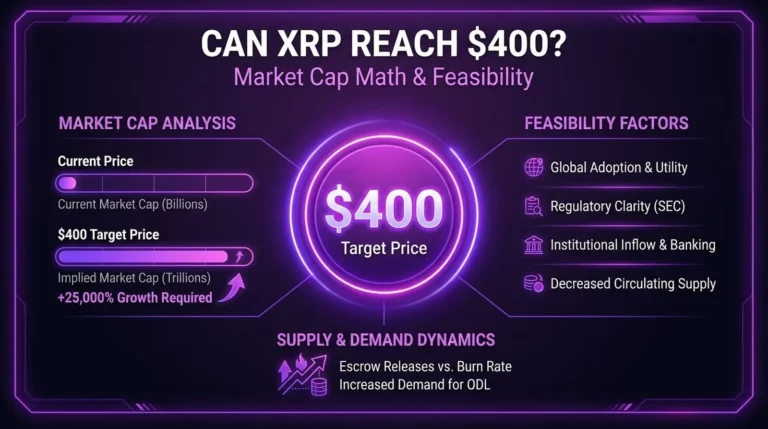
At $400, XRP’s market cap equals $400 × supply: ~50B XRP implies ~$20T; 100B implies ~$40T. That’s larger than most major asset markets today, so $400 requires extraordinary adoption, deep liquidity, and broad regulatory access.
A price of $400 per XRP implies a market capitalization that exceeds most individual asset classes in existence today. Under a circulating supply of roughly 58 billion tokens, the implied market cap would be approximately $23.2 trillion. Under the full 100 billion maximum supply, the figure climbs to $40 trillion. For context, the total market capitalization of the entire global equity market sits near $100–110 trillion as of early 2025, and gold’s total above-ground value is roughly $17–18 trillion.
This means $400 XRP is not a base-case forecast. It belongs in the category of extreme, tail-risk scenarios that require multiple extraordinary conditions to align simultaneously over a long time horizon. The purpose of this analysis is not to predict that XRP will reach $400 but to define exactly what would need to be true for it to happen, what constraints stand in the way, and which observable milestones would signal movement toward or away from that outcome.
Market Cap Reference at $400
| Supply Assumption | XRP Supply | Implied Market Cap | Scale Comparison |
| Circulating (~58B) | ~58 billion | ~$23.2 trillion | Exceeds gold market |
| Reduced float (~40B) | ~40 billion | ~$16 trillion | Comparable to gold |
| Max supply (100B) | 100 billion | ~$40 trillion | ~40% of global equities |
Scenario Summary at a Glance
| Scenario | Probability Class | Key Driver | Time Horizon |
| Base Case | Very unlikely | Current constraints dominate | N/A (does not reach $400) |
| Bull Case | Extremely unlikely | Access + adoption + liquidity expansion | 15–25+ years |
| Tail-Risk Case | Negligible but non-zero | Major monetary regime change | 20–30+ years |
Target Ladder Navigation
- Can XRP reach $50?
- Can XRP reach $100?
- Can XRP reach $400? (You are here)
- Can XRP reach $500?
- Can XRP reach $1,000?
- Can XRP reach $10,000?
Quick Answer — Is $400 XRP Realistic?
Feasibility Summary (Math-First)
The simplest way to evaluate any price target is to calculate what it implies about total market capitalization. Market cap equals price multiplied by supply. At $400 per XRP, even the most conservative supply assumption produces a market cap in the tens of trillions of dollars.
Under circulating supply (~58 billion XRP), the implied market cap is approximately $23.2 trillion. Under maximum supply (100 billion XRP), the figure reaches $40 trillion. Both numbers are enormous by any standard. The entire cryptocurrency market reached roughly $3.5 trillion at its 2024 peak. The total global bond market is approximately $130 trillion. Gold’s total value sits near $17–18 trillion.
For XRP alone to command a market cap in the $16–40 trillion range, it would need to absorb capital on a scale that has no historical precedent for a single digital asset. This does not make it theoretically impossible, but it places $400 firmly in the extreme-scenario category rather than any reasonable base case.
Five Conditions That Must Be True
For XRP to reach $400, all of the following conditions would need to materialize simultaneously or in sequence:
- Global adoption at extreme scale — XRP would need to become a dominant settlement layer for cross-border payments and potentially other financial use cases, operating at volumes far exceeding today’s levels.
- Broad institutional access — Multiple spot ETFs, custody solutions, and derivatives markets would need to exist across every major jurisdiction, channeling sustained capital allocation from institutional portfolios.
- Durable regulatory clarity — Comprehensive, favorable regulatory frameworks across the United States, European Union, Asia-Pacific, and other regions would need to remove legal friction and unlock compliant institutional participation.
- Sustained macro liquidity expansion — A prolonged period of accommodative monetary policy, risk-on sentiment, and global credit expansion would need to persist for years or decades.
- Structural supply reduction — A significant portion of XRP’s total supply would need to be effectively locked, staked, or otherwise removed from active circulation, concentrating price impact on a smaller liquid float.
For a deeper analysis of the individual catalysts behind each condition, see the XRP price drivers and catalysts hub and the XRP fundamentals analysis.
Market Cap Math for XRP at $400
Formula and Definitions
The fundamental equation is: Market Cap = Price × Supply. However, the meaning of “supply” depends on the assumption used:
- Circulating supply — The number of tokens currently available in the open market. For XRP, this figure is approximately 58 billion as of early 2025, though it fluctuates as Ripple releases tokens from escrow.
- Maximum supply — The protocol-defined cap of 100 billion XRP. No new tokens can be created beyond this limit.
- Liquid float — A more conservative estimate that excludes tokens held in escrow, in long-term Ripple treasury holdings, or by entities unlikely to sell. Estimates vary but might range from 35–45 billion.
The supply assumption you choose dramatically affects the implied market cap at any given price, and therefore the scale of capital inflows required to reach that price.
Implied Market Cap Under Different Supply Assumptions
| Supply Assumption | Tokens (Billions) | Implied Market Cap at $400 | Reference Scale |
| Liquid float (low est.) | ~35B | ~$14 trillion | ~80% of gold market |
| Liquid float (high est.) | ~45B | ~$18 trillion | Roughly equal to gold |
| Circulating supply | ~58B | ~$23.2 trillion | Exceeds gold; ~22% of global equities |
| Maximum supply | 100B | $40 trillion | ~38% of global equity market |
Scale Comparisons Across Major Asset Classes
To appreciate the scale implied by $400 XRP, consider the approximate total market capitalizations of the world’s largest asset classes as of 2024–2025:
| Asset Class | Approximate Total Value |
| Global equity markets | ~$100–110 trillion |
| Global bond markets | ~$130 trillion |
| Global real estate | ~$330+ trillion |
| Gold (above-ground) | ~$17–18 trillion |
| Total crypto market (peak 2024) | ~$3.5 trillion |
| Apple (largest public company) | ~$3.5–3.7 trillion |
| XRP at $400 (circ. supply) | ~$23.2 trillion |
XRP at $400 would represent a single digital asset commanding more value than the entire global gold market and roughly one-fifth of all publicly traded equities worldwide. This context is essential for evaluating the feasibility of the target.
Constraints Beyond Market Cap
Market cap alone does not tell the full story. Several structural constraints determine whether a particular market cap is actually achievable.
Liquidity Versus Market Cap: Depth, Slippage, and Spreads
Market cap is a static snapshot—price multiplied by supply at a single moment. It does not reflect how much capital actually moved into the asset to produce that price. The real constraint is liquidity: the depth of order books, the tightness of bid-ask spreads, and the ability of the market to absorb large buy or sell orders without significant slippage.
For XRP to sustain $400, the market would need order-book depth comparable to the deepest equity and commodity markets in the world. Current XRP spot markets, while liquid relative to most altcoins, have far less depth than markets for gold, U.S. Treasuries, or major equity indices. The gap between XRP’s current liquidity profile and what $400 would require is measured in orders of magnitude.
For current liquidity metrics and how they relate to price movement, see the XRP sentiment and liquidity analysis.
Required Flows and Time Horizon Sensitivity
There is no single dollar amount of inflows that guarantees any price target because the relationship between net inflows and price depends on liquidity depth, how much supply is available for sale at each price level, and the time period over which those flows occur. A gradual accumulation over 20 years produces a very different price trajectory than the same capital deployed over 2 years.
As a rough framework: if XRP’s market cap needs to grow from approximately $130–150 billion (at mid-2025 levels near $2.50) to $23 trillion, that represents roughly a 150× increase. Compounded over 30 years, this implies an annualized growth rate of approximately 18–19%. Over 20 years, the required rate rises to roughly 28–29% annually. Over 10 years, it would need approximately 60%+ annually—far beyond what any large-cap asset has sustained.
The longer the time horizon, the less extreme the annual growth requirement—but even over multi-decade periods, the numbers remain aggressive by historical standards.
Supply Float and Distribution Effects
XRP’s supply dynamics create unique considerations. Ripple holds a significant portion of total supply in escrow, releasing up to 1 billion tokens per month. The effective float—the supply actually available for trading—is smaller than the circulating supply figure suggests.
If a large portion of XRP becomes structurally locked (through institutional custody, staking mechanisms, or long-term holdings by large participants), the effective float decreases. A smaller float means less supply needs to be absorbed to move the price, which in theory makes higher prices more achievable but also increases volatility and fragility. Conversely, if escrow releases and sell-side pressure increase over time, the effective float grows and makes reaching extreme prices harder.
What Would Need to Happen for XRP to Reach $400
Each of the following conditions represents a major requirement on the path to $400. For a comprehensive view of the catalysts driving XRP’s price potential, see the XRP drivers and catalysts hub.
Global Adoption at Extreme Scale (Settlement Narrative)
The most coherent bull case for XRP at extreme valuations centers on the settlement and cross-border payments narrative. If XRP were adopted as a primary bridge asset for global cross-border settlement, the daily transaction volumes flowing through the network could be enormous. Cross-border payments alone are estimated at $150+ trillion annually.
However, adoption at the scale required for $400 goes well beyond Ripple’s current partnership ecosystem. It would require XRP to become a settlement standard used by central banks, major commercial banks, and payment networks globally—not just a technology option offered by one company. The gap between current adoption levels and what $400 implies is vast.
Institutional Access Stack: ETFs, Custody, and Derivatives
Institutional capital enters markets through regulated access points. For XRP to attract the capital flows implied by $400, it would need a complete institutional access stack across multiple products. Spot ETFs would need to be approved and widely adopted across major markets. Institutional-grade custody solutions from firms like Fidelity, BNY Mellon, or Coinbase Institutional would need to support XRP at scale. Regulated derivatives markets (futures, options) would need to provide hedging and exposure management tools. For the latest on ETF developments, see the XRP ETF tracker.
Each layer of this access stack reduces friction and enables larger capital allocations. Without it, the capital required for $400 simply cannot enter the market through compliant channels.
Regulatory Clarity Across Major Regions
Regulatory status directly determines which institutions can hold and transact in XRP. The Ripple v. SEC lawsuit has been the dominant legal narrative, and its resolution shapes market perception. For the $400 scenario, regulatory clarity would need to extend far beyond a single U.S. court ruling. It would require classification frameworks that treat XRP favorably across the EU (under MiCA), Japan, South Korea, Singapore, the UK, and other major financial centers. For ongoing legal developments, see the XRP SEC lawsuit and legal analysis hub.
Macro Liquidity Regime: Sustained Risk-On Environment
Crypto assets, including XRP, are highly sensitive to global liquidity conditions. Risk-on environments—characterized by low interest rates, expanding central bank balance sheets, and abundant credit—tend to drive capital into higher-risk, higher-potential-return assets. Risk-off environments do the opposite.
For XRP to reach $400, the macro environment would need to remain broadly supportive for an extended period—likely spanning multiple economic cycles. A single bull market is insufficient. Sustained, multi-decade liquidity expansion of the kind that would support an asset growing from $2–3 to $400 has no clear historical analog in traditional markets.
Supply-Side Changes: Float Reduction and Structural Locking
The lower the available float, the less net buying pressure is required to move the price. Mechanisms that could structurally reduce XRP’s liquid supply include long-term escrow extensions by Ripple, staking or lockup mechanisms introduced through protocol upgrades, institutional custody that takes tokens off exchanges, and increased use of XRP in settlement where tokens are held rather than immediately sold.
If the effective liquid float were reduced from 58 billion to, for example, 30–35 billion, the implied market cap at $400 drops significantly—though it remains enormous. Supply reduction makes extreme prices marginally more plausible but does not eliminate the fundamental scale challenge.
Preconditions Checklist
| Condition | Why It Matters | Observable Proxy | Threshold | Notes |
| Global settlement adoption | Drives demand at scale | RippleNet + ODL volume | $1T+ annual volume | Must be multi-corridor, multi-bank |
| Spot ETF approval | Unlocks institutional capital | SEC/CFTC filings, AUM | $50B+ AUM across products | Multiple issuers required |
| Regulatory clarity (global) | Removes legal friction | Classification rulings | Clear status in 10+ major markets | MiCA, US, Japan, Singapore, etc. |
| Deep spot liquidity | Supports price without fragility | 1% order-book depth | $500M+ within 1% of mid | Across 10+ major venues |
| Sustained macro risk-on | Drives asset allocation | Central bank rates, M2 growth | Multi-decade expansion | Multiple cycles, not one bull run |
| Supply float reduction | Concentrates price impact | Escrow, staking, custody data | <35B liquid tokens | Must be structural, not temporary |
Scenarios for XRP to Reach $400
Base Case: Constraints Dominate
In the base case, current structural constraints remain largely in place. Regulatory clarity improves gradually but unevenly. Institutional access expands through ETFs and custody solutions but does not reach the scale necessary to drive multi-trillion-dollar inflows. Adoption grows steadily but XRP remains one of several competing settlement technologies rather than a global standard.
Under this scenario, XRP can appreciate significantly from current levels—potentially reaching targets in the $10–$100 range depending on the breadth of adoption and institutional participation—but $400 remains out of reach because the required scale of capital allocation, liquidity depth, and supply dynamics do not converge.
For analysis of the more achievable targets within this trajectory, see Can XRP reach $50? and Can XRP reach $100?.
Bull Case: Access + Adoption + Liquidity Expansion
The bull case requires an extraordinary convergence of positive catalysts sustained over 15–25+ years. In this scenario, XRP becomes a major global settlement asset used by central banks and commercial institutions for cross-border payments. Multiple spot ETFs attract hundreds of billions in AUM. Regulatory frameworks across all major jurisdictions provide clear, favorable treatment. Macro conditions support sustained risk-on allocation to digital assets.
Even in this optimistic scenario, $400 sits at the extreme upper boundary of what is plausible. It requires that essentially nothing goes wrong for an extended period and that multiple independently uncertain events all resolve favorably. The probability is extremely low—not zero, but far below what most investors should plan around.
Tail-Risk Case: Major Monetary Regime Change
The tail-risk scenario introduces a variable that changes the rules: a fundamental shift in the global monetary system. This could involve sustained high inflation that drives capital away from fiat currencies, a coordinated move by central banks toward digital reserve assets, or a de-dollarization trend that creates demand for alternative settlement layers.
In such a regime, nominal asset prices in fiat terms could rise dramatically across the board. A $400 XRP price might be achievable in nominal terms, but the real purchasing power of $400 in a debased-currency environment would be very different from $400 in today’s dollars. Any analysis of extreme price targets must separate nominal from real value.
This scenario is speculative by nature—it depends on geopolitical and macroeconomic developments that are inherently unpredictable. It represents the tail of the probability distribution: extremely unlikely, but the only class of scenario where $400 becomes even marginally plausible within shorter time horizons.
Unit Bias Warning
XRP’s relatively low per-unit price compared to Bitcoin or Ethereum can create a cognitive bias called unit bias—the tendency to perceive a $2 asset as “cheap” and therefore more likely to reach high dollar figures. In reality, an asset’s price per unit is arbitrary and depends on total supply. What matters is market capitalization, not unit price. XRP at $400 implies a larger market cap than Bitcoin has ever achieved, regardless of how low the current per-unit price appears. Always evaluate targets through market cap math, not unit price intuition.
Sensitivity Tables
Supply Sensitivity
This table shows how the implied market cap at $400 changes under different supply assumptions:
| Effective Supply (Billions) | Implied Market Cap at $400 | Scale Context |
| 30B (aggressive float reduction) | $12 trillion | ~70% of gold market |
| 40B (moderate float reduction) | $16 trillion | ~Comparable to gold |
| 50B (slight float reduction) | $20 trillion | Exceeds gold by ~15% |
| 58B (current circulating) | $23.2 trillion | ~22% of global equities |
| 75B (partial max supply) | $30 trillion | ~29% of global equities |
| 100B (full max supply) | $40 trillion | ~38% of global equities |
Adoption and Flow Sensitivity (Order-of-Magnitude Estimates)
Estimating exact inflow requirements is imprecise because the relationship between capital inflows and price is nonlinear and depends on liquidity depth. The following table provides order-of-magnitude estimates under simplified assumptions:
| Horizon | Net Inflow Required (Est. Range) | Liquidity Assumptions | Commentary |
| 10 years | $5–15 trillion+ | Shallow to moderate depth | Requires ~60%+ CAGR; historically unprecedented for large-cap assets |
| 20 years | $3–10 trillion+ | Moderate to deep liquidity | ~28–29% CAGR; aggressive but within range of early-stage tech over select periods |
| 30+ years | $2–8 trillion+ | Deep, institutional-grade liquidity | ~18–19% CAGR; aggressive but less extreme; requires sustained compounding |
These estimates are rough guides, not forecasts. Actual inflow requirements depend on liquidity depth, supply distribution, and market microstructure at each price level.
Time Horizon Sensitivity
| Starting Price | Target | Required CAGR (10y) | Required CAGR (20y / 30y) |
| $2.50 | $400 | ~66% | ~29% / ~18% |
| $5.00 | $400 | ~55% | ~24% / ~15% |
| $10.00 | $400 | ~45% | ~20% / ~13% |
| $50.00 | $400 | ~23% | ~11% / ~7% |
Starting from higher intermediate milestones (e.g., $50) significantly reduces the required growth rate. This is why the target-ladder approach is useful: each milestone makes the next more or less plausible based on the conditions that produced it.
What to Watch: Milestones and Metrics
Rather than predicting whether XRP will reach $400, it is more useful to track observable milestones that would increase or decrease the probability of extreme scenarios. The following sections define key watchlist categories.
Legal and ETF Milestones
- Final resolution of the Ripple v. SEC case — A definitive ruling (or settlement) that provides clear legal status for XRP in the United States.
- Spot XRP ETF filings and approvals — Track the number of applications, SEC/CFTC commentary, and eventual approval or denial across U.S. and international markets.
- International regulatory classifications — Formal classification decisions under MiCA (EU), Payment Services Act (Japan), and equivalent frameworks in South Korea, Singapore, UK, and other major markets.
- Institutional custody announcements — Major custodians adding XRP support signals readiness for institutional allocation at scale.
Liquidity Metrics: Depth, Spreads, Open Interest, and Funding
- 1% order-book depth — The total dollar value of buy and sell orders within 1% of the mid-price on major exchanges. Deeper books mean the market can absorb larger orders without moving the price.
- Bid-ask spreads — Tighter spreads indicate healthier, more liquid markets. Track across top venues over time.
- Futures open interest (OI) — Growing OI on regulated futures exchanges (CME, if listed) signals institutional participation and hedging activity.
- Funding rates — Persistent positive funding rates indicate leveraged demand. Extreme funding rates signal overheating.
Network Usage Proxies
- RippleNet and On-Demand Liquidity (ODL) transaction volume — Growth in the actual settlement volume flowing through XRP-based corridors.
- Active accounts and unique addresses — A growing number of active participants on the XRP Ledger.
- XRPL DeFi and tokenization activity — Expansion of the XRP Ledger’s utility beyond simple transfers, including decentralized exchange activity, NFT minting, and real-world asset tokenization.
- Escrow release and absorption rate — Whether monthly escrow releases are absorbed by demand or returned to escrow.
Trigger Map
| Trigger | Metric | Threshold | Scenario Weight Change |
| XRP ETF approval (US) | SEC order | Approved + launched | Bull case probability increases moderately |
| ETF AUM exceeds $50B | AUM tracking | >$50B within 3 years | Significant increase in bull case probability |
| ODL volume >$1T/yr | Ripple/XRPL data | $1T+ annual settlement | Major increase; adoption condition partially met |
| Global regulatory clarity | Classification rulings | 10+ major jurisdictions | Removes key constraint; all scenarios shift upward |
| Macro regime shift | CPI, M2, reserve diversification | Sustained debasement trend | Tail-risk case probability increases; nominal vs real distinction critical |
| Regulatory crackdown | Enforcement actions | Adverse ruling or ban in major market | Bull case probability decreases sharply; invalidation risk |
| Liquidity contraction | 1% depth, spreads, OI | Sustained decline in depth metrics | All upside scenarios become less plausible |
Frequently Asked Questions
What market cap would XRP need to reach $400?
Market cap equals price multiplied by supply. At $400, approximately 50 billion XRP implies about $20 trillion. The full 100 billion maximum supply implies about $40 trillion. The exact number depends on whether you use circulating supply, maximum supply, or a smaller liquid float assumption.
Is $400 XRP possible with the current supply?
It is extremely unlikely under today’s market structure because the implied market caps are enormous. A coherent path would require extraordinary adoption, broad institutional access, deep liquidity, and possibly a fundamentally different macroeconomic and monetary regime.
Does XRP price depend more on market cap or liquidity?
Liquidity and marginal buying pressure move price; market cap is an output (price multiplied by supply). For very high targets, the depth of order books and the size of the available float matter more than the headline market cap figure.
How much money would need to flow into XRP to reach $400?
There is no single inflow number because it depends on liquidity depth, how much supply is for sale at each price level, and the time horizon. Use a sensitivity table to estimate net inflows over 10–30+ years under different liquidity assumptions.
Could an XRP ETF make $400 XRP more realistic?
An ETF can improve access and participation and may significantly increase liquidity. It can raise the probability of bull-case scenarios, but $400 still implies extreme scale. ETF access is supportive but not sufficient on its own.
Would global payments adoption be enough for $400 XRP?
Payments adoption can raise utilization, but price impact depends on value accrual, velocity, and how much XRP must be held for settlement. For $400, adoption would need to be enormous, persistent, and supported by deep capital allocation shifts beyond payments alone.
Could XRP reach $400 in a major inflation or debasement regime?
Nominal prices can rise in debasement regimes, but the key question is real purchasing power. If the unit of account loses value, a high nominal target may not imply the same real value. Always separate nominal from real targets in the assumptions.
What milestones would increase the probability of the $400 scenario?
Key milestones include durable regulatory clarity across major jurisdictions, broad institutional access through ETFs and custody solutions, deep spot liquidity, sustained network usage growth, and an extended risk-on liquidity regime. Map each milestone to observable proxy metrics and thresholds.
What would invalidate a path toward $400 XRP?
Persistent regulatory friction, repeated failures to expand institutional access, sustained liquidity contraction, and extended risk-off macro regimes can invalidate the bull-case pathway. Use invalidation rules tied to both catalyst outcomes and market structure signals.
Which XRP targets are more realistic than $400?
Targets like $50 and $100 require significantly less extreme scale than $400. Use the target ladder to compare implied market caps and required conditions consistently. Each lower target serves as a prerequisite milestone on the path toward higher ones.
Methodology and Assumptions Disclosure
This analysis follows a market-cap-math-first approach to evaluate the feasibility of specific price targets. For the complete methodology behind all VTrader.io price analysis content, see the XRP price prediction methodology hub.
Key assumptions and limitations:
- Supply figures are approximate and based on publicly available data from the XRP Ledger and Ripple’s quarterly reports. Circulating supply fluctuates as escrow releases occur.
- Market cap comparisons use approximate values for global asset classes based on widely cited 2024–2025 estimates. These figures change over time.
- Inflow estimates are order-of-magnitude approximations, not precise calculations. The relationship between net inflows and price is nonlinear and depends on variables that cannot be known in advance.
- CAGR calculations assume a fixed starting price and do not account for volatility, drawdowns, or compounding irregularities.
- Scenario probabilities are qualitative assessments (e.g., “very unlikely,” “extremely unlikely”) rather than precise numerical probabilities. No model can reliably assign exact probabilities to events of this nature.
- This content is educational and analytical. It does not constitute financial advice, investment recommendations, or forecasts. Past performance does not predict future results.
Last updated: February 2026. Supply figures, market data, and regulatory developments are reviewed periodically. Assumptions are updated as material changes occur.
Continue the Target Ladder
This article is part of VTrader.io’s comprehensive XRP price prediction content network. Explore the full target ladder to compare implied market caps and required conditions at each level:
| Target | Implied Market Cap (~58B) | Difficulty | Link |
| $50 | ~$2.9 trillion | Ambitious but structurally plausible | Can XRP reach $50? |
| $100 | ~$5.8 trillion | Very aggressive; requires broad adoption | Can XRP reach $100? |
| $400 | ~$23.2 trillion | Extreme; tail-risk scenario only | You are here |
| $500 | ~$29 trillion | Extreme; beyond current models | Can XRP reach $500? |
| $1,000 | ~$58 trillion | Extreme; requires regime change | Can XRP reach $1,000? |
| $10,000 | ~$580 trillion | Theoretical; far beyond any current model | Can XRP reach $10,000? |
For the full list of price targets and supporting analysis, visit the XRP price targets hub. For technical analysis and chart-based perspectives, see the XRP technical analysis hub.

Steve Gregory is a lawyer in the United States who specializes in licensing for cryptocurrency companies and products. Steve began his career as an attorney in 2015 but made the switch to working in cryptocurrency full time shortly after joining the original team at Gemini Trust Company, an early cryptocurrency exchange based in New York City. Steve then joined CEX.io and was able to launch their regulated US-based cryptocurrency. Steve then went on to become the CEO at currency.com when he ran for four years and was able to lead currency.com to being fully acquired in 2025.