Table of Contents
Can XRP Reach $10? Feasibility, Market Cap Math, and Scenarios
How high would XRP market cap be at $10?
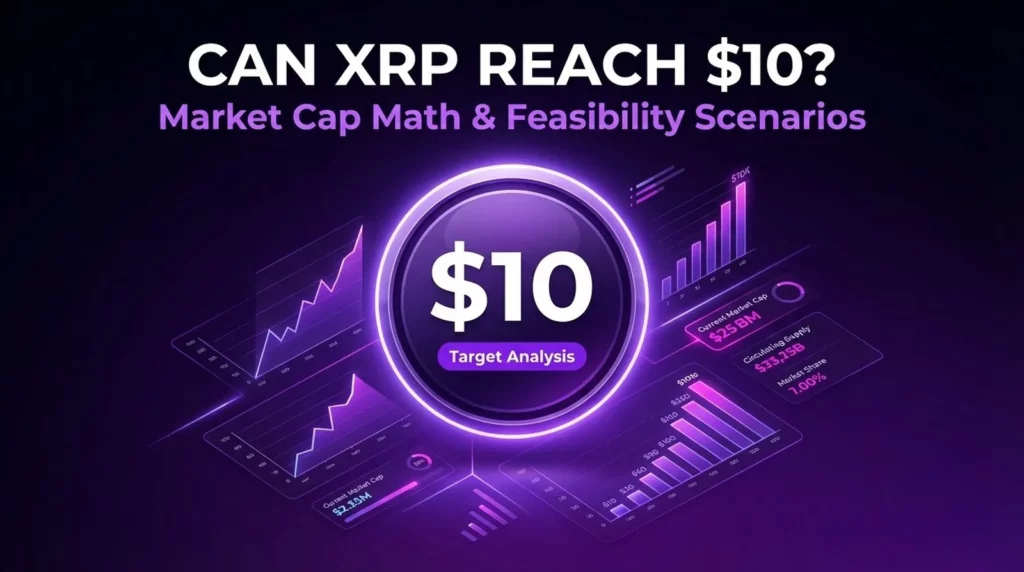
At $10, XRP’s market cap equals $10 × supply. With ~57–61B XRP in circulation, that’s roughly $570–610B; with 100B total supply, about $1T fully diluted. Reaching $10 likely requires strong liquidity, broader access, and favorable catalysts—not just hype.
Can XRP reach $10? The short answer: it is high but not mathematically absurd. Unlike targets such as $500 or $1,000, reaching $10 does not require XRP to surpass the entire cryptocurrency market’s current valuation. It does, however, require a meaningful expansion of liquidity, access, and adoption—conditions that are plausible under certain scenarios but far from guaranteed.
This page breaks down exactly what $10 XRP would mean in market-cap terms, identifies the constraints that go beyond simple multiplication, and maps out the base, bull, and bear scenarios that could determine whether—and when—that level becomes realistic. Every assumption is stated explicitly, every metric is linked to an observable proxy, and every scenario is structured around confirmation and invalidation triggers.
Market Cap Math at a Glance
| Supply Assumption | Implied Market Cap at $10 | Scale Reference |
| ~57B (liquid circulating) | ~$570B | Roughly 40% of Bitcoin’s peak market cap |
| ~61B (reported circulating) | ~$610B | Larger than Ethereum’s ATH market cap |
| 100B (max supply / FDV) | ~$1T | Comparable to a top-5 global company |
Scenario Summary:
- Base case: $10 remains a stretch target within a single cycle; requires sustained liquidity expansion and catalyst confirmation.
- Bull case: Regulatory access, institutional rails, and macro tailwinds converge—$10 becomes achievable within one to two cycles.
- Bear case: Regulatory setbacks, persistent risk-off conditions, or liquidity contraction keep XRP well below $10.
Related Target & Forecast Pages:
Explore the full target ladder: Can XRP reach $5? → Can XRP reach $20? → Can XRP reach $50? | XRP Price Prediction | XRP Price Targets Hub
Quick Answer — Is $10 XRP Realistic?
Feasibility Summary (Math-First)
XRP reaching $10 is a feasibility question, not a prediction. The math is straightforward: price multiplied by supply equals market capitalization. At $10, XRP’s implied market cap ranges from approximately $570 billion (using liquid circulating supply around 57 billion tokens) to $1 trillion (using the 100 billion maximum supply for fully diluted valuation).
For context, Bitcoin’s market cap peaked above $2 trillion during the 2024–2025 cycle, while Ethereum’s all-time high market cap reached approximately $570 billion. A $10 XRP would place it in the range of Ethereum’s peak or modestly above it—ambitious but not unprecedented within the broader digital-asset landscape.
The critical point: $10 is not impossible from a pure market-cap perspective, but it requires a very different market environment from the one that existed before the 2025 regulatory clearing events. The question is not whether the math permits it, but whether the conditions can sustain it.
Most Important Conditions (Top 5)
| Condition | Why It Matters | Observable Proxy |
| Sustained liquidity expansion | Price moves on marginal flows; deeper markets sustain higher valuations | Order-book depth, bid-ask spreads, futures open interest |
| Broad regulatory access | Unlocks participation from institutions and geographies currently restricted | ETF inflows, exchange listings, jurisdictional approvals |
| Institutional custody and rails | Enables large allocators (pensions, wealth managers, sovereign funds) to participate | Custody AUM, ETF AUM, OTC desk volumes |
| Network usage growth | Validates demand beyond speculation; supports long-term valuation | XRPL transaction volume, active addresses, ODL corridor flows |
| Favorable macro regime | Risk-on environments expand capital allocation to digital assets | Central bank policy stance, real yields, equity risk premiums |
Market Cap Math for XRP at $10
Formula and Supply Definitions
The formula for implied market capitalization is:
Market Cap = Price × Supply
Three supply figures matter when evaluating XRP’s $10 target:
- Circulating supply (~57–61 billion XRP): The amount reported by major data aggregators as tradable in the market. Different platforms report slightly different figures depending on methodology.
- Liquid float (estimated lower): Not all circulating tokens are actively available for trading. Some are held in long-term wallets, locked in escrow releases, or otherwise illiquid.
- Maximum supply (100 billion XRP): The hard cap written into the XRP Ledger protocol. This figure is used for fully diluted valuation (FDV).
This article uses a range of supply assumptions rather than a single figure. The circulating supply as of early 2026 is approximately 60.85 billion XRP, while the total existing supply is approximately 99.99 billion XRP. Ripple’s escrow mechanism releases tokens on a scheduled basis, with unused portions returned to escrow.
Implied Market Cap Under Multiple Supply Assumptions
| Supply Assumption | Tokens (B) | Implied Market Cap at $10 | Notes |
| Conservative liquid float | ~50B | ~$500B | Excludes illiquid, escrowed, and dormant tokens |
| Current circulating supply | ~61B | ~$610B | Based on CoinMarketCap / CoinGecko reporting |
| Mid-range (escrow releases over time) | ~75B | ~$750B | Accounts for gradual supply expansion |
| Full max supply (FDV) | 100B | $1T | Upper bound; assumes all tokens in circulation |
Comparisons: Major Crypto Assets and Large Liquid Markets
To put a $570–610 billion XRP market cap in perspective:
- Bitcoin’s market cap as of early February 2026 is approximately $1.4–1.5 trillion, having reached above $2 trillion at its peak.
- Ethereum’s market cap currently sits around $250–270 billion, with an all-time high near $570 billion.
- The total cryptocurrency market cap is approximately $2.4–2.7 trillion.
- Among equities, Apple and Microsoft each carry market caps above $3 trillion; gold’s total above-ground value is estimated at roughly $18–20 trillion.
At $10, XRP would represent roughly 20–25% of the total cryptocurrency market cap at current levels—a concentration that is plausible only if the overall market expands substantially or XRP captures a disproportionate share of capital flows. In a scenario where the total crypto market cap reaches $8–10 trillion (a level some analysts project for a mature market), XRP at $610 billion would represent about 6–8%—a more sustainable proportion.
Constraints Beyond Market Cap
Market-cap math tells you what $10 implies in aggregate valuation. It does not tell you whether the market can actually get there. Three structural constraints matter more than the arithmetic.
Liquidity, Market Depth, and the Marginal Buyer Effect
Price is set at the margin. A single large buy order in a thin order book can move price far more than the same order in a deep, liquid market. For XRP to sustain $10, the market needs sufficient buy-side depth to absorb selling pressure at elevated prices without extreme slippage.
Key liquidity metrics to monitor include order-book depth within 2% of the mid-price across major exchanges, bid-ask spreads on high-volume pairs, futures open interest and funding rates, and average daily spot and derivatives volume. As of early 2026, XRP’s 24-hour trading volume typically ranges between $2–5 billion, and futures open interest has expanded substantially since the ETF launches. However, the depth required to sustain a $600 billion+ asset class is materially higher than current levels.
Supply Float and Distribution
Not all supply is equal. XRP’s effective float—the portion actively available for trading—is smaller than the reported circulating supply. Ripple holds substantial amounts in escrow, institutional wallets hold long-term positions, and spot ETF custodians now lock tokens away from liquid markets.
As of late 2025, over 800 million XRP were locked in ETF custody alone, and the trend of exchange outflows suggests accumulation by longer-term holders. A shrinking active float can amplify price moves in both directions: it can accelerate rallies when demand rises, but it can also increase downside volatility if large holders liquidate concentrated positions.
Time Horizon and Reflexivity (Cycles vs. Adoption)
Crypto markets are reflexive: rising prices attract attention, which drives flows, which drives prices further. This reflexivity works in both directions. A cycle-driven move toward $10 could happen faster but would be more fragile; an adoption-driven move would take longer but potentially be more durable.
The distinction matters for probability assessment. Within a single market cycle (12–24 months of strong momentum), reaching $10 from current prices (~$1.50–$2.00) would require a 5–7x move—aggressive but within historical crypto cycle magnitudes. Over a longer adoption-driven timeline (3–5+ years), the move can compound through multiple phases of access expansion, usage growth, and valuation re-rating. The XRP price prediction methodology used across this content network evaluates both timeframes separately.
What Would Need to Happen for XRP to Reach $10
On-Chain and Network Usage Growth
XRP’s long-term valuation case rests partly on the XRP Ledger’s utility for payments, tokenization, and cross-border settlement. For $10 to be sustained (rather than briefly spiked), network usage metrics need to show meaningful growth:
- Transaction throughput on XRPL (currently capable of ~1,500 transactions per second) needs to show rising real-world usage, not just testing activity.
- On-Demand Liquidity (ODL) corridors—Ripple’s product that uses XRP as a bridge currency—need to expand in volume and geographic coverage.
- Active addresses and new wallet creation should trend upward, indicating broadening participation.
- DeFi, tokenization, and stablecoin activity on XRPL (including RLUSD) contribute to the usage narrative.
Usage growth alone will not drive price to $10, but it provides a fundamental underpinning that makes elevated valuations more defensible and less prone to speculative collapse.
Regulatory Clarity and Access (US and Major Regions)
The regulatory landscape for XRP shifted dramatically in 2025. The SEC–Ripple lawsuit, which began in December 2020, reached its conclusion on August 7, 2025, with Ripple paying a $125 million civil penalty and both parties dropping all appeals. The court’s ruling that XRP is not a security in secondary-market sales was made permanent.
Following the settlement, the regulatory environment improved rapidly:
- The GENIUS Act, signed into law in July 2025, provided a legal framework for crypto-native firms to operate as federally regulated financial institutions.
- Multiple spot XRP ETFs launched in November 2025, with Canary Capital’s XRPC becoming the first to trade on a U.S. exchange on November 13, 2025.
- The OCC granted Ripple a de novo national trust bank charter on December 12, 2025, authorizing Ripple National Trust Bank to manage reserves for RLUSD under federal supervision.
- Cumulative spot XRP ETF inflows approached $1.37 billion by early 2026.
For $10 to become feasible, this regulatory momentum would need to continue and expand internationally—particularly in major markets such as the EU (under MiCA), the UK, Japan, and Southeast Asia. Ripple has already secured a preliminary EMI license in Luxembourg, signaling EU expansion under MiCA compliance.
Institutional Rails (Custody, ETFs, Derivatives)
Institutional access is the bridge between regulatory clarity and capital flows. The infrastructure that enables large allocators to participate includes regulated custody solutions (Coinbase Custody, Anchorage Digital Bank, BitGo currently serve XRP ETFs), listed ETF products available through standard brokerage accounts, futures and options markets for hedging and structured exposure, and OTC desks for block-size trades that minimize market impact.
As of early 2026, this infrastructure is substantially more developed than it was a year prior. Leveraged products like the Teucrium 2x Long Daily XRP ETF (XXRP) have attracted over $300 million in assets, and the overall spot ETF category has seen no net outflow days since launch. For $10, institutional rails need to scale further—particularly through wealth management platforms, retirement account integration, and global ETF expansion.
Macro Conditions (Risk Appetite, Liquidity)
Crypto assets remain sensitive to global liquidity conditions. Periods of loose monetary policy, declining real yields, and strong risk appetite tend to drive capital into digital assets. Conversely, tightening cycles and risk-off environments compress crypto valuations.
For XRP to reach $10, the macro backdrop would likely need to include accommodative or neutral central bank policy in major economies, stable or declining real interest rates that make alternative assets more attractive, equity markets that are not in severe drawdown (since crypto correlations increase during stress), and geopolitical conditions that do not trigger sustained capital flight from risk assets.
The early 2026 environment shows mixed signals: Bitcoin has pulled back from its 2025 highs amid hawkish policy expectations, and the total crypto market has shed approximately $410 billion since January 1, 2026. A more supportive macro environment would meaningfully increase the probability of the bull scenario.
Scenarios for XRP to Reach $10
Base Case: Cycle-Driven Upside With Constraints
In the base case, XRP benefits from the broader crypto cycle and regulatory improvements already in motion but faces constraints that limit the magnitude of the move. Key assumptions:
- XRP ETF inflows continue at a moderate pace ($100–200 million per month).
- Regulatory access expands incrementally but does not trigger a step-change in participation.
- Macro conditions are neutral to mildly supportive.
- Network usage grows but does not achieve the scale that would justify a standalone valuation re-rating.
Base case outcome: XRP reaches the $3–$5 range during the next sustained momentum phase but does not break into $10 territory within a single cycle. $10 remains a possibility in a subsequent cycle if the adoption foundation strengthens.
Bull Case: Access + Adoption + Liquidity Expansion
The bull case requires multiple favorable conditions to align:
- Spot XRP ETF cumulative inflows exceed $5–10 billion, creating sustained buy-side pressure.
- Regulatory clarity extends globally, unlocking new pools of capital (EU, Asia-Pacific, Middle East).
- Institutional adoption accelerates—wealth management platforms, pension allocators, and sovereign funds gain meaningful XRP exposure.
- XRPL network usage demonstrates exponential growth in payments, tokenization, or stablecoin settlement.
- Macro conditions shift to accommodative, expanding the total crypto market cap toward $8–12 trillion.
Bull case outcome: XRP reaches $10 within one to two market cycles (2–4 years). In an extreme tail scenario with maximum catalyst convergence, it could happen within a single cycle, though this carries higher reversion risk.
Bear Case: Setback, Risk-Off, Regulatory Friction
The bear case involves one or more derailing factors:
- Regulatory reversals or new enforcement actions targeting XRP or the broader crypto industry.
- Sustained risk-off macro environment with tightening monetary policy.
- ETF inflows plateau or reverse, removing a key demand driver.
- Network adoption stalls, undermining the fundamental case for elevated valuation.
- Liquidity contraction and exchange delistings reduce market depth.
Bear case outcome: XRP fails to break above its prior all-time high range and remains in a $1–$3 trading band. $10 is deferred indefinitely until the structural environment changes.
Sensitivity Tables (Assumptions)
Supply Sensitivity
The table below shows how different supply assumptions change the implied market cap at various price targets, not just $10. This allows readers to compare across the target ladder.
| Price Target | 50B Supply | 61B Supply | 75B Supply | 100B Supply (FDV) |
| $5 | $250B | $305B | $375B | $500B |
| $10 | $500B | $610B | $750B | $1.0T |
| $20 | $1.0T | $1.22T | $1.5T | $2.0T |
| $50 | $2.5T | $3.05T | $3.75T | $5.0T |
| $100 | $5.0T | $6.1T | $7.5T | $10.0T |
Time Horizon Sensitivity
Different scenario paths imply different timeframes for reaching $10. The table below maps the relationship between scenario assumptions and estimated time horizons.
| Scenario Path | Key Driver | Estimated Time to $10 | Confidence Level |
| Cycle-driven (aggressive) | Speculative momentum + ETF flows | 12–24 months from cycle low | Low–Medium |
| Access-driven (institutional) | ETF scaling + custody expansion | 2–3 years | Medium |
| Adoption-driven (fundamental) | Network usage + global rails | 3–5+ years | Medium–High (if sustained) |
| Multi-cycle compounding | Incremental progress across cycles | 5–10 years | Higher (longer timeframe reduces concentration risk) |
What to Watch (Milestones and Metrics)
Legal and ETF Milestones
| Milestone | Why It Matters | Current Status (Early 2026) |
| SEC–Ripple settlement finalization | Removed primary regulatory overhang for XRP | Complete (Aug 7, 2025) |
| Spot XRP ETF approvals | Broadens access through regulated investment vehicles | Multiple live (Canary, Franklin, Grayscale, Bitwise, others) |
| Cumulative ETF inflows | Measures sustained institutional demand | Approaching $1.37B |
| Global ETF expansion (EU, Asia) | Unlocks non-US institutional capital | In progress (Canada live; EU pending) |
| Ripple National Trust Bank operations | Validates institutional financial integration | OCC charter granted Dec 2025 |
Liquidity Metrics (Depth, Spreads, OI, Funding)
| Metric | What to Watch | Bullish Signal for $10 Path |
| Order-book depth (±2%) | Depth at major exchanges (Binance, Coinbase, Bitstamp) | Sustained increase in resting orders at higher price levels |
| Bid-ask spreads | Tighter spreads indicate improving market quality | Spreads narrowing even as price rises |
| Futures open interest | Total outstanding contracts across exchanges | OI expanding without excessive leverage |
| Funding rates | Cost of holding long/short positions | Neutral to mildly positive (not overheated) |
| Spot volume trends | 24h and 7d rolling average volumes | Rising volumes on up-days; declining volumes on down-days |
Adoption Metrics (Usage Proxies)
| Metric | Source / Observable | Threshold for Scenario Upgrade |
| XRPL daily transactions | XRPL Explorer / on-chain data | Sustained growth above prior cycle peaks |
| Active addresses (weekly) | On-chain analytics | New addresses trending upward consistently |
| ODL corridor volume | Ripple reporting / third-party estimates | Expanding geographic coverage + rising volume |
| RLUSD circulation and usage | XRPL stablecoin metrics | Growing circulation as proxy for ecosystem utility |
| ETF-locked XRP | ETF holding disclosures | Rising locked supply reducing active float |
Frequently Asked Questions
What market cap would XRP need to reach $10?
Market cap equals price multiplied by supply. At $10, approximately 57–61 billion circulating XRP implies a market cap of roughly $570–610 billion. Using the full 100 billion maximum supply, the fully diluted valuation would be $1 trillion. The exact figure depends on which supply metric you use—this article provides a range to maintain transparency.
Is $10 XRP possible in the next bull cycle?
It is possible as a scenario but not guaranteed. The probability increases if liquidity expands substantially, institutional access broadens through ETFs and custody solutions, and macro conditions support risk-on behavior. A single cycle move from ~$1.50–$2.00 to $10 would require a 5–7x gain—aggressive but within historical crypto cycle magnitudes for high-momentum assets.
How does XRP supply affect the $10 target?
Supply directly determines the implied market cap at any price. A higher effective supply means a larger market cap is needed to sustain $10. Consider circulating supply, the liquid float (which is smaller), and whether Ripple’s escrow releases will increase the float over time. The sensitivity table above shows implied market caps across four supply assumptions.
Does market cap determine XRP price or does liquidity matter more?
Liquidity and marginal buying pressure move price; market cap is an output (price times supply), not an input. A market can reach a high market cap with relatively modest flows if the active float is small and order-book depth is thin. Conversely, deep liquidity can stabilize price and make higher market caps more sustainable. Both dimensions matter.
What catalysts could push XRP toward $10?
The most impactful catalysts include continued ETF inflow acceleration, expanded global regulatory clarity (especially in the EU and Asia), institutional adoption through wealth platforms and retirement accounts, rising XRPL network usage, and a shift to accommodative macro policy. Each catalyst should be mapped to observable metrics and specific thresholds—see the XRP price drivers and catalysts hub for detailed analysis.
Could an XRP ETF help XRP reach $10?
ETFs broaden access and participation, improving liquidity and creating a more stable demand base. The spot XRP ETFs launched in late 2025 have already attracted over $1 billion in cumulative inflows. However, ETFs alone are not sufficient—sustained demand, favorable macro conditions, and network adoption are also needed to support a $10 valuation.
What would prevent XRP from reaching $10?
Extended risk-off macro environments, adverse regulatory or legal developments, weak liquidity, ETF outflows, competitive displacement by other digital assets, and repeated failures at key technical resistance zones can all prevent XRP from reaching $10. The bear-case scenario above outlines the specific conditions under which $10 is deferred indefinitely.
How long could it take for XRP to reach $10?
Timeframe depends on the scenario path. A cycle-driven move could happen in 12–24 months if liquidity and catalysts align aggressively. An access-driven institutional path typically takes 2–3 years. An adoption-driven fundamental path may take 3–5+ years. The time horizon sensitivity table above maps these paths in detail.
What price levels would confirm a move toward $10?
Confirmation involves breaking and holding above major resistance zones with improving liquidity and market-structure signals. Key intermediate levels include the prior all-time high ($3.65 as of July 2025) and the $5 psychological threshold. Sustained trading above $5 with expanding volume and depth would materially increase the probability of a $10 move.
Which XRP targets are more realistic than $10 and which are harder?
Closer targets like $5 require less extreme market-cap scale and are achievable under a wider range of conditions. Higher targets such as $20, $50, and $100 require progressively larger market caps and stronger sustained conditions. Use the target ladder to compare: Can XRP reach $5 → $10 → $20 → $50 → $100 → $1,000.

Steve Gregory is a lawyer in the United States who specializes in licensing for cryptocurrency companies and products. Steve began his career as an attorney in 2015 but made the switch to working in cryptocurrency full time shortly after joining the original team at Gemini Trust Company, an early cryptocurrency exchange based in New York City. Steve then joined CEX.io and was able to launch their regulated US-based cryptocurrency. Steve then went on to become the CEO at currency.com when he ran for four years and was able to lead currency.com to being fully acquired in 2025.