Table of Contents
XRP Price Drivers & Catalysts
What factors affect XRP price the most?
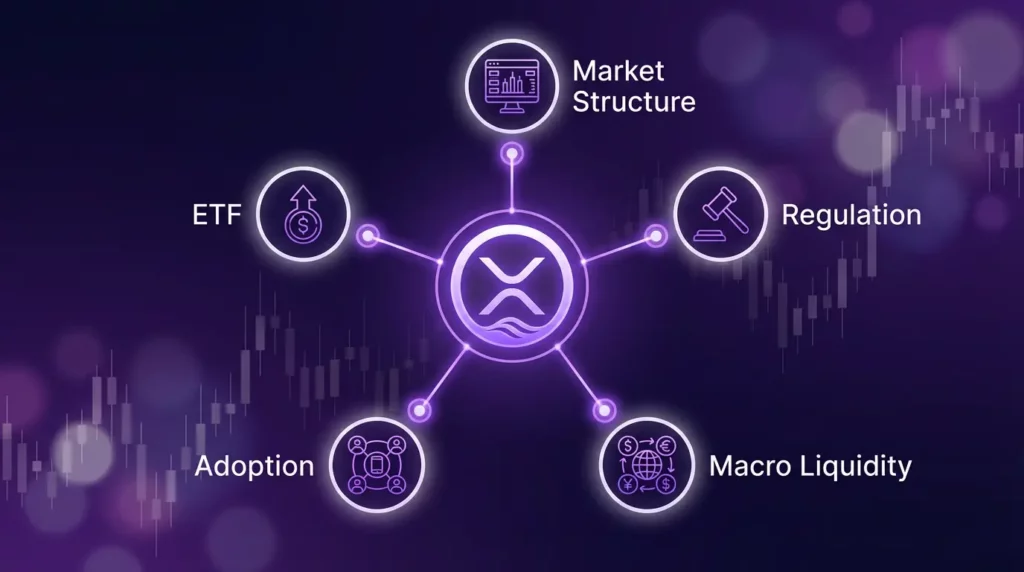
XRP is most influenced by market structure and liquidity, major regulatory or legal headlines, ETF expectations, macro risk sentiment, and adoption/utility signals from the Ripple/XRPL ecosystem. These drivers shift bullish/base/bear scenario probabilities.
Driver vs Catalyst: A driver is an ongoing causal factor (liquidity conditions, macro regime, adoption trend). A catalyst is an event that changes probabilities (a legal ruling, ETF approval, a major level break). Strong forecasts show how catalysts modify driver effects.
This hub explains the major factors that move XRP price and how they connect to forecast scenarios. Understanding drivers and catalysts helps you interpret forecast changes and know what signals to watch. For the complete forecasting framework, see the XRP price prediction methodology.
Last updated: January 14, 2026
Quick Overview: The 5 Drivers That Move XRP Most
| Driver | What It Changes | What to Watch | Impact Speed |
| ETF/Access | Liquidity, institutional participation, sentiment | Filings, approvals, flow data | Fast (news) / Slow (flows) |
| SEC/Legal | Risk premium, exchange access, participation | Rulings, settlements, legislation | Fast (rulings) / Slow (clarity) |
| Macro/Liquidity | Risk appetite, overall crypto demand | Fed decisions, rates, BTC trend | Medium (regime shifts) |
| Adoption/Utility | Long-term demand, fundamental valuation | ODL volume, partnerships, XRPL activity | Slow (adoption curves) |
| Market Structure | Short-term volatility, liquidity dynamics | OI, funding, order book depth | Fast (positioning shifts) |
Jump to a Catalyst/Driver
Select a driver category to explore its impact on XRP forecasts, what signals to watch, and how it connects to scenario probabilities.
XRP ETF Impact
Why it matters: ETFs expand market access, bring institutional capital, and shift liquidity dynamics. XRP ETFs launched in November 2025, attracting $1.6B+ in cumulative inflows by January 2026, locking over 781 million XRP.
Signals to watch:
- Daily/weekly ETF flow data (creation/redemption activity)
- New ETF filings (BlackRock, additional issuers)
- International ETF approvals (Japan, Europe)
- AUM milestones and market share vs competitors
Full analysis: XRP ETF impact hub | Forecast application: XRP 2026 forecast
SEC/Legal and Regulation
Why it matters: Regulatory clarity determines who can hold XRP, where it trades, and the risk premium investors demand. The August 2025 SEC settlement removed major legal uncertainty, enabling ETF launches and expanded exchange access.
Signals to watch:
- Legislative progress (Market Structure Bill, CLARITY Act)
- Banking license applications (Ripple’s US charter pursuit)
- International regulatory developments (EU MiCA, Japan FSA)
- Exchange listing/delisting announcements
Full analysis: SEC/legal impact hub | Related: Ripple’s path to banking license could propel XRP to $50
Macro Liquidity and Bitcoin Correlation
Why it matters: XRP trades within the broader crypto ecosystem. Bitcoin sets the risk regime (~0.68 correlation with XRP), while macro conditions (Fed policy, global liquidity) determine overall risk appetite for crypto assets.
Signals to watch:
- Federal Reserve rate decisions and forward guidance
- Bitcoin trend and key level breaks (BTC dominance)
- Risk-on/risk-off sentiment (equity markets, VIX)
- Bitcoin halving cycle positioning (next halving: 2028)
Forecast application: XRP price prediction by year | Related: ChatGPT, Grok, and Claude weigh in on XRP rally
Adoption and Utility (Ripple/XRPL)
Why it matters: Long-term XRP value depends on actual usage for payments and settlements. On-Demand Liquidity (ODL) volumes, banking partnerships, RLUSD adoption, and XRPL ecosystem growth drive fundamental demand beyond speculation.
Signals to watch:
- ODL transaction volume growth
- New banking and payment corridor partnerships
- RLUSD stablecoin adoption metrics
- XRPL network activity (transactions, active addresses)
- Developer ecosystem and DeFi integrations
Full analysis: XRP fundamentals hub | Learn more: Altcoins explained
Market Structure (Liquidity, Listings, Derivatives)
Why it matters: Market structure determines short-term price behavior. Order book depth, derivatives positioning (open interest, funding rates), and exchange balance changes affect volatility and price discovery.
Signals to watch:
- Exchange-held XRP balances (down 57% since early 2025)
- Futures open interest and funding rates
- Implied volatility and options positioning
- Order book depth around key levels
Full analysis: XRP technical analysis hub | Related: XRP’s ABC wave pattern analysis
How Catalysts Change XRP Price Forecasts (Scenario Switch Model)
Catalysts modify scenario probabilities. When a catalyst materializes, it shifts the likelihood of bull, base, or bear outcomes. Understanding this mechanism helps you interpret forecast updates.
Base vs Bull vs Bear Probability Bands
Each forecast includes three scenarios with probability weightings that catalysts can shift:
| Scenario | Catalyst Impact | Example Triggers |
| Bull | Probability increases when supportive catalysts materialize; range widens upward | ETF approval, favorable legislation, BTC breakout |
| Base | Probability remains highest when conditions stay neutral; no major catalyst shift | Trend continuation, steady ETF flows, neutral macro |
| Bear | Probability increases when adverse catalysts dominate; range shifts to risk levels | ETF outflows, regulatory setback, BTC breakdown |
Confirmation and Invalidation Signals
Not every catalyst immediately moves price. Confirmation and invalidation signals help determine if a catalyst is being priced in:
- Confirmation signals: Trend continuation post-event, resistance breaks with volume, sustained support holds
- Invalidation signals: Failure to hold key levels, rapid mean reversion, volume declining on continuation attempts
Catalyst Timeline (What to Watch Next)
Upcoming catalysts and events that could shift XRP forecasts:
ETF Watch (Quarterly Updates)
- Q1 2026: Monitor BlackRock filing potential; track cumulative AUM milestones
- Q2 2026: Japan ETF developments (SBI Holdings filing); European MiCA implementation effects
- Ongoing: Weekly ETF flow tracking for scenario probability adjustments
Legal/Regulatory Watch (Quarterly Updates)
- 2026: Market Structure Bill progress in Congress
- 2026: Ripple banking license application developments
- Ongoing: International regulatory developments affecting XRP access
Where Drivers Plug Into Forecast Pages
Different forecast horizons emphasize different drivers. Use this guide to match your planning horizon with the right forecast pages:
Today/Tomorrow/Next Week
Dominant drivers: Market structure, technical levels, immediate catalysts (scheduled events, breaking news).
Forecasts: XRP price prediction today | XRP price prediction tomorrow | XRP price prediction next week | Ripple XRP forecast: What this week holds
Monthly Forecasts (2026 Priority)
Dominant drivers: ETF flows, macro regime, scheduled catalyst windows (Fed meetings, earnings), trend structure.
Forecasts: XRP price prediction by month
Yearly Forecasts (2026 Priority)
Dominant drivers: Regulatory evolution, adoption trajectory, Bitcoin cycle, long-term macro trends.
Forecasts: XRP price prediction by year | XRP price prediction 2026 | XRP price targets
Main hub: XRP price prediction | AI-assisted forecasting: XRP AI modeling hub
Frequently Asked Questions
What are the biggest catalysts that move XRP price?
The largest XRP catalysts tend to be (1) major regulatory/legal developments, (2) ETF-related expectations or approvals, (3) macro risk-on/risk-off shifts, (4) liquidity changes (derivatives/exchanges), and (5) adoption or utility milestones that change long-term demand expectations.
How does an XRP ETF impact price in the short term vs long term?
Short term, ETF narratives can shift sentiment and liquidity expectations quickly. Long term, the impact depends on sustained flows, broader accessibility, and how market structure evolves. Treat ETF impact as a probability driver, not a guarantee.
How do SEC/legal outcomes affect XRP’s risk premium and liquidity?
Clearer legal status can lower perceived risk and expand participation across venues, while negative outcomes can restrict access and raise uncertainty. This changes the risk premium investors demand and can shift scenario ranges on forecast pages.
How does Bitcoin’s trend influence XRP price movements?
Bitcoin often sets the broader risk regime for crypto. When BTC is trending strongly, altcoins like XRP can follow; when BTC weakens, liquidity tightens and downside risk increases. Use BTC correlation as a context layer, not a single-cause explanation.
Which macro indicators matter most for XRP (rates, inflation, liquidity)?
Liquidity conditions and risk appetite often dominate: interest rates, inflation surprises, and broad financial conditions can shift demand for risk assets. Macro changes typically act through liquidity—expanding upside in risk-on periods and compressing it in risk-off regimes.
What adoption signals should investors watch for XRP and XRPL?
Watch for credible usage growth signals: payment/settlement partnerships, network activity, ecosystem development, and institutional adoption milestones. Adoption signals matter most when they affect long-term demand expectations and liquidity access.
What is the difference between a catalyst and a driver in crypto markets?
A driver is an ongoing causal factor (liquidity, macro regime, adoption trend). A catalyst is an event that changes probabilities (a legal decision, ETF approval news, a major breakout). Strong forecasts show how catalysts modify driver effects.
How do catalysts change your bullish, base, and bearish scenarios?
Catalysts change probability bands: supportive catalysts increase the likelihood and size of bullish ranges; adverse catalysts increase bearish probability and shift focus to risk levels. Each catalyst should have confirmation and invalidation signals.
What confirmation signals show a catalyst is being priced in?
Confirmation can include trend continuation after the event, breaks of key resistance with volume/liquidity improvement, and sustained support holding above prior levels. Invalidation is the opposite: failure to hold key levels or rapid mean reversion.
How should readers use catalyst pages alongside monthly and yearly forecasts?
Use catalyst pages to understand what could change the forecast and which signals to watch. Then use monthly and yearly pages for scenario ranges and key levels. Together, they keep the forecast ‘updateable’ instead of static.
Last updated: January 14, 2026

Steve Gregory is a lawyer in the United States who specializes in licensing for cryptocurrency companies and products. Steve began his career as an attorney in 2015 but made the switch to working in cryptocurrency full time shortly after joining the original team at Gemini Trust Company, an early cryptocurrency exchange based in New York City. Steve then joined CEX.io and was able to launch their regulated US-based cryptocurrency. Steve then went on to become the CEO at currency.com when he ran for four years and was able to lead currency.com to being fully acquired in 2025.