




Table of Contents
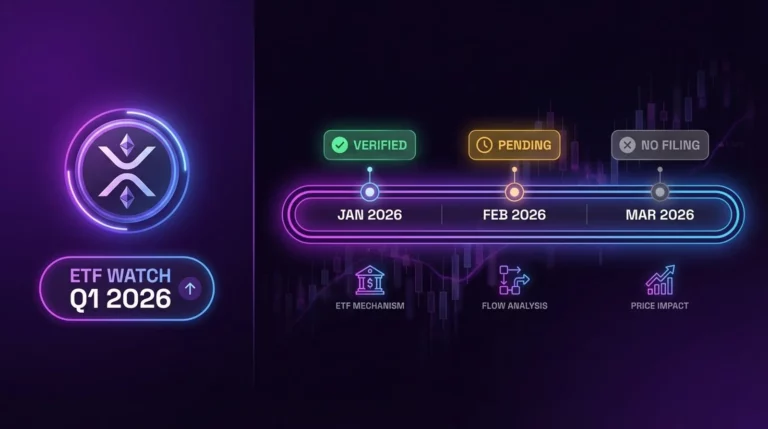
XRP ETF Watch Q1 2026
Is there an XRP ETF, and when could it be approved?
XRP ETF outcomes depend on verified filings, regulatory review, and market-structure requirements (custody, surveillance, listing). This Q1 2026 tracker separates confirmed updates from rumors and explains how ETF access could affect liquidity and price scenarios.
Quarter Window: Q1 2026 (January 1 – March 31, 2026 UTC)
Last Updated: January 28, 2026, 14:00 UTC
Status Snapshot:
- US Spot ETF: Multiple S-1 filings submitted; 19b-4 filings pending SEC review
- Regulatory Status: SEC review ongoing; new administration signals pro-crypto stance
- Timeline: First potential decision windows: Q1-Q2 2026 (estimated)
- Market Narrative: Strengthened post-inauguration; ETF probability priced higher
⚠ VERIFIED VS UNVERIFIED
VERIFIED: S-1 filings by multiple issuers (Grayscale, Bitwise, 21Shares, Canary, WisdomTree); SEC acknowledgment of filings; post-Ripple settlement regulatory clarity.
UNVERIFIED: Specific approval dates; claims of ‘imminent’ approval; unnamed sources predicting outcomes. Social media speculation should not be treated as filing status.
Impact Channels (How an ETF Could Affect Price):
- Access: Expands investor segments (retirement accounts, institutional mandates)
- Liquidity: Market makers + tighter spreads + deeper order books
- Flows: Net inflows/outflows create reflexive price pressure
- Volatility: Can increase short-term (event volatility) before stabilizing
Scenario Strip:
| Scenario | What It Means | Forecast Impact |
| No ETF Progress | No new filings; delays; narrative fades | Neutral; other drivers dominate |
| ETF Progress | Filing advances; SEC engagement; timeline clarity | Bullish bias; range expands on news |
| ETF Approval | Formal approval; trading begins | Major catalyst; volatility spike; flow-driven |
Navigate: XRP ETF hub | XRP catalysts hub | Forecast methodology | Sentiment and liquidity
What’s New in Q1 2026 (Verified Developments)
| Issuer | Product | Jurisdiction | Filing Date | Status | Next Step | Source |
| Grayscale | Spot ETF | US | Oct 2024 | S-1 filed; 19b-4 pending | SEC review | SEC EDGAR |
| Bitwise | Spot ETF | US | Oct 2024 | S-1 filed; 19b-4 pending | SEC review | SEC EDGAR |
| 21Shares | Spot ETF | US | Nov 2024 | S-1 filed | 19b-4 filing | SEC EDGAR |
| Canary Capital | Spot ETF | US | Oct 2024 | S-1 filed | 19b-4 filing | SEC EDGAR |
| WisdomTree | Spot ETF | US | Dec 2024 | S-1 filed | SEC acknowledgment | SEC EDGAR |
Filings and Issuers
Multiple major asset managers have filed S-1 registration statements for XRP spot ETFs with the SEC. Grayscale and Bitwise led with filings in October 2024, followed by 21Shares, Canary Capital, and WisdomTree. These filings represent the first step in the ETF approval process. The next critical milestone is 19b-4 filings by exchanges seeking to list these products, which trigger formal SEC review periods.
Regulatory Interactions (Responses, Delays, Comment Periods)
The SEC has acknowledged receipt of multiple XRP ETF filings but has not yet published formal review timelines for most applications. The regulatory environment shifted positively following the January 2026 inauguration, with the new administration signaling a more constructive approach to digital asset regulation. Post-Ripple settlement clarity removes a key legal uncertainty that previously complicated XRP product approvals. For legal context, see the SEC lawsuit impact hub.
Market Infrastructure Updates (Custody, Venues, Products)
Custody solutions for XRP have matured significantly. Major custodians (Coinbase Custody, BitGo, Anchorage) now support XRP with institutional-grade security. Trading venue infrastructure includes Cboe, NYSE Arca, and Nasdaq as potential listing venues for XRP ETFs. Market surveillance agreements—a key SEC requirement—are in development between exchanges and spot markets.
XRP ETF Landscape (Explainer)
Spot vs Futures vs ETP/ETN vs Trust Structures
| Structure | How It Works | Pros | Cons |
| Spot ETF | Holds actual XRP; creation/redemption in-kind or cash | Direct exposure; NAV tracks spot | Requires custody; SEC approval |
| Futures ETF | Holds XRP futures contracts; rolls positions | SEC familiar with structure | Roll costs; tracking error |
| ETP/ETN | Exchange-traded product/note; varies by structure | Available in some jurisdictions | Credit risk (ETN); varies |
| Trust | Grantor trust holding XRP; OTC traded | Exists (Grayscale); no SEC approval needed | Premium/discount; less liquid |
What ‘Approval’ Actually Means (Listing Venue, Custody, Surveillance)
ETF approval is a multi-step process:
- S-1 Registration: Issuer files with SEC disclosing fund structure, fees, risks
- 19b-4 Rule Change: Exchange files to list the product; triggers SEC review clock
- Custody Arrangements: Qualified custodian must secure underlying XRP
- Surveillance Sharing: Agreements between listing exchange and spot markets to prevent manipulation
- Effectiveness: SEC declares S-1 effective; trading can begin
Timeline & Decision Points (Q1 2026)
| Date/Window | Event | What It Means | Forecast Impact |
| Jan 2026 | New SEC leadership transition | Potential policy shift on crypto ETFs | Sentiment positive; probability up |
| Q1 2026 | 19b-4 filings expected from major exchanges | Triggers formal SEC review clock | Timeline clarity; catalyst potential |
| Q1-Q2 2026 | First potential decision windows | SEC approve/delay/deny decisions | Major catalyst window |
| Ongoing | Comment periods on rule changes | Public input on proposed listings | Industry engagement signal |
Known Deadlines and What They Represent
As of late January 2026, no fixed SEC decision deadlines have been published for XRP spot ETFs because most applications are awaiting 19b-4 exchange filings. Once 19b-4 filings are submitted and published in the Federal Register, the SEC has up to 240 days (with extensions) to issue a decision. The earliest potential decision windows are estimated for late Q1 or Q2 2026, depending on filing progress.
What Would Count as Meaningful Progress
Progress signals to watch:
- 19b-4 filings published in Federal Register (triggers SEC clock)
- SEC staff engagement with issuers (comment letters, meetings)
- Surveillance sharing agreements announced
- Public statements from SEC leadership on XRP product review
How an XRP ETF Could Affect Price (Mechanism Map)
| Effect Channel | How It Works | Metric to Watch |
| Access | ETF enables exposure via brokerage accounts, IRAs, 401(k)s | AUM growth; new investor segments |
| Liquidity | Market makers provide continuous quotes; tighter spreads | Bid-ask spreads; order book depth |
| Flows | Net inflows/outflows create buying/selling pressure | Daily ETF flow data; custody holdings |
| Volatility | Can spike around decisions; may stabilize over time | Realized vol; options IV; range width |
| Correlation | May increase correlation to traditional risk assets | XRP-SPY correlation; macro sensitivity |
Access & Distribution (New Investor Segments)
An ETF would unlock XRP exposure for investors who cannot or prefer not to hold cryptocurrency directly. This includes retirement accounts (IRAs, 401(k)s), institutional mandates that require regulated securities, financial advisors seeking compliant products for clients, and retail investors who prefer brokerage accounts over crypto exchanges. The BTC and ETH ETF launches demonstrated significant demand from these segments.
Liquidity & Market Depth (Spreads, Impact)
ETF market makers provide continuous liquidity, typically tightening bid-ask spreads. The creation/redemption mechanism links ETF prices to underlying XRP spot markets, improving price discovery. Over time, this can deepen overall market liquidity. However, large flows (especially early) can temporarily widen spreads and increase slippage. For liquidity tracking, see the sentiment and liquidity hub.
Flow Dynamics (Inflows/Outflows and Reflexivity)
ETF flows create reflexive price dynamics. Net inflows → ETF creation → XRP purchases → price support. Net outflows → ETF redemption → XRP sales → price pressure. Early-stage flows tend to be concentrated and directional (often inflows post-launch), creating momentum effects. Flow data becomes a key metric for short-term price forecasting.
Volatility Regime Changes (Why It Can Rise First)
Counter-intuitively, ETF access can initially increase volatility. Decision uncertainty creates event volatility. Early flows are often concentrated and directional. New participants may have different time horizons and risk tolerances. Over time (months to years), volatility typically stabilizes as markets mature. Short-term traders should expect elevated volatility around ETF milestones.
Forecast Implications (Scenario Requirements + Triggers)
| Scenario | Trigger | Confirmation | Invalidation | Market Behavior |
| No ETF Progress | Filings stall; no 19b-4s; delays | Narrative fades from headlines | New filings; SEC engagement | Neutral; other drivers matter |
| Progress Case | 19b-4 filings; SEC clock starts | Timeline clarity; issuer confidence | SEC rejects filings; delays | Bullish; range expansion |
| Approval Case | SEC approves 19b-4; S-1 effective | Trading begins; flows reported | N/A (already approved) | Major vol spike; flow-driven |
Base Case: No ETF Progress (What Matters Instead)
If ETF progress stalls, XRP price dynamics return to other fundamental drivers: BTC regime, overall crypto liquidity, Ripple adoption metrics, and macro risk sentiment. The ETF narrative would fade from weekly forecasts, and technical levels plus positioning would dominate. This is the current baseline assumption until filing progress is confirmed.
Progress Case: Credible Filings + Approvals Pathway
If 19b-4 filings are submitted and the SEC clock begins, the ETF narrative strengthens. Markets typically front-run approval probability—prices may rise on progress even before formal approval. Weekly forecasts would expand ranges to account for headline volatility. The progress case currently has elevated probability given post-inauguration signals. For weekly updates, see this week’s XRP outlook.
Approval Case: Early Flow Expectations + Risk Controls
Formal approval would trigger immediate market response. Based on BTC/ETH ETF precedents, expect: initial volatility spike, concentrated early inflows, potential ‘buy the rumor, sell the news’ dynamics, and flow-driven price action in the weeks following launch. Risk controls matter—elevated leverage (OI, funding) combined with approval could create squeeze conditions. For monthly planning, see the next month forecast.
Risks & Misconceptions
Confusing Rumors with Filings
Social media frequently circulates unverified ‘ETF news.’ Verified filings appear on SEC EDGAR. Verified regulatory communications are published officially. Unnamed sources, ‘insider’ claims, and prediction posts are not filings. This tracker only includes verified developments. Always check the source.
Assuming ‘ETF = Guaranteed Up-Only’
ETFs expand access but do not guarantee price appreciation. Markets often front-run expected events (‘buy the rumor’). Post-approval dynamics can be complex (‘sell the news’). BTC ETF saw initial outflows from GBTC conversions. Price direction depends on net flows, not just approval. An ETF is a market structure change, not a guaranteed price catalyst.
Underestimating Liquidity/Volatility Shocks
ETF-related events can produce outsized volatility. Decision days (approve/delay/deny) create binary event risk. Early flows can be concentrated and directional. Elevated leverage (current OI: $1.49B) amplifies moves. Traders should widen expected ranges around ETF milestones and manage position sizing accordingly.
How VTrader Incorporates ETF Developments (Method Excerpt)
ETF developments enter VTrader forecasts through the catalyst framework:
- Filing updates: Verified filings shift probability assessments and can expand forecast ranges
- Timeline milestones: Known decision windows are flagged in weekly/monthly catalysts
- Scenario adjustments: Progress/approval would shift bull scenario probability and targets
- Volatility expectations: ETF events justify wider ranges around milestones
For the full methodology on how catalysts affect forecasts, see the forecast methodology hub. For the complete XRP forecast framework, see the XRP price prediction pillar. For 2026 context, see the XRP 2026 outlook.
Frequently Asked Questions
What is an XRP ETF and how is it different from an ETP or trust?
An ETF (Exchange-Traded Fund) is a regulated fund structure with standardized creation/redemption, market makers, and exchange listing. ETPs (Exchange-Traded Products) and ETNs (Exchange-Traded Notes) vary by jurisdiction and structure—ETNs carry issuer credit risk. Trusts (like Grayscale’s) trade OTC and can have premiums/discounts to NAV. The structure affects liquidity, access, and regulatory requirements.
Is there an XRP spot ETF in the U.S.?
As of January 2026, no XRP spot ETF has been approved for trading in the U.S. Multiple issuers (Grayscale, Bitwise, 21Shares, Canary, WisdomTree) have filed S-1 registration statements with the SEC. These filings are under review, but formal approval requires 19b-4 exchange filings and SEC approval of the rule change. No approval has been granted yet.
What needs to happen for an XRP ETF to be approved?
Key requirements: (1) S-1 registration statement filed and reviewed, (2) 19b-4 rule change filed by listing exchange, (3) SEC review and approval of the rule change, (4) qualified custody arrangements, (5) market surveillance agreements between exchange and spot markets. The exact timeline depends on SEC engagement and any comments or requests for amendments.
What are the key dates and deadlines to watch in Q1 2026?
No fixed SEC decision deadlines are currently published for XRP spot ETFs. The key milestone to watch is 19b-4 filings by exchanges (Cboe, NYSE Arca, Nasdaq), which would trigger formal SEC review clocks. Once filed, the SEC has up to 240 days to decide. Q1 monitoring focuses on new filings, regulatory engagement, and policy signals from new SEC leadership.
Would an XRP ETF increase the price immediately?
Not necessarily. Markets often front-run expected events—prices may rise on progress before approval. Post-approval dynamics depend on net flows. ‘Buy the rumor, sell the news’ patterns are possible. BTC ETF saw initial GBTC outflows offsetting new ETF inflows. An ETF expands access but doesn’t guarantee price direction. Net flows, liquidity, and risk regime determine impact.
How could an ETF change XRP liquidity and volatility?
ETF access typically deepens liquidity over time through market makers and broader participation. However, short-term volatility can increase around decisions and early trading. Concentrated flows create reflexive price pressure. Track spreads, order book depth, and derivatives positioning to gauge liquidity regime changes. Volatility often spikes first, then stabilizes over months.
What risks could delay or prevent an XRP ETF?
Potential risks: regulatory uncertainty or policy shifts, market integrity concerns raised by SEC, insufficient surveillance sharing agreements, custody or security questions, or broader market conditions affecting review priorities. While the post-settlement environment is positive, approval is not guaranteed. Monitor SEC communications and filing status for delay signals.
How does an ETF narrative affect weekly and monthly forecasts?
ETF probability changes act as catalysts. Weekly forecasts widen ranges around decision windows and track immediate volatility. Monthly forecasts assess whether the narrative shifts the liquidity regime or changes scenario probabilities. Progress elevates bull scenario probability; delays return focus to other drivers.
Where can I track the latest XRP ETF updates on VTrader?
This quarterly ETF Watch post tracks verified developments. The XRP ETF hub provides evergreen context on ETF mechanisms and implications. The Catalysts hub includes ETF milestones alongside other drivers. Weekly and monthly forecasts incorporate ETF narrative into scenario assessments.
Update Log (Q1 2026)
| Date/Time (UTC) | Update Notes |
| Jan 1, 10:00 | Q1 2026 ETF Watch published. Status: Multiple S-1 filings; no 19b-4s yet. |
| Jan 20, 16:00 | Updated: New administration inaugurated; pro-crypto policy signals noted. |
| Jan 28, 14:00 | Updated: Added WisdomTree to filing table. Regulatory environment section expanded. |

Steve Gregory is a lawyer in the United States who specializes in licensing for cryptocurrency companies and products. Steve began his career as an attorney in 2015 but made the switch to working in cryptocurrency full time shortly after joining the original team at Gemini Trust Company, an early cryptocurrency exchange based in New York City. Steve then joined CEX.io and was able to launch their regulated US-based cryptocurrency. Steve then went on to become the CEO at currency.com when he ran for four years and was able to lead currency.com to being fully acquired in 2025.