This guide is part of the “Advanced Crypto Trading Strategies” series.
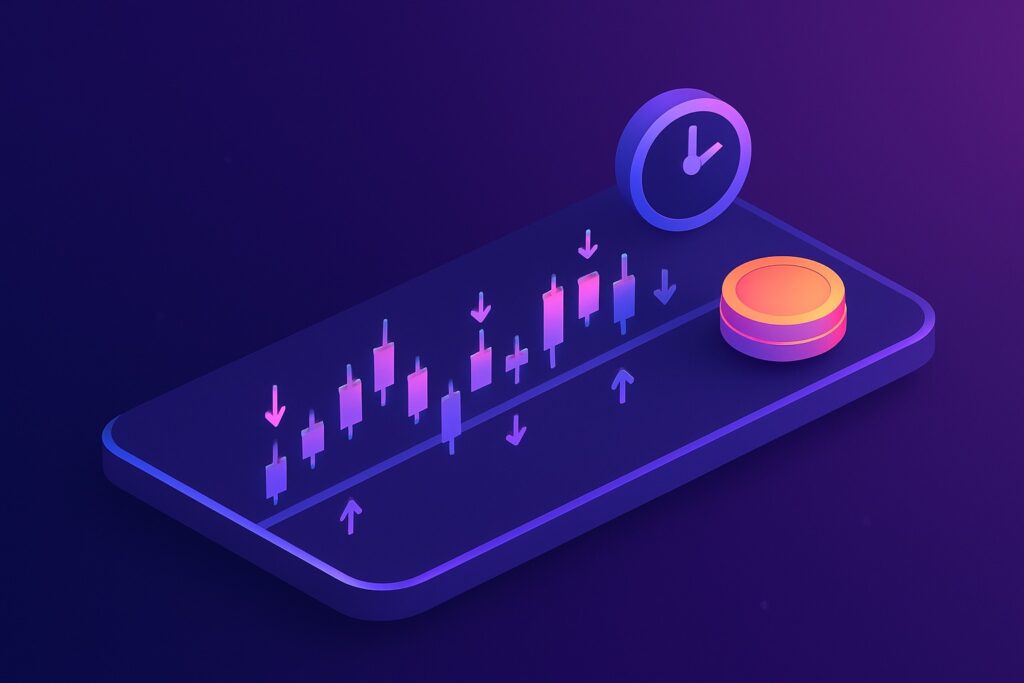
Crypto scalping is a type of trading which is focused on capturing tiny, repeatable profits from short-term price fluctuations. Instead of waiting for huge moves in the market, scalp traders thrive on frequent trades, entering and exiting positions within seconds or minutes. The main point is not to chase large moves but to make small, consistent profits that compound over time.
In crypto trading, where markets run 24/7 and the volatility is massive, this approach can be demanding but very lucrative. Scalping strategies perform best in markets that are liquid, volatile, and have strong technical chart formations.
If you read this whole article, you’ll learn how crypto scalping works, what its main pros and cons are, the best trading strategies, and the most important risk management tips that every trader needs to know in order to make money.
Table of Contents
How Does Crypto Scalping Really Work
Discipline, speed, and accuracy are the most important skills for crypto scalping. You could open and close dozens or even hundreds of trades in a single trading session if you are a scalper. The goal of each trade is to take advantage of small changes in the price.
Let’s talk about how it works:
- Scalpers use advanced technical analysis tools to find small price changes. You get in and out of trades quickly.
- You don’t stay in a trade for hours or days; instead, you get out as soon as you make a small profit. This keeps you from being exposed to bigger swings and events that happen overnight.
- Some people use leverage to boost their returns, but this also increases losses, so it’s important to size your positions correctly.
- A lot of modern traders use bot trading or automatic trading systems to carry out these strategies very quickly, which humans just can’t match.
For scalping to work well, your market and exchange must meet a few important requirements:
High Liquidity: The term “liquidity” refers to how easily an asset can be bought or sold in the market without causing a big change in its price. It makes sure that trades can be done right away and at the right price. Slippage is the difference between the price you think you’ll get for a trade and the price at which it actually happens. BTC/USDT and ETH/USDT are examples of very liquid markets. They are great because they have small bid-ask spreads, which means there isn’t much of a difference between buyers and sellers.
High Volatility: You can’t make money if prices don’t move. Scalpers need a market that constantly shifts up and down, giving them multiple entry and exit opportunities. The crypto market is arguably the best for this.
Low Timeframes: Scalping operates on ultra-short intervals like the 1M, 5M, or 15M charts. These low timeframes allow traders to spot mini trends and react fast.
Focus on Technical Analysis: Scalpers rely almost entirely on technical indicators, volume analysis, and pattern recognition, while long-term investors rely on fundamentals and economics.
In other words, this kind of trading is the purest form of short-term speculation. It’s not about guessing where Bitcoin will be in a month, it’s about where it might be in the next 30-60 seconds.
The Good and Bad Things About Crypto Scalping
Scalping, like any other strategy, has its pros and cons.
Benefits of Scalping
Lots of Opportunity for Outsized Gains
Since scalpers execute so many trades, small profits can add up. If a trader captures 0.3% profit per trade across 50 successful trades, the compounding effect becomes really meaningful.
Less Risk Per Trade
Each position is held only for mere moments, minimizing the chance of you being caught in large market reversals. A quick exit also means exposure is short-lived.
Profitable in Any Market Condition
Scalpers can profit in bull, bear, or consolidating markets as long as there is enough liquidity and volatility. Unlike trend traders, they don’t need big market moves, just some movement.
Potential for Automation
Scalping performs well in automatic trading and bot trading setups. Algorithms can identify entries and execute instantly, removing human emotion and other weaknesses from the process.
The Risks and Downsides
If you choose scalping as your main trading activity, you should deeply understand the following risks:
High Transaction Costs
Since scalping involves frequent trades, transaction fees can eat into your profits fast. You need to look for exchanges with the lowest maker/taker fees possible.
Time Consuming and Stressful
Scalping demands absolute focus from you and lightning-fast reactions. It’s mentally exhausting and can often lead to overtrading. It’s a common trap where traders take unnecessary risks to chase losses or trade out of boredom.
Risk of Large Losses
One mistake or sudden price movement against you can erase dozens of small wins. If you don’t use strict risk management, even a minor mistake in discipline can cost you.
Steep Learning Curve
Finally, scalping is not very beginner-friendly. It requires mastery of technical analysis, awareness of slippage, and emotional control to avoid panic exits or revenge trades.
While scalping can be profitable, it’s far from forgiving. You have to treat it like a precision sport where every move counts.
Essential Toolkit for a Crypto Scalping
Choose the Right Crypto Exchange
The exchange you choose to trade on can make or break your scalping activities. The ideal exchange will offer high liquidity, extremely low transaction fees, and a fast, reliable trading platform. Look for exchanges with tight bid-ask spreads, instant order execution, and minimal downtime during volatile hours.
Professional scalp traders often prefer platforms like Binance, OKX, or vTrader because they support high-frequency trading, provide you with real-time data, and charge low fees. vTrader is likely to be the best for beginners as it offers 0% trading fees for accounts over $1000.
Advanced Charting Software
As a scalper you will depend on visuals. TradingView and other platforms let you do technical analysis in real time with customizable indicators like EMAs, Bollinger Bands, RSI, and MACD. It’s easier to keep track of price changes and volume spikes with tick charts and clean interfaces on these platforms.
Bots (Optional)
If you know how to code or set up your own trading software, automation can help you quite a lot. Scalping bots carry out your set trading plan without any doubts, allowing for real high-frequency trading that humans can’t do by hand.
But this also increases the risk of software problems, such as bugs, bad backtesting, or network delays that cause trades to happen at the wrong time.
Bots can be helpful, but they still need people to watch over them. An automated system still needs people to make decisions and manage the day to day in order to stay profitable.
5 Best Crypto Scalping Strategies
There are rules, structure, and data behind crypto scalping. Here are five strategies that professional scalp traders use every day that work. Each one has clear logic, rules for when to enter and exit, and built-in risk management rules to keep your money safe.
Strategy 1: Use Support And Resistance To Trade In A Range
This is one of the oldest and most dependable ways to trade. Markets mostly move sideways, bouncing between support and resistance levels. This price action draws out a range you can see, where you can take advantage of the swings.
How it works:
You find a clear horizontal range on a short time frame, like 1M or 5M. You then buy when the price is at the lower boundary (support) and sell when it is at the upper boundary (resistance).
Trade Signals:
- Buy signal: When the price hits support and makes a rejection candle, like a hammer or an engulfing pattern.
- Sell signal: The price gets close to the resistance zone and stops or goes back. You should only trade after you are sure that the trend has changed.
Tip for managing risk:
For bullish trades (buying), put a stop-loss order just below support. For bearish trades (selling), put it just above resistance. Take a small risk-to-reward ratio of at least 1:1.5, which means you risk $10 to make $15.
For example, if Bitcoin goes up and down between $100,200 and $100,500, you might buy near $100,220 with a stop at $100,180 and sell at $100,470. It’s fast, organized, and easy to measure.
Strategy 2: The Spread Strategy
This method is based on making money from the bid-ask spread, which is the small difference between the highest price buyers are willing to pay and the lowest price sellers are willing to take.
How it works:
Traders put limit orders near the bid or ask to take advantage of small changes in this spread. The less spread there is, the more competition there is. But in markets with a lot of volume, these small gains will add up quickly.
Important: This is an advanced technique that only traders with access to a lot of liquidity and very fast execution speeds should use. Also, to take advantage of these kinds of set ups, you often need to use bot trading or automatic trading systems.
What Are the Dangers?
When prices change quickly, limit orders can fill just before a big drop, which can lead to losses. Always set a stop-loss when you enter a trade and keep an eye out for slippage.
Strategy 3: Moving Average Crossover
The moving average (MA), especially when a fast and slow MA cross over each other, is one of the easiest to understand and most useful trading indicators out there. It helps you spot changes in short-term momentum and lets you ride trends in short time frames.
Setup:
Use two exponential moving averages (EMAs):
- 5 period EMA (fast)
- 20 period EMA (slow)
Entry Signals:
- Buy when the fast EMA goes above the slow EMA.
- When the fast EMA goes below the slow EMA, you should sell or short.
For example, on a 1-minute ETH/USDT chart, you can place a buy order when the 5 EMA rises above the 10 EMA and volume spikes. You can then exit after making a move of 0.3% to 0.5%. This method works best in trending markets rather than choppy ones. So trend, consolidation, and as the next trend starts you enter.
Combine all strategies with volume analysis to confirm the real momentum. A high volume confirms a real crossover signal.
Strategy 4: Using RSI and Bollinger Bands Together
The Relative Strength Index (RSI) and Bollinger Bands can be powerful tools when combined. RSI measures momentum and potential overbought and oversold conditions, while Bollinger Bands capture volatility. Together, they point out short-term exhaustion levels.
Signals to Trade:
- Buy: When the price touches the lower Bollinger Band and RSI drops below 30, then starts turning upward.
- Sell: When the price touches the upper Bollinger Band and RSI rises above 70, then turns down.
For example, you look at a 5-minute BTC chart and see that the price drops below the lower Bollinger Band with the RSI at 25. When RSI starts to rise, you buy and set a stop-loss order just below the candle low. When the RSI reaches 60–70 or the price hits the middle band, you take your profits.
How it works:
It takes advantage of short periods of the market overreacting, which happens a lot with crypto pairs that are very volatile.
Strategy 5: The EMA and Stochastic Oscillator Strategy (1M)
This setup is made for trades that happen very quickly and try to catch quick changes in the market. It first checks to see which way the overall trend is going, and then it looks for signs of strength or weakness in that same direction.
Setup:
- Use a 50-period EMA to find the short-term trend.
- Stochastic Oscillator (14,3,3) to find good times to buy.
Trade Signals:
Only buy or sell in the direction of the EMA trend.
- Buy when the price is above the EMA and the Stochastic drops below 20 (oversold) and then goes up.
- Sell: When the price is below the EMA and the Stochastic goes up above 80 (overbought) and crosses down.
For example, if ETH is above its 50 EMA, we want to buy. You can go long as the Stochastic shows bullish momentum higher moving from 18 to 25.
Risk management:
Keep a tight stop-loss, ideally no larger than 0.2–0.3% per trade. Scalping is all about protecting capital through small but frequent wins.
How Not to Lose Your Account
Even the best trading strategy will fail without solid risk control. Scalping amplifies both your profits and losses because of things like leverage, speed, and frequency. The following principles keep traders in the game.
Setting Tight Stop-Losses
A stop-loss order is like your seatbelt in scalping. You have to apply it to every trade without exception. Stops should be placed close, just below or above the last key candle. If your stop gets triggered several times in a row, stop yourself and analyze the situation again.
The 1% Rule
Never risk more than 1% of total capital per trade. Aggressive scalpers may even go lower, around 0.5%. If your trading account is $10,000, your maximum loss per trade should not be bigger than $100.
This small risk ensures you can survive long losing streaks without blowing your account. Scalping is a numbers game, not a single big win strategy.
Favorable Risk-to-Reward Ratio
Even though scalping often targets small gains, aim for at least a 1:1.5 or 1:2 risk-to-reward ratio. That means risking $10 to make $15 or $20. This simple rule ensures you remain profitable even if only 60% of your trades are winners.
Discipline and Patience
Perhaps the hardest part of scalping is maintaining trading discipline. Overconfidence after a few wins or frustration after several losses can lead to emotional trading. Overtrading and revenge trading is the enemy of every scalper.
Use a trading journal to record every trade. Record the entry price, exit price, reason for entering the trade, and outcome. If you get into the habit of reviewing it weekly it will help you detect emotional biases and improve your setup.
How to Start Crypto Scalping Today
Even if you understand the theory, putting scalping into practice requires structure and discipline. These five steps will help you start trading with confidence in what you’re doing and minimizing the most common mistakes every beginner makes.
Step 1: Learn How To Do Technical Analysis
Scalping is based only on technical analysis, not on long-term fundamentals. You’ll need to use charts, volume, and patterns a lot to find places to enter and exit.
Learn about different types of charts, such as candlestick and Heikin Ashi. Learn how to read indicators like moving averages, RSI, CCI, and Bollinger Bands. Also, learn how to spot simple patterns like flags, wedges, and support/resistance zones.
Your goal isn’t to be able to perfectly predict the future, but to make choices that give you the best odds of success.
Step 2: Use A Demo Account To Practice First
Spend some time trading on a demo account before you put real money on the line. A lot of exchanges have simulators that let you try out strategies in real life without putting your own money at risk.
This is where you can work on your speed of execution, see how well your risk-to-reward ratio works, and figure out which scalp trading indicators work best for you. You will also learn how to be patient and time things right, which are two things that set successful traders apart from unsuccessful ones.
Step 3: Pick Your Tools And Exchange
Choose a cryptocurrency exchange that allows high-frequency trading, has a lot of liquidity, and keeps the bid-ask spread small. You need a platform like vTrader or Binance that has low transaction fees and always fills orders correctly.
Use it together with professional charting tools like TradingView for visualization and strategy testing. If you do use automation, make sure your bot software integrates well and can handle automatic signals without causing lag or slippage.
Step 4: Start Small with Real Money
Once you’ve built consistency on paper and you feel confident in your results, you can go live. Start with small position sizes at first to get used to market psychology and execution delays.
Use proper position sizing as mentioned above, to ensure you never risk more than 1% of your account on a single trade. Your focus should be consistency. Profits come from repetition and control, not luck.
Step 5: Start Keeping a Trading Journal
Every successful trader maintains a trading journal. This tool helps you measure what works, detect your bad habits, and refine your trading strategy. If you don’t want to keep your trades in an excel sheet, or Notion/Notes you can use pre-programmed journals like Edgewonk, TradesViz and Tradervue, all of which are highly recommended.
By keeping records of your trades you’ll see patterns emerge, what times you perform best, which pairs offer better spreads, and when your fatigue leads to mistakes. Scalping is as much about self-analysis as it is about charts.
Scalp Trading, Day Trading and Swing Trading
Scalping often gets grouped with other short-term trading methods, but the differences are quite significant. Here’s a simple breakdown:
| Trading Style | Typical Duration | Trade Frequency | Average Target | Core Focus |
| Scalp Trading | Seconds to minutes | Dozens to hundreds per day | 0.1–0.5% per trade | Timing, precision, indicators |
| Day Trading | Minutes to hours | Several per day | 1–3% per trade | Trends and daily momentum |
| Swing Trading | Days to weeks | Few per week | 5–20% per trade | Chart patterns and trends |
Fig. 1 – Table Comparing Short Term Trading Strategies
Scalping is the most demanding in terms of time and attention, but it offers constant opportunity and fast results. Swing trading is slower-paced and less stressful, while day trading sits comfortably in between and gets rid of overnight risk.
Is Crypto Scalping Profitable?
The short answer is yes. But the ones who make the most money are those who treat it like a business. Scalping success depends on three pillars: discipline, execution, and capital management.
Here’s why:
- Profits come from taking advantage of micro price movements many times throughout the day, not from a single winning trade.
- Transaction fees and tight control of limit orders determines whether you end the week in profit or loss.
- Proper risk management, especially the consistent use of stop-loss orders, ensures that one bad trade will never wipe out multiple good ones.
If you want to be good at scalping you need to think in probabilities rather than emotions. You might lose 4 out of 10 trades, but with a 1:1.5 risk-to-reward ratio, the 6 winners can more than offset those losses. If you lose more than that, you need to adjust your R/R ratio to 1:2 or higher.
The risks are real – over-leveraging, overtrading, and burnout are common mistakes. The mental strain of constant chart-watching and the temptation to deviate from your plan can be costly.
The Scalper’s Edge
Crypto scalping is the art of turning micro-movements into measurable gains. It’s not glamorous, it’s systematic, data-driven, and profitable when done right.
If you can build patience, maintain strict discipline, and focus on small, repeatable wins, scalping can provide steady income and sharpen your trading instincts across all markets.
Every trade, every lesson in your trading journal, every small win will compound over time with this strategy. The market rewards those who show up with structure and consistency in mind.
So, if you’re ready to take on one of the most demanding yet lucrative niches in crypto trading, start with vTrader, trade smart, and let your tools be your edge.

Steve Gregory is a lawyer in the United States who specializes in licensing for cryptocurrency companies and products. Steve began his career as an attorney in 2015 but made the switch to working in cryptocurrency full time shortly after joining the original team at Gemini Trust Company, an early cryptocurrency exchange based in New York City. Steve then joined CEX.io and was able to launch their regulated US-based cryptocurrency. Steve then went on to become the CEO at currency.com when he ran for four years and was able to lead currency.com to being fully acquired in 2025.