Table of Contents
Can XRP Reach $20? Feasibility, Market Cap Math, and Scenarios
What market cap would XRP need to reach $20?
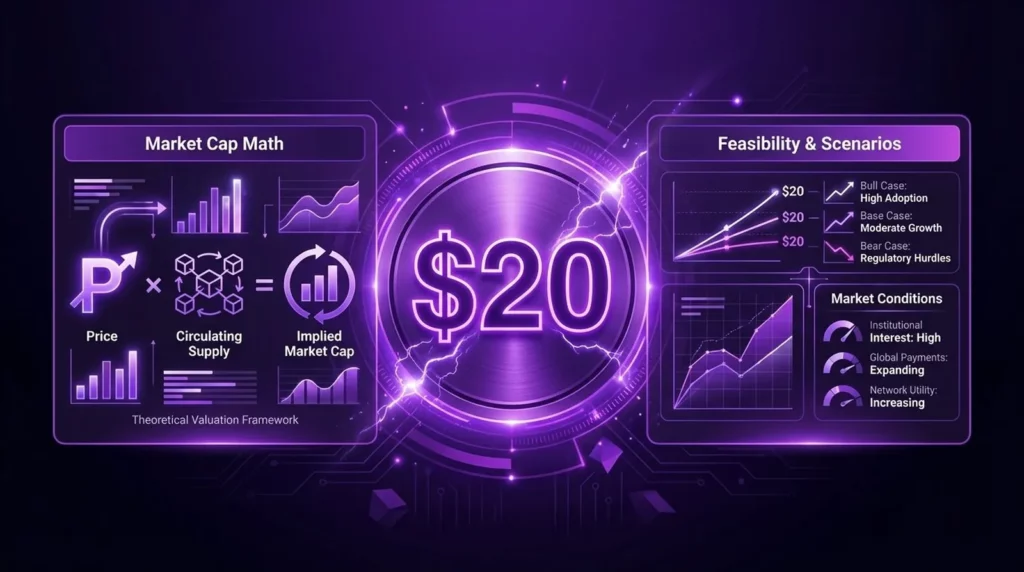
At $20, XRP’s market cap equals $20 × supply: ~57B XRP implies ~$1.14T; 100B implies ~$2T. Reaching $20 likely requires broad access, deep liquidity, and strong catalysts over more than one cycle—not a quick move.
Market Cap Math at a Glance
| Supply Assumption | Implied Market Cap at $20 | Scale Note |
| ~57B (circulating) | ~$1.14 trillion | Comparable to Bitcoin at mid-cycle peak |
| ~75B (mid-range float) | ~$1.5 trillion | Exceeds most single-asset crypto peaks |
| 100B (max supply) | ~$2 trillion | Approaches gold-ETF-scale territory |
Scenario Summary
| Scenario | Description | $20 Probability |
| Base Case | Partial catalyst alignment; limited access expansion; moderate liquidity growth | Low |
| Bull Case | Broad access (ETF + custody) + strong liquidity cycle + sustained demand + regulatory clarity | Moderate |
| Bear Case | Prolonged risk-off regime; adverse regulatory friction; weak liquidity and adoption stalls | Very Low |
Navigate the full target range: explore all XRP price targets for the complete ladder, or jump to specific levels:
For time-based forecasts, see the XRP price prediction for 2026 or the
XRP price prediction for 2030 outlook.
Quick Answer — Is $20 XRP Realistic?
Feasibility Summary (Math-First)
A $20 XRP price requires XRP’s total market capitalization to reach approximately $1.14 trillion using the current circulating supply of roughly 57 billion tokens. If the calculation uses the full maximum supply of 100 billion XRP, the implied market cap rises to $2 trillion. For context, Bitcoin’s market capitalization has ranged between $1 trillion and $2 trillion during strong cycle peaks, and the total crypto market has historically peaked near $3 trillion. An XRP market cap of $1–2 trillion would therefore represent an outsized share of the broader crypto market unless total market capitalization expands substantially.
$20 is not impossible in absolute terms, but it sits at the upper boundary of what the current market structure can support. It becomes more plausible if access expands, liquidity deepens, and catalysts sustain demand across more than one market cycle. Treat it as a scenario with defined triggers rather than a baseline expectation.
Top 5 Conditions That Must Be True
- Regulatory clarity and durable legal outcomes: XRP’s classification and Ripple’s legal standing must be resolved in a way that enables institutional participation without ongoing uncertainty.
- Broad investor access through regulated products: An approved spot XRP ETF and institutional custody infrastructure are needed to channel significant capital into XRP.
- Deep and resilient spot liquidity: Order book depth, tight spreads, and low slippage at scale are required to support a price level of $20 without fragile market structure.
- Macro liquidity regime that supports risk assets: A $20 target becomes credible only during periods of accommodative monetary policy, strong risk appetite, and sustained capital flows into digital assets.
- Adoption and usage growth that reinforces demand: Network activity, payment volume, partner integrations, and tokenization use cases on the XRP Ledger need to expand enough to generate durable demand beyond speculation.
Market Cap Math for XRP at $20
Formula and Definitions
Market capitalization is calculated as price per token multiplied by circulating supply. For XRP, three supply figures matter: circulating supply (the tokens currently available in the open market, approximately 57 billion as of early 2026), the effective liquid float (circulating supply minus tokens held in known wallets unlikely to sell, often estimated in the range of 40–55 billion), and the maximum supply (100 billion tokens, fixed at the XRP Ledger’s inception). Each assumption produces a different implied market cap at $20, and the choice of supply figure shapes how realistic the target appears.
For a detailed breakdown of how supply, liquidity, and catalysts interact across all XRP targets, see the full XRP price prediction pillar page.
Implied Market Cap Under Different Supply Assumptions
The table below maps $20 against three supply scenarios. Each row includes a scale comparison to anchor the number in familiar financial terms.
| Supply Assumption | Implied Market Cap at $20 | Scale Comparison Note |
| ~57B (current circulating) | ~$1.14 trillion | Comparable to Bitcoin’s market cap during strong cycle peaks; would make XRP one of the top 5–10 most valuable assets globally by market cap |
| ~75B (mid-range float estimate) | ~$1.5 trillion | Exceeds the peak market cap of any single altcoin in history; approaches the scale of large sovereign wealth funds |
| 100B (max supply, fully diluted) | ~$2.0 trillion | Comparable to the entire crypto market’s capitalization during prior peaks; roughly 6–7% of gold’s estimated market cap (~$30–34T) |
Conceptual Comparisons (Large Liquid Markets and Crypto Benchmarks)
At ~$1.14 trillion (circulating supply basis), XRP’s market cap would sit in the same order of magnitude as Bitcoin’s peak valuations and roughly half the total crypto market’s all-time high of ~$3 trillion. The fully diluted figure of $2 trillion would place XRP alongside the entire crypto market at its historical peak, which is a scale that implies either massive sector growth or an exceptionally dominant position for XRP within the ecosystem.
For external benchmarks: gold’s market cap is estimated at $30–34 trillion, the U.S. equity market exceeds $50 trillion, and the global bond market surpasses $130 trillion. A $1–2 trillion asset is large but not unprecedented in global finance. The question is whether XRP specifically can command that scale, given its utility profile, competitive position, and the maturity of the crypto market as a whole.
Constraints Beyond Market Cap
Liquidity vs. Market Cap (Depth, Spreads, Slippage)
Market cap is an output, not a driver. Price moves because of marginal buying pressure against available liquidity. A $20 XRP price requires not just a large market cap number but the order book depth and market microstructure to support trading at that level without extreme slippage. Today, XRP’s spot market depth is thin relative to Bitcoin or Ethereum, meaning large orders can move price significantly. For $20 to be sustainable, bid-ask spreads need to tighten, depth needs to multiply, and the ratio of real liquidity to market cap needs to improve.
Capital Flows and Time Horizon (Order of Magnitude)
Moving XRP from its current price range to $20 requires substantial net capital inflows over time. The exact amount depends on liquidity conditions, but order-of-magnitude estimates suggest tens to hundreds of billions of dollars in net buying pressure would be needed, depending on the time horizon and market depth along the way. The table below provides rough flow estimates across different horizons.
| Horizon | Net Inflow Required (Range) | Liquidity Assumption | Commentary |
| 12–18 months | $80B–$200B+ | Current depth; limited access | Requires rapid, concentrated demand; high slippage risk |
| 2–4 years | $50B–$150B | Moderate depth growth; ETF access | More gradual absorption; lower per-period pressure |
| Multi-cycle (5+ years) | $30B–$100B | Deep, mature market; broad access | Structural demand accumulates; slippage much lower |
Supply Float and the ‘Who Sells’ Problem in Rallies
As price rises, holders who accumulated at lower levels face increasing incentive to take profits. The effective liquid float—how many tokens are realistically available for sale at any given price—shrinks as conviction holders sit tight and expands as profit-takers sell. For XRP, Ripple’s escrow releases add a structural supply component: up to 1 billion XRP per month can enter circulation, though most is typically returned to escrow. At $20, each monthly release could represent up to $20 billion in potential sell pressure if fully distributed. The interplay between demand inflows and this supply schedule is a critical constraint that market cap math alone does not capture.
What Would Need to Happen for XRP to Reach $20
The following preconditions represent the structural conditions that would need to align for $20 to become a credible target. Each condition is mapped to an observable proxy metric and a threshold that would signal meaningful progress.
Access Expansion (Regulated Products, Custody, Institutional Rails)
Institutional capital needs a pathway into XRP that meets regulatory and compliance requirements. This means approved spot XRP ETFs in major markets (U.S., Europe, Asia-Pacific), qualified custodian support from firms like Coinbase Custody or BitGo, and inclusion in model portfolios and pension-eligible products. Without access expansion, the addressable demand pool remains limited to crypto-native capital, which is unlikely to sustain a $1 trillion+ market cap on its own.
Regulatory Clarity and Legal Outcomes
Durable regulatory clarity is a prerequisite. The SEC v. Ripple case set important precedents, but ongoing uncertainty around XRP’s classification in other jurisdictions and the broader U.S. regulatory framework affects institutional willingness to allocate. A definitive resolution—whether through legislation, rulemaking, or final court rulings—that confirms XRP’s non-security status for secondary market trading would remove a significant friction point.
For the latest developments on how regulation and legal milestones shape XRP’s trajectory, see the XRP price drivers and catalysts hub.
Macro Liquidity Regime and Risk Appetite
Crypto assets, including XRP, are sensitive to global liquidity conditions. Periods of monetary tightening, rising real rates, and risk-off sentiment historically compress crypto valuations. A $20 target is most plausible during an expansionary phase: accommodative central bank policy, declining real rates, strong equity markets, and elevated risk appetite. If macro conditions are neutral or restrictive, even strong XRP-specific catalysts are unlikely to push the price to $20.
Adoption and Narrative Durability (Usage Proxies)
Sustainable price levels require demand that goes beyond speculative cycles. For XRP, this means measurable growth in on-ledger transaction volume, cross-border payment corridor usage through RippleNet or On-Demand Liquidity (ODL), and tokenization activity on the XRP Ledger. Partner announcements, stablecoin integration (RLUSD), and DeFi activity on the XRPL also contribute. The narrative needs to shift from “XRP could be used for payments” to “XRP is being used for payments” with verifiable metrics.
Market Structure Maturity (Spot Depth and Derivatives)
A mature market structure supports sustained price levels. This includes deep spot order books across major exchanges, liquid futures and options markets for hedging, and a healthy funding rate environment that avoids persistent overheating. XRP’s derivatives market has grown but remains less developed than Bitcoin’s or Ethereum’s. Open interest, funding rates, and basis spreads are all metrics to monitor.
Preconditions Checklist
| Condition | Why It Matters | Observable Proxy | Threshold | Notes |
| Spot XRP ETF approval | Unlocks institutional and retail access at scale | SEC/regulatory filing status | Approved and trading in U.S. | Monitor 19b-4 and S-1 filings; EU equivalents also relevant |
| Durable legal clarity | Removes institutional friction | Court rulings, legislation | Final, non-appealable ruling or legislation | SEC v. Ripple resolution; potential crypto market structure bills |
| Macro liquidity expansion | Supports risk-on capital flows | Fed funds rate, M2 growth, DXY | Rate cuts underway; M2 rising; DXY stable or declining | Global central bank coordination matters; not U.S.-only |
| Deep spot liquidity | Supports price without fragility | Order book depth (2% band), spreads | Depth >$50M within 2% on top 5 exchanges | Current depth is well below this; monitor growth rate |
| Sustained usage growth | Provides demand beyond speculation | XRPL txn volume, ODL corridors, TVL | Consistent QoQ growth for 4+ quarters | Watch for adoption milestones: partner launches, RLUSD integrations |
Scenarios for XRP to Reach $20
Base Case (Partial Catalyst Alignment)
In the base case, some catalysts materialize but not all. Regulatory clarity improves incrementally (e.g., the SEC case resolves but comprehensive legislation remains pending), an XRP ETF files but approval is delayed, and macro conditions are mixed. Liquidity grows modestly but remains insufficient to sustain prices above $10–$15 without significant correction. In this scenario, $20 remains aspirational rather than achievable within a single cycle. XRP may approach the lower end of the feasibility range but struggles to reach and hold $20.
Bull Case (Broad Access + Strong Liquidity + Sustained Demand)
The bull case requires multiple catalysts to align within the same macro window. A spot XRP ETF is approved and attracts meaningful inflows, legal clarity is established durably, the macro environment turns accommodative with strong risk appetite, and on-ledger usage grows in a way that reinforces the demand narrative. Under these conditions, XRP could approach or reach $20 during a cycle peak, particularly if the total crypto market cap expands beyond its prior high of ~$3 trillion. This scenario is possible but requires a specific confluence of events that may take more than one cycle to materialize.
Bear Case (Friction + Risk-Off)
In the bear case, key catalysts fail or are delayed. Regulatory outcomes are adverse or ambiguous, ETF approval is denied or indefinitely postponed, macro conditions tighten, and adoption metrics stagnate. XRP’s price remains range-bound well below $20, and the implied market cap math becomes increasingly disconnected from market reality. This scenario does not mean XRP has no value; it means $20 is not reachable under these conditions.
Sensitivity Tables (Assumptions)
Supply Sensitivity
The following table shows how the implied market cap at $20 changes under different supply assumptions. The “liquid float” column adjusts for tokens held in escrow or by long-term holders unlikely to sell.
| Supply Scenario | Token Count | Implied Market Cap at $20 | Feasibility Rating |
| Conservative liquid float | ~40B | ~$800B | High-end but within cycle range |
| Current circulating supply | ~57B | ~$1.14T | Challenging; requires broad access + deep liquidity |
| Mid-range float (escrow releases) | ~75B | ~$1.5T | Difficult; needs strong sustained demand |
| Full dilution (max supply) | 100B | ~$2.0T | Very challenging; near total crypto market peak |
Time Horizon Sensitivity (12–24 Months vs. Multi-Cycle)
Time horizon significantly affects the feasibility assessment. Shorter horizons require faster capital deployment and greater liquidity absorption, increasing slippage risk. Longer horizons allow for gradual market structure maturation.
| Horizon | $20 Feasibility | Key Dependency | Risk Profile |
| 12–18 months | Very challenging | Requires rapid ETF approval, macro tailwind, and parabolic sentiment | High slippage; unsustainable without deep market structure |
| 2–4 years | Challenging but plausible | Access expansion + steady liquidity growth + at least one strong cycle | Moderate; allows time for structural improvements |
| 5+ years (multi-cycle) | Plausible under bull conditions | Cumulative access, adoption, and market maturity across multiple cycles | Lower per-period risk; macro regime changes are the wild card |
What to Watch (Milestones and Metrics)
Legal and ETF Milestones
The most immediate catalysts are legal and product-access milestones. Monitor SEC v. Ripple case status (appeals, settlements, or final resolution), XRP ETF filings and SEC review timelines, and congressional crypto market structure legislation. Each milestone can shift the scenario weighting: a final favorable ruling upgrades the bull case; ETF approval expands the addressable market. Track filing deadlines, comment periods, and regulatory calendar events.
For ongoing legal and ETF milestone tracking, see the XRP price prediction methodology hub.
Liquidity Metrics (Depth, Spreads, OI, Funding)
Market structure metrics indicate whether price can be sustained at higher levels. Key metrics include spot order book depth within 2% of the mid-price across major exchanges, bid-ask spreads (tighter is better), futures open interest growth (indicates growing participation), and funding rates (persistent positive funding suggests overleveraged longs; neutral funding is healthier). If these metrics improve while price rises, it signals structural support. If price rises on thin liquidity and high funding rates, it signals fragility.
Adoption Proxies (Usage, Partner Announcements, Volume Narratives)
Usage growth validates the demand thesis beyond speculation. Track XRP Ledger transaction volume (daily/monthly), On-Demand Liquidity (ODL) corridor volume, RLUSD stablecoin adoption and integration, new partner and enterprise announcements involving the XRPL, and DeFi total value locked (TVL) on the XRP Ledger. Sustained growth in these metrics strengthens the case for durable demand. One-off announcements without follow-through are less meaningful than consistent quarter-over-quarter improvement.
For the latest month-by-month forecasts factoring in these adoption metrics, visit the XRP price prediction next month hub.
Trigger Map
| Trigger | Metric | Threshold | Scenario Weight Change |
| Spot XRP ETF approved (U.S.) | SEC order / exchange listing | Trading live on major exchanges | Bull case probability increases significantly; base case shifts upward |
| SEC v. Ripple fully resolved | Court ruling / settlement status | Final, non-appealable outcome favorable to Ripple | Removes overhang; upgrades all scenarios |
| Fed begins sustained rate cuts | Federal funds rate; forward guidance | 2+ consecutive cuts with dovish guidance | Supports risk-on environment; macro tailwind for bull case |
| XRP spot depth doubles | Order book depth (2% band) | >$50M depth on top 5 exchanges | Structural support for higher prices; reduces fragility risk |
| XRPL txn volume sustained growth | Daily/monthly transactions | 4+ consecutive quarters of growth | Validates adoption thesis; strengthens demand durability |
| Adverse regulation / ETF denial | SEC action / legislative failure | Formal denial or restrictive rule | Bear case weight increases; bull case probability drops sharply |
| Macro tightening resumes | Rate hikes; DXY surge; M2 contraction | Policy reversal toward tightening | Broad risk-off; all crypto targets deferred |
Frequently Asked Questions
What market cap would XRP need to reach $20?
Market cap is price multiplied by supply. At $20, approximately 57 billion circulating XRP implies a market cap of about $1.14 trillion. Using the full 100 billion maximum supply, the figure rises to roughly $2 trillion. The estimate varies depending on which supply figure you use, so always state the assumption.
Is $20 XRP possible with the current supply?
It is possible only as a higher-end scenario. The implied scale is large relative to both the current crypto market and XRP’s historical capitalization. Reaching $20 typically requires broad access, deep liquidity, and catalysts that sustain demand. Treat it as a scenario with specific triggers rather than a baseline expectation.
Can XRP hit $20 in the next bull run?
It depends on whether catalysts align with a strong liquidity regime. A bull cycle can move price quickly, but targets at this scale are more credible when market depth expands and access improves simultaneously. Define a trigger checklist covering legal, ETF, and liquidity milestones to evaluate feasibility in real time.
Does XRP price depend more on liquidity or market cap?
Liquidity and marginal buying pressure move price; market cap is an output (price multiplied by supply). For targets of this magnitude, depth, spreads, and available float determine whether price can reach and hold a level without extreme slippage. Market cap tells you what the number implies but does not cause the move.
What catalysts could push XRP toward $20?
Potential catalysts include clearer regulation and legal outcomes, broader investor access through ETFs and institutional custody, deepening spot liquidity, and sustained narratives that convert into real demand. Each catalyst should be mapped to a measurable proxy metric and a threshold to track progress.
Could an XRP ETF help XRP reach $20?
An ETF can expand access and improve liquidity, which raises bull-case probabilities. It is a supportive condition but not sufficient alone. Macro liquidity, sustained demand, and market structure maturity all still matter. An ETF removes an access barrier but does not guarantee a specific price level.
What would prevent XRP from reaching $20?
Prolonged risk-off regimes, adverse regulatory or legal developments, ETF denial, and weak liquidity growth can prevent $20. Use invalidation rules that combine catalyst outcomes with market-structure signals such as depth, spreads, and volatility. If multiple bear triggers fire simultaneously, the $20 scenario should be deferred or downgraded.
How long could it take for XRP to reach $20?
Time depends on the scenario path. A cycle-driven move could happen in a shorter window if liquidity and catalysts align, though the 12–18 month timeframe is extremely challenging. A structural, adoption-driven path typically takes longer. Provide short, medium, and long horizon ranges rather than committing to a single date.
What milestones would increase the probability of $20 XRP?
Key milestones include durable legal clarity, broader product access (custody, ETFs), deep spot liquidity, mature derivatives markets, and sustained usage growth. The preconditions checklist on this page maps each milestone to proxy metrics and thresholds that can ‘upgrade’ scenarios from base to bull.
Which XRP targets are easier or harder than $20?
Closer targets such as $10 typically require less scale and fewer aligned catalysts. Higher targets such as $50, $100, $500, and $1,000 require much larger market caps and increasingly stringent conditions. Use the target ladder below to compare assumptions consistently across the full range, or visit the Can XRP reach $400 and Can XRP reach $500 pages for higher-target analysis.
Methodology & Assumptions (Disclosure)
This analysis uses a math-first framework that calculates implied market capitalization under different supply assumptions, maps preconditions and catalysts to observable metrics, and frames outcomes as scenarios with defined triggers rather than point predictions. The approach is consistent across all target pages in the XRP price target series to enable direct comparison.
For a full explanation of the framework, including how supply figures are selected, how scenario weights are assigned, and how triggers are defined, see the XRP price prediction methodology hub.
Supply data is sourced from CoinMarketCap and CoinGecko as of early 2026 (approximately 57 billion circulating; 100 billion maximum). Market cap comparisons use publicly available data for gold, equities, and the total crypto market. All projections are educational and scenario-based. This content is not financial, investment, or legal advice. Always conduct your own research and consult a qualified professional before making investment decisions.
Continue the Target Ladder
Each target page uses the same market-cap math framework, preconditions checklist, and scenario structure so that readers can compare consistently across the full range of XRP price targets.
| Target | Implied Market Cap (~57B) | Difficulty | Key Dependency | Link |
| $5 | ~$285B | Achievable in a moderate cycle | Baseline growth | — |
| $10 | ~$570B | Challenging but within cycle range | ETF + legal clarity | XRP $10 page |
| $20 | ~$1.14T | Difficult; broad access + deep liquidity | Multiple catalysts aligned | This page |
| $27 | ~$1.54T | Very difficult; near BTC peak scale | Strong sustained demand | XRP $27 page |
| $50 | ~$2.85T | Extremely difficult; exceeds prior crypto peak | Sector-wide expansion | XRP $50 page |
| $100 | ~$5.7T | Near-impossible under current structure | Paradigm shift | XRP $100 page |
| $400 | ~$22.8T | Requires fundamental transformation | Multi-decade shift | XRP $400 page |
| $500 | ~$28.5T | Approaches gold market cap | Global finance overhaul | XRP $500 page |
| $1,000 | ~$57T | Beyond current financial market scale | Theoretical only | XRP $1,000 page |
For the comprehensive XRP outlook integrating all targets, catalysts, and analytical frameworks, visit the XRP price prediction pillar page or explore specific drivers on the XRP price drivers and catalysts hub.

Steve Gregory is a lawyer in the United States who specializes in licensing for cryptocurrency companies and products. Steve began his career as an attorney in 2015 but made the switch to working in cryptocurrency full time shortly after joining the original team at Gemini Trust Company, an early cryptocurrency exchange based in New York City. Steve then joined CEX.io and was able to launch their regulated US-based cryptocurrency. Steve then went on to become the CEO at currency.com when he ran for four years and was able to lead currency.com to being fully acquired in 2025.