Table of Contents
Can XRP Reach $500? Feasibility, Market Cap Math, and Scenarios
What market cap would XRP need to reach $500?
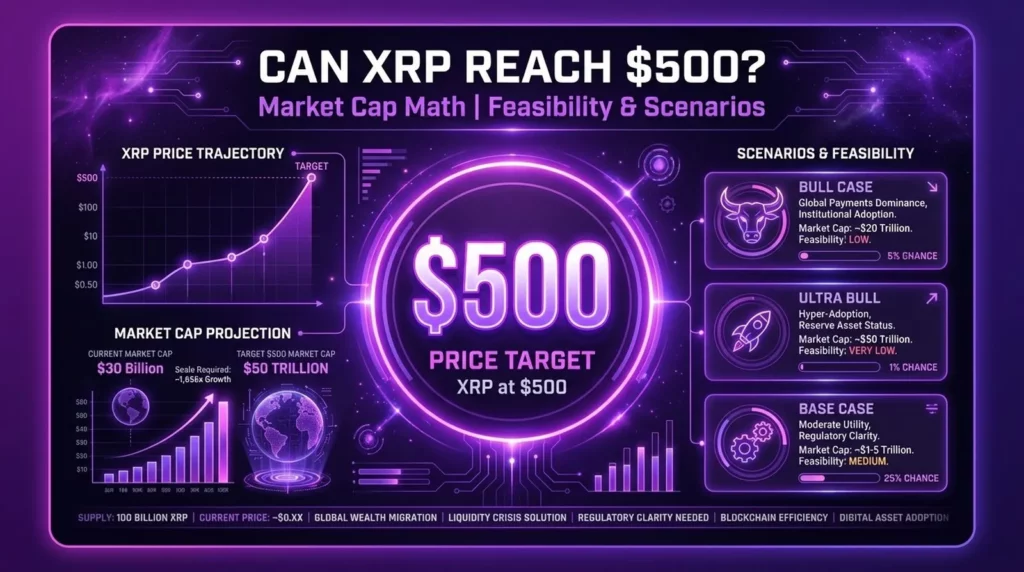
At $500, XRP’s market cap equals $500 multiplied by supply: approximately 57.7 billion circulating XRP implies roughly $28.85 trillion, while 100 billion maximum supply implies $50 trillion. That is larger than most major asset markets today, so reaching $500 would require extraordinary adoption, deep liquidity, and broad regulatory access.
A $500 price target for XRP is one of the most ambitious scenarios discussed in the cryptocurrency space. Whether this target is achievable depends entirely on market cap math, supply dynamics, and a specific set of real-world conditions that would need to align over an extended time horizon.
Under the current circulating supply of roughly 57.7 billion XRP, a $500 price implies a market capitalization of approximately $28.85 trillion. Under the maximum supply of 100 billion XRP, that figure rises to $50 trillion. For context, gold’s total above-ground market capitalization sits near $27 to $28 trillion as of 2025, while global equities collectively are valued at approximately $115 trillion.
These numbers place the $500 target firmly in the category of extreme outcomes. This article breaks down the math, examines the constraints beyond market cap, identifies the conditions that would need to be true, and frames realistic scenarios so you can evaluate this target with clarity.
| Scenario | Probability Frame | Key Driver | Time Horizon |
| Base Case | Extremely unlikely | Current constraints dominate | N/A |
| Bull Case | Very low probability | Extraordinary adoption + institutional access | 20–30+ years |
| Tail-Risk Case | Negligible under current regime | Major monetary/macro regime shift | 30+ years |
Explore the full target ladder: XRP Price Targets Hub | Can XRP Reach $1,000? | Can XRP Reach $100? | Can XRP Reach $50?
Quick Answer — Is $500 XRP Realistic?
Feasibility Summary (Math-First)
The feasibility of XRP at $500 starts and ends with the market cap requirement. At approximately 57.7 billion circulating tokens, a $500 price implies a market capitalization near $28.85 trillion. At full dilution of 100 billion tokens, the implied market cap approaches $50 trillion.
Gold, the world’s most established store-of-value asset, carries an above-ground market capitalization in the range of $27 to $28 trillion. Global equities collectively are valued at roughly $115 trillion, and the global bond market sits near $140 trillion. For XRP to reach $500 at full supply, it would need to command a value equivalent to roughly 35 to 43 percent of the entire global equity market.
By any conventional measure, this target is not realistic under current market structures. However, feasibility is not binary. If you extend the time horizon to multiple decades and combine several structural shifts, the probability moves from near-zero to small but non-zero.
5 Conditions That Must Be True
- Global settlement and payments adoption at extreme scale. XRP would need to become a dominant bridge asset for cross-border value transfer, capturing a significant share of the global remittance and institutional settlement market.
- Broad institutional access. Spot ETFs, futures, options, custody solutions, and derivatives markets would need to be fully operational across major jurisdictions.
- Durable regulatory clarity. Major jurisdictions including the United States, European Union, United Kingdom, and key Asian markets would need to provide clear, supportive legal frameworks for XRP.
- Sustained macro liquidity regime. An extended period of risk-on capital allocation, expanding money supply, and favorable monetary conditions would need to persist.
- Supply-side structural changes. Effective circulating supply would need to decrease through long-term holding behavior, lost coins, escrow retention, and transaction fee burns.
Market Cap Math for XRP at $500
Formula and Definitions
Market capitalization represents the total implied value of an asset and is calculated by multiplying the price per unit by the total number of units in circulation.
Market Cap = Price per XRP × Supply
Two supply figures matter for XRP. Circulating supply refers to the tokens currently available for trading and transactions, which is approximately 57.7 billion XRP as of early 2025. Maximum supply is the hard cap of 100 billion XRP tokens that were pre-mined at the XRP Ledger’s inception.
When evaluating extreme price targets, stating your supply assumption is essential because it changes the implied market cap by nearly a factor of two.
Implied Market Cap Under Different Supply Assumptions
| Supply Assumption | Implied Market Cap at $500 | Scale Comparison |
| ~57.7B (circulating) | ~$28.85 trillion | Approximately equal to gold’s total above-ground market cap (~$27–28T) |
| ~75B (mid-range estimate) | ~$37.5 trillion | Larger than gold; roughly one-third of global equities (~$115T) |
| 100B (maximum supply) | $50 trillion | Roughly 43% of global equities; larger than gold + total crypto combined |
Scale Comparisons: Largest Asset Classes
Placing XRP’s implied market cap at $500 alongside the world’s largest asset classes reveals the scale required.
| Asset Class | Approximate Market Cap (2025) |
| Global bond market | ~$140 trillion |
| Global equities | ~$115 trillion |
| Gold (above-ground) | ~$27–28 trillion |
| U.S. equities (S&P 500) | ~$50 trillion |
| Total cryptocurrency market | ~$3 trillion |
| XRP at $500 (circulating supply) | ~$28.85 trillion |
| XRP at $500 (max supply) | ~$50 trillion |
At $500 per token using circulating supply, XRP alone would rival the entire value of the world’s above-ground gold. At maximum supply, XRP would need to capture value equivalent to the total market capitalization of U.S. equities.
Constraints Beyond Market Cap
Liquidity vs Market Cap: Market Depth and Slippage
Market capitalization is a theoretical figure. It does not reflect how much actual money has flowed into an asset. Liquidity, which describes how easily an asset can be bought or sold without significantly moving the price, is a more practical constraint for extreme price targets.
For XRP to sustain a $500 price, the order book depth across major exchanges would need to be multiple orders of magnitude deeper than it is today. At current liquidity levels, even relatively modest sell pressure can move XRP’s price by several percentage points. Sustaining a multi-trillion-dollar valuation requires deep, persistent bid-side liquidity across spot, derivatives, and over-the-counter markets. The relationship between XRP sentiment, liquidity depth, and price stability is explored in more detail in the VTrader.io sentiment and liquidity analysis.
Flows Required and Time Horizon Sensitivity
There is no single dollar figure for how much money would need to flow into XRP to reach $500, because the answer depends on the liquidity profile at each price level and the time frame over which the move occurs.
A gradual appreciation over 20 to 30 or more years requires smaller annual net inflows than a rapid price surge over five years. Longer time horizons also allow for compounding effects from adoption growth, supply reduction, and reinvestment. The following table illustrates how different horizons affect the scale of required inflows.
| Time Horizon | Estimated Annual Net Inflow Range | Liquidity Assumption | Commentary |
| 10 years | $2T–$5T+ per year | Requires liquidity growth far beyond current trajectory | Implausible under current market structure |
| 20 years | $500B–$2T per year | Assumes sustained deep institutional participation | Requires extraordinary but not impossible conditions |
| 30+ years | $200B–$800B per year | Assumes structural expansion of crypto as an asset class | Most plausible if a path exists at all |
These estimates are order-of-magnitude ranges, not precise forecasts. They illustrate that $500 XRP is not a near-term possibility and would require decades of sustained capital allocation even under the most favorable assumptions.
Supply Float, Distribution, and Long-Term Holding Behavior
XRP’s effective circulating supply is influenced by several factors beyond the headline number. Ripple Labs holds a significant portion of XRP in escrow, releasing up to 1 billion tokens per month, though much of this is typically re-escrowed. Long-term holders who do not sell effectively reduce the float, and transaction fees are permanently burned, slowly decreasing the total supply over time.
For a $500 target, the effective float matters significantly. If a large percentage of XRP is locked in long-term holdings, escrow, or lost wallets, the active tradable supply is lower, and the market cap math shifts accordingly. However, higher prices also incentivize selling, which tends to increase the effective float as dormant holders take profits.
What Would Need to Happen for XRP to Reach $500
Global Settlement and Payments Adoption at Extreme Scale
XRP was designed as a bridge currency for cross-border payments on the XRP Ledger. For $500 to be achievable, XRP would need to become the dominant settlement layer for a significant share of the global remittance and institutional payment market. The global cross-border payments market processes trillions of dollars annually, and XRP would need to capture a substantial and growing portion of this flow with strong value accrual to the token itself.
Critically, transaction velocity matters. If XRP is used as a bridge asset and held for only seconds during settlement, the price impact is limited. Value accrual at this scale requires that XRP be held, staked, or locked as collateral rather than simply transited. The XRP fundamentals analysis provides deeper coverage of utility-driven value accrual.
Institutional Access Stack: ETFs, Custody, Derivatives, and Compliance
A $500 XRP requires full institutional infrastructure. This means approved spot ETFs in the United States, Europe, and Asia, regulated custody solutions from major financial institutions, deep derivatives markets including futures and options, and compliance frameworks that allow pension funds, sovereign wealth funds, and endowments to hold XRP exposure. The current trajectory of XRP ETF developments is a necessary first step, but ETF access alone is supportive rather than sufficient for a $500 outcome.
Regulatory Clarity Across Major Jurisdictions
XRP’s legal status has been a defining factor in its price history. The SEC lawsuit and legal developments have shaped market perception significantly. For $500, regulatory clarity would need to extend beyond the United States to include the European Union (under MiCA and subsequent frameworks), the United Kingdom, Japan, South Korea, Singapore, and other major financial centers. Clarity must be durable, meaning not subject to reversal by future administrations or regulatory shifts.
Macro Liquidity Regime and Sustained Demand
Cryptocurrency prices are heavily influenced by global liquidity conditions. Risk-on environments with expanding central bank balance sheets, low real interest rates, and abundant capital tend to drive crypto valuations higher. A $500 XRP target essentially requires that the macro liquidity environment remain broadly supportive for decades, with only temporary interruptions that do not permanently impair the adoption trajectory.
Supply-Side Changes: Float Reduction, Lost Coins, and Structural Locking
Every XRP transaction burns a small fee, permanently reducing total supply. Over decades, this deflationary mechanism, combined with lost wallet keys, long-term escrow retention, and structural locking through smart contracts or DeFi protocols, could meaningfully reduce the effective circulating supply. A lower effective supply shifts the market cap math in favor of higher per-token prices, but the magnitude of this effect is uncertain and slow.
Scenarios for XRP to Reach $500
Base Case: Constraints Dominate
In the base case, current structural constraints remain largely in place. Institutional access expands gradually through ETFs and custody solutions, regulatory clarity improves but remains fragmented globally, and XRP adoption grows steadily but does not achieve dominance in cross-border settlements. Under these conditions, XRP may reach meaningful price appreciation but $500 remains well beyond the achievable range.
Base case assessment: $500 is extremely unlikely. The implied market cap is too large relative to probable capital flows and adoption trajectories.
Bull Case: Extraordinary Adoption and Access
The bull case requires the convergence of multiple favorable conditions: global regulatory clarity, deep ETF and derivatives markets, significant cross-border payments adoption with strong XRP value accrual, and a sustained macro liquidity tailwind. Even in this scenario, $500 would likely require 20 to 30 or more years of compounding growth. The XRP price drivers and catalysts hub tracks the individual factors that could contribute to this scenario.
Bull case assessment: Very low probability, but not zero if all conditions converge over an extended time horizon.
Tail-Risk Case: Major Monetary Regime Change
The tail-risk scenario envisions a fundamental restructuring of the global monetary system. This could include significant fiat currency debasement, a shift toward digital or crypto-based reserve assets, or a geopolitical realignment that elevates blockchain-based settlement systems. In this scenario, nominal price targets become less meaningful because the purchasing power of the dollar itself may be significantly different.
If the dollar loses substantial value, a $500 nominal XRP price may not represent the same real value as $500 in today’s purchasing power. Any analysis of extreme targets should separate nominal from real price expectations.
Tail-risk assessment: Negligible probability under the current monetary regime. Only relevant if structural changes to the global financial system fundamentally alter the relationship between fiat currencies and digital assets.
Unit Bias and Denomination Framing
Many investors are drawn to low unit-price assets because of unit bias: the psychological preference for owning whole units rather than fractions. XRP, priced well below $10 at the time of writing, appeals to investors who feel they are getting more for their money compared to bitcoin at five or six figures per coin.
Unit bias can fuel speculative demand, but it does not change the fundamental market cap math. Whether an asset is priced at $500 with 57 billion units or $50,000 with 570 million units, the total market capitalization is identical. Focus on the implied market cap and the conditions required to sustain it, not the per-unit price in isolation.
Sensitivity Tables (Assumptions)
Supply Sensitivity
The following table shows how different supply assumptions affect the implied market cap at $500. This is critical because circulating supply increases over time as Ripple releases tokens from escrow.
| Supply Assumption | Implied Market Cap at $500 | Context |
| 50B XRP | $25 trillion | Lower-bound estimate; assumes significant burn + lost coins |
| 57.7B XRP (current circ.) | ~$28.85 trillion | Approximately equal to gold’s market cap |
| 75B XRP | $37.5 trillion | Mid-range; higher than gold, significant fraction of equities |
| 100B XRP (max) | $50 trillion | Equivalent to total U.S. equity market capitalization |
Adoption and Flow Sensitivity (Order-of-Magnitude)
This table illustrates how different levels of global adoption could translate into XRP demand, using order-of-magnitude estimates.
| Adoption Scenario | Annual Flow Estimate | Years to $500 (approx.) | Notes |
| Current trajectory | $10B–$50B/year | Not reachable | Insufficient scale for multi-trillion cap |
| Moderate institutional adoption | $100B–$500B/year | 50+ years | Requires sustained ETF + custody flows |
| Major global settlement adoption | $500B–$2T/year | 20–30 years | Requires XRP as dominant bridge asset |
| Regime-shift scenario | $2T+/year | 10–20 years | Assumes fundamental monetary system restructuring |
Time Horizon Sensitivity
| Time Horizon | Required CAGR from $2 | Supply Assumption | Feasibility | Comparable Growth |
| 5 years | ~200%/year | 57.7B | Implausible | No major asset sustains this CAGR |
| 10 years | ~70%/year | 57.7B | Extremely unlikely | Peak crypto bull runs only |
| 20 years | ~31%/year | 57.7B | Very unlikely; possible with regime shift | Early-stage tech companies |
| 30 years | ~20%/year | 57.7B | Unlikely but not inconceivable | S&P 500 long-run (10%); requires 2x equity growth rate |
What to Watch (Milestones and Metrics)
Legal and ETF Milestones
- SEC case final resolution and precedent clarity. A definitive resolution removes the largest source of institutional uncertainty for XRP in the United States.
- XRP spot ETF approval in the U.S. ETF access unlocks participation from retirement accounts, registered investment advisors, and institutional allocators.
- EU and Asia regulatory frameworks. MiCA implementation and clarity from Japan, Singapore, and South Korea broaden the global access surface.
- Derivatives market depth. Regulated XRP futures and options on major exchanges like CME signal institutional maturation.
Liquidity Metrics: Depth, Spreads, Open Interest, and Funding
- Order book depth within 2 percent of mid-price across top 10 exchanges.
- Bid-ask spreads on major trading pairs (XRP/USD, XRP/USDT, XRP/BTC).
- Open interest in futures and perpetual contracts as a proxy for speculative and hedging demand.
- Funding rates as an indicator of directional market bias and leverage.
Network Usage Proxies
- Daily active accounts and unique addresses on the XRP Ledger.
- Transaction volume denominated in XRP (as opposed to dollar value, which is price-dependent).
- RippleNet partner adoption and on-demand liquidity corridor expansion.
- DEX volume on the XRP Ledger as a measure of organic network activity.
The following trigger map connects specific events to their impact on scenario probability.
| Trigger | Metric | Threshold | Scenario Weight Change |
| U.S. spot XRP ETF approved | SEC filing status | Final approval and trading begins | Bull case probability increases modestly |
| Global settlement adoption | XRP corridor volume | $10B+ daily settled via XRP | Bull case probability increases meaningfully |
| Major fiat debasement event | CPI / M2 supply | Sustained >10% annual inflation in G7 | Tail-risk case becomes more plausible |
| Liquidity depth expansion | Order book depth (2% range) | 10x current levels sustained | Supports higher sustained price levels |
| Regulatory reversal | Legal/policy action | Re-classification or ban in major jurisdiction | Base case reinforced; bull case probability decreases |
| Sustained risk-off macro | Global liquidity index | Multi-year contraction in global M2 | All bullish scenarios probability decreases |
Preconditions Checklist:
| Condition | Why It Matters | Observable Proxy | Threshold | Notes |
| Regulatory clarity (U.S.) | Unlocks institutional access | SEC case status; ETF filings | Final resolution; ETF trading | Necessary but not sufficient |
| Global regulatory clarity | Broadens market access surface | MiCA, Asia frameworks | Clear legal status in 10+ major markets | Slow-moving; multi-year process |
| Deep liquidity | Sustains price without slippage | Order book depth; OI | 10x+ current depth | Grows with institutional participation |
| Settlement adoption | Creates demand for holding XRP | XRP corridor volume | $10B+ daily | Value accrual depends on holding vs transit |
| Macro tailwind | Drives risk-on capital flows | Global M2; real rates | Sustained expansion over decades | Cyclical; expect interruptions |
Target Feasibility Ladder:
| Target Price | Implied Market Cap (~57.7B) | Difficulty | Feasibility | Link |
| $50 | ~$2.89T | High but within crypto scaling range | Possible | Can XRP reach $50? |
| $100 | ~$5.77T | Very high; requires broad adoption | Unlikely | Can XRP reach $100? |
| $500 | ~$28.85T | Extreme; rivals gold’s market cap | Extremely unlikely | This article |
| $1,000 | ~$57.7T | Beyond extreme; larger than U.S. equities | Near-zero probability | Can XRP reach $1,000? |
| $10,000 | ~$577T | Exceeds all global financial assets combined | Not plausible | Can XRP reach $10,000? |
Frequently Asked Questions
What market cap would XRP need to reach $500?
Market cap is price multiplied by supply. At $500, approximately 57.7 billion circulating XRP implies about $28.85 trillion, while 100 billion maximum supply implies $50 trillion. Always state your supply assumption so the comparison is clear and consistent.
Is $500 XRP possible with the current supply?
It is extremely unlikely under today’s market structure because the implied market caps are enormous. A coherent path would require extraordinary adoption, broad regulatory access, deep liquidity, and potentially a different macro or monetary regime sustained over decades.
Does XRP price depend more on market cap or liquidity?
Liquidity and marginal buying pressure move price; market cap is an output of price multiplied by supply. For very high targets, market depth and available float matter more than the headline market cap figure because they determine whether price levels can be sustained.
How much money would need to flow into XRP to reach $500?
There is no single inflow number because it depends on liquidity depth, how much supply is available for sale, and the time horizon. Use the sensitivity tables above to estimate net inflow ranges over 10 to 30 or more years under different liquidity assumptions.
Could an XRP ETF make $500 XRP more realistic?
An ETF can improve access and participation and may increase liquidity, which raises bull-case probabilities. But $500 still implies extreme scale, so ETF access is supportive rather than sufficient. Track __XRP ETF developments__ for the latest on institutional access milestones.
Would global payments adoption be enough for $500 XRP?
Payments adoption can raise utilization, but price impact depends on value accrual, velocity, and how much XRP must be held for settlement. For $500, adoption would need to be massive and persistent, with strong demand for holding rather than just transient bridge usage.
Could XRP reach $500 if the dollar loses value significantly?
Nominal prices can rise in debasement regimes, but the key question is real purchasing power. If the dollar loses value, a $500 nominal target may not imply the same real value. Always separate nominal from real targets in your assumptions.
What milestones would increase the probability of the $500 scenario?
Milestones include durable regulatory clarity, broad institutional access, deep spot liquidity, sustained network usage growth, and an extended risk-on liquidity regime. Map each milestone to observable proxy metrics and thresholds as described in the trigger map and preconditions checklist above.
What would invalidate a path toward $500 XRP?
Repeated failures to expand liquidity, persistent regulatory friction, and prolonged risk-off periods can invalidate the bull-case pathway. Define invalidation using both catalyst outcomes such as legal or ETF reversals and market structure signals including depth erosion, widening spreads, and declining open interest.
Which XRP targets are more realistic than $500?
Targets like $50 and $100 require less extreme scale than $500. Use the target ladder table above to compare implied market caps and required conditions consistently. For comprehensive coverage across all price targets, visit the __XRP Price Targets Hub__.

Steve Gregory is a lawyer in the United States who specializes in licensing for cryptocurrency companies and products. Steve began his career as an attorney in 2015 but made the switch to working in cryptocurrency full time shortly after joining the original team at Gemini Trust Company, an early cryptocurrency exchange based in New York City. Steve then joined CEX.io and was able to launch their regulated US-based cryptocurrency. Steve then went on to become the CEO at currency.com when he ran for four years and was able to lead currency.com to being fully acquired in 2025.