Table of Contents
Can XRP Reach $27?
What market cap would XRP need to reach $27?
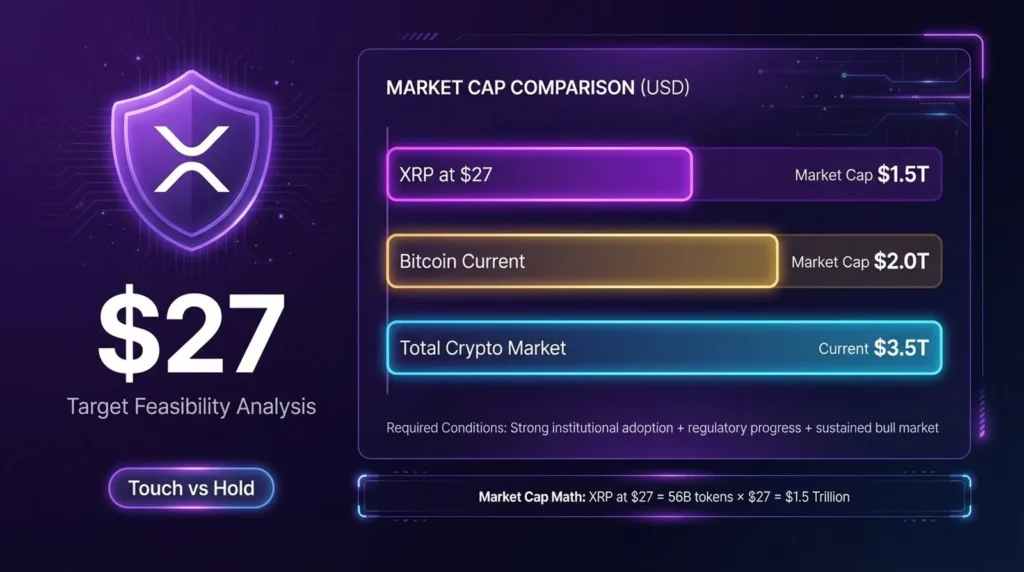
To estimate XRP’s market cap at $27, multiply $27 by circulating supply (and optionally fully diluted supply). The result is a market-cap range you can compare to benchmarks like Bitcoin and the total crypto market cap to judge feasibility.
Disclaimer: This is informational content, not financial advice. Price targets involve uncertainty. Always conduct your own research.
Last Updated: January 2026
Direct Answer: XRP reaching $27 is feasible under specific conditions. A $27 price would imply a market cap of approximately $1.57 trillion (circulating) to $2.7 trillion (fully diluted)—roughly 55-95% of the current total crypto market cap. This is more achievable than extreme targets like $100 or $1,000, but still requires: sustained risk-on market regime, improved liquidity depth, continued market access expansion, and constructive catalysts. The key question is whether XRP can touch $27 (possible in a speculative overshoot) or hold $27 (requires deeper structural support).
XRP at $27: Market Cap at a Glance
| Supply Assumption | Supply (B) | Market Cap at $27 | vs Total Crypto |
| Circulating | ~58B | ~$1.57 trillion | ~55% of current |
| Fully Diluted | 100B | $2.7 trillion | ~95% of current |
Touch vs Hold: Quick Assessment
- Touch $27: Possible in a strong risk-on cycle with leverage and momentum; could occur during speculative overshoots
- Hold $27: Requires deeper liquidity, broader participation, sustained demand, and confirmation the level isn’t immediately rejected
Key Requirements for $27:
- Risk-On Cycle: BTC trending higher; broad crypto market strength
- Liquidity Depth: Sufficient market depth to absorb large orders at elevated prices
- Market Access: ETF products, exchange availability, custody infrastructure
- Legal/Regulatory Clarity: Continued risk premium compression from settled regulatory status
- Adoption Signals: Growing utility metrics (ODL volume, XRPL activity, institutional participation)
Market Cap Math for XRP at $27
Circulating Supply vs Fully Diluted Supply (Why Both Matter)
Market cap calculations depend on which supply figure you use. Circulating supply (~58 billion XRP) represents tokens currently tradeable in the market—this is what most rankings use. Fully diluted supply (100 billion XRP) represents the maximum possible supply including escrow. Both matter: circulating for current feasibility assessment, fully diluted for stress-testing whether the math still works if all supply eventually enters circulation.
Market Cap Ranges Under Different Supply Assumptions
| Supply Assumption | Supply | Price | Implied Market Cap | Feasibility Note |
| Circulating | 58B | $27 | $1.57 trillion | ~55% total crypto |
| Partially Diluted | 75B | $27 | $2.03 trillion | ~72% total crypto |
| Fully Diluted | 100B | $27 | $2.7 trillion | ~95% total crypto |
Benchmark Comparisons (BTC, Total Crypto, Large-Cap Equities)
| Benchmark | Approximate Value | XRP $27 as % of Benchmark |
| BTC Market Cap (Current) | ~$2.5 trillion | 63% (circulating) |
| Total Crypto Market Cap | ~$2.8 trillion | 56% (circulating) |
| ETH Market Cap (Current) | ~$400 billion | 392% (circulating) |
| Microsoft Market Cap | ~$3.0 trillion | 52% (circulating) |
At $27, XRP’s circulating market cap would be larger than ETH and about 63% of BTC. This is achievable if: (1) total crypto grows significantly, (2) XRP captures more market share, or (3) both. For methodology on evaluating targets, see the methodology hub.
Supply, Distribution, and Token Economics (What Changes the Math?)
How Circulating Supply Is Measured and Why It Changes
XRP’s circulating supply is approximately 58 billion tokens out of a maximum 100 billion. Circulating supply increases gradually as Ripple releases tokens from escrow (typically 1 billion monthly, with unused portions returned). This means market cap calculations using current circulating supply may understate future dilution. Track supply changes quarterly to update feasibility assessments.
Escrow and Distribution Considerations (State as Constraints)
Ripple’s escrow mechanism provides predictable supply release schedules. The remaining ~42 billion XRP will enter circulation over time, which affects long-term feasibility. For $27 to be sustainable at fully diluted supply, the market cap would need to reach $2.7 trillion—a more demanding requirement. XRP has minimal burn (transaction fees are destroyed), but the burn rate is negligible relative to total supply.
Why Price × Supply Is Necessary but Not Sufficient
Market cap math shows what must be true numerically, but doesn’t guarantee feasibility. A $1.57 trillion market cap requires: (1) enough liquidity to support trading at those levels, (2) marginal buyers willing to pay $27, and (3) a macro environment supporting risk assets. For fundamental analysis, see the fundamentals hub.
Liquidity and Market Structure Feasibility
Spot Liquidity Depth and Slippage (What Improves Feasibility)
For XRP to sustainably trade at $27, spot markets need sufficient depth to absorb large orders without excessive slippage. Currently, XRP has strong liquidity for an altcoin, but a ~10x price increase would require proportionally deeper order books. This depth typically develops with: institutional participation, more trading venues, mature market makers, and ETF-driven liquidity. For liquidity analysis, see the sentiment and liquidity hub.
Derivatives and Leverage Role (How Spikes Happen)
Derivatives markets can amplify price moves and create conditions for rapid spikes. In a strong risk-on cycle with elevated leverage, XRP could spike toward $27 even without fundamental support at that level—this is the ‘touch $27’ scenario. However, leverage-driven moves often reverse sharply. More mature derivatives infrastructure (options markets, better risk management) can support sustained pricing.
Sustaining $27: Required Liquidity + Participation Breadth
| Condition | Likely to ‘Touch’ $27? | Likely to ‘Hold’ $27? | Why |
| Leverage-driven spike | Yes | Unlikely | Momentum can create overshoot; usually reverses |
| BTC cycle peak momentum | Yes | Possible | Rising tide lifts XRP; depends on cycle duration |
| Institutional adoption surge | More likely | More likely | Deeper liquidity; longer-term holders |
| Total crypto 2x growth | More likely | More likely | XRP share doesn’t need to grow much |
| Utility milestone (CBDC) | Possible | Possible | Fundamental demand supports pricing |
Scenario Pathways to $27 (EAV Scenarios)
| Scenario | Requirements | Evidence Signals | Failure Signals |
| A: Cycle Expansion | BTC cycle continuation; broad risk-on; XRP maintains share | BTC new highs; altseason rotation; OI growth | BTC cycle peak; risk-off rotation |
| B: Access Expansion | ETF flows surge; institutional critical mass; risk premium falls | ETF AUM growth; custody stats; exchange additions | ETF outflows; regulatory reversal |
| C: Speculative | Leverage extreme; momentum cascade; thin liquidity spike | OI spike; funding extreme; social volume surge | Liquidation cascade; sharp reversal |
| D: Constrained | Multiple headwinds prevent $27 (low probability path) | Sustained rejections; declining metrics | This is the failure mode |
Scenario A — Cycle Expansion + Broad Risk-On Regime (Base Bull)
This is the most straightforward path to $27. It requires the crypto market to continue its cycle expansion with BTC making new highs and altcoins participating in the rally. XRP doesn’t need to significantly increase market share—just maintain it while total crypto grows. Key signals: BTC trending above $150K+, altseason rotation in progress, XRP breaking above prior resistance zones with follow-through. Time horizon: 1-3 years. For year-specific probability, see the XRP price prediction 2027.
Scenario B — Access Expansion + Risk Premium Compression
This scenario requires XRP to capture disproportionate institutional flows relative to other altcoins. Drivers: XRP ETF products reaching critical mass, custody infrastructure enabling pension/endowment allocation, risk premium compressing from sustained regulatory clarity, and unique utility positioning. This path can work even in a sideways crypto market if XRP-specific catalysts are strong enough. For catalyst tracking, see the catalysts hub.
Scenario C — Speculative Overshoot (Touch vs Hold)
A speculative overshoot could push XRP to $27 briefly even without fundamental support at that level. This requires: elevated leverage positioning, momentum cascade from retail FOMO, thin liquidity at higher price levels, and lack of immediate selling pressure. However, this scenario typically reverses sharply—’touching’ $27 is the probable outcome, not ‘holding’ it. Evidence: OI reaching cycle highs, funding rates at extreme positive, social media volume spiking.
Scenario D — Low-Probability Constraints (Define Why)
This scenario represents conditions that would prevent XRP from reaching $27: sustained risk-off macro environment, crypto market stagnation or bear market, regulatory reversals, XRP-specific headwinds (competitive displacement, utility thesis failure), or structural liquidity deterioration. Include this scenario to define what would force downgrade of $27 probability. Signals: sustained rejection at major resistance, declining utility metrics, institutional outflows.
Confirmation & Invalidation Triggers
| Lever | What Must Change | Observable Proxies | Risks |
| Market Regime | Sustained risk-on; BTC cycle continuation | BTC price; dominance; volatility | Cycle exhaustion; risk-off |
| Total Crypto Cap | Grow toward $5T+ for easier $27 path | Total market cap; flow data | Stagnation; outflows |
| XRP Market Share | Maintain or grow share | XRP rank; dominance % | Competitive displacement |
| Institutional Adoption | ETF growth; custody expansion | ETF AUM; holder composition | Outflows; access constraints |
| Liquidity Depth | Deeper books at higher prices | Order book depth; spreads | Thin liquidity; slippage |
Evidence That Increases Probability (Levels, Regime, Liquidity)
Events that would increase $27 probability:
- XRP breaks above $10, then $15, then $20 with confirmed follow-through
- BTC continues cycle expansion toward $150K-$200K
- Total crypto market cap exceeds $5 trillion
- XRP ETF AUM grows to $20B+ with sustained inflows
- Utility metrics (ODL, XRPL activity) show exponential growth
Evidence That Reduces Probability (Rejections, Risk-Off, Access Setbacks)
Events that would decrease $27 probability:
- XRP rejected multiple times at major resistance zones ($10, $15)
- BTC cycle exhaustion and correction below $100K
- Risk-off macro rotation (recession, policy shock)
- ETF outflows or institutional exit signals
- XRP market share decline from competitive displacement
Time Horizon Considerations
Near-Term vs Multi-Year Feasibility (Why Timeframe Changes the Answer)
Timeframe significantly affects $27 feasibility assessment. Near-term (2026): Possible in a strong cycle with favorable catalysts; would require significant momentum. Medium-term (2027-2028): More achievable if total crypto continues growing and XRP maintains position; cycle dynamics supportive. Long-term (2030+): Higher probability if crypto achieves mainstream adoption; less dependent on single-cycle dynamics.
Link to Year Hubs for Time-Bounded Discussion
For year-specific probability assessments and scenario weights: XRP Price Prediction 2026 | XRP Price Prediction 2027 | XRP Price Prediction 2030 | All years
Related Target Articles
Can XRP Reach $5 / $10 / $20 / $100 / $500 / $1000
Compare $27 feasibility with other price targets:
- Can XRP reach $5? (near-term achievable)
- Can XRP reach $10? (cycle feasible)
- Can XRP reach $20? (bull scenario target)
- Can XRP reach $100? (long-term / multi-cycle)
- Can XRP reach $500? (extreme scenario)
- Can XRP reach $1,000? (highly constrained)
For all targets: XRP price targets index | XRP price prediction
Frequently Asked Questions
Can XRP realistically reach $27?
Yes, it’s feasible under specific conditions. $27 implies a ~$1.57 trillion circulating market cap (about 55% of current total crypto). This requires: sustained risk-on cycle, BTC strength, maintained/growing XRP market share, and sufficient liquidity. Unlike extreme targets ($100+), $27 is achievable within a single strong cycle or moderate total crypto growth.
What market cap would XRP need to hit $27?
Market cap = price × supply. At $27: circulating supply (~58B) implies ~$1.57 trillion; fully diluted (100B) implies $2.7 trillion. Compare to benchmarks: current total crypto (~$2.8T), BTC (~$2.5T), ETH (~$400B). XRP at $27 would be larger than ETH and about 63% of BTC’s current cap.
Does circulating supply or fully diluted supply matter more for $27?
Circulating supply is used for most comparisons and near-term feasibility. Fully diluted supply (100B) helps stress-test long-term sustainability as escrow releases continue. At $27, the difference is ~$1.57T (circulating) vs ~$2.7T (fully diluted)—both are achievable but represent different constraint levels.
Is it easier for XRP to touch $27 briefly or hold $27 sustainably?
Touching $27 is easier than holding it. A speculative overshoot in a strong risk-on cycle can create a brief spike. Holding $27 requires: deeper liquidity supporting trading at that level, broader participation (not just leveraged traders), sustained demand, and confirmation the level isn’t immediately rejected. Plan for both scenarios.
What catalysts could make a $27 XRP scenario more likely?
BTC cycle continuation (new highs), total crypto market growth toward $5T+, XRP ETF AUM expansion, institutional adoption surge, risk premium compression from regulatory clarity, and utility growth (ODL, XRPL metrics). Convert each catalyst into observable triggers: price levels, flow data, positioning metrics.
What risks or events could prevent XRP from reaching $27?
Risk-off macro regimes, BTC cycle exhaustion/correction, crypto market stagnation, regulatory reversals, XRP market share decline from competitive displacement, sustained rejection at major resistance zones, or liquidity deterioration. Track these signals to adjust scenario probability.
How does XRP at $27 compare to Bitcoin’s market cap or the total crypto market cap?
XRP at $27 (~$1.57T circulating) would be: ~63% of Bitcoin’s current market cap, ~56% of total crypto market cap, and ~4x larger than ETH. This is achievable if total crypto grows toward $5T (XRP would be ~31% of total) or if XRP captures more share of the current market.
Can XRP reach $27 without mass adoption?
A brief spike to $27 is possible without mass adoption—if leverage and momentum create a speculative overshoot. But sustaining $27 typically requires stronger demand drivers: institutional participation, utility growth, and healthier market structure. Without mass adoption, expect higher probability of reversal after any spike.
Which year forecasts discuss the probability of XRP reaching $27?
Use the Year Index Hub and relevant year pages (2026, 2027, 2030). Check whether $27 appears in bull scenarios and what conditions are required. Year hubs track how scenario weights change as market conditions evolve—$27 may move from ‘extreme’ to ‘bull’ to ‘base’ as evidence accumulates.
Update Log
| Date | Update Notes |
| January 2026 | Initial $27 feasibility analysis published. Market cap math: ~$1.57T circulating, ~$2.7T fully diluted. |
This update log tracks changes in: supply inputs, market benchmarks (total crypto, BTC cap), access/regulation assumptions, key level progression, and scenario probability assessments. Material changes trigger page refresh.

Steve Gregory is a lawyer in the United States who specializes in licensing for cryptocurrency companies and products. Steve began his career as an attorney in 2015 but made the switch to working in cryptocurrency full time shortly after joining the original team at Gemini Trust Company, an early cryptocurrency exchange based in New York City. Steve then joined CEX.io and was able to launch their regulated US-based cryptocurrency. Steve then went on to become the CEO at currency.com when he ran for four years and was able to lead currency.com to being fully acquired in 2025.