If you want to buy bitcoin safely, it really boils down to three things: pick a reputable, regulated exchange, lock down your account with strong multi-factor authentication, and get your coins into a personal wallet that you control. This simple framework—select, secure, and self-custody—is the bedrock of a solid investment strategy. It’s about taking ownership, moving from hoping a platform is safe to knowing your assets are.
Laying the Groundwork for a Secure Bitcoin Purchase

Before you even get close to that ‘buy’ button, you need to understand the security landscape. That’s your best defense. Digital assets move fast, and being proactive about safety isn’t optional—it’s essential. This is more than just dodging scams; it’s about building a durable system for managing your investment right from the start.
I find it helpful to think about the process in three core stages, or pillars. Each one addresses a different part of the journey, making sure you’re protected before, during, and after you buy.
The Three Pillars of Safe Bitcoin Ownership
Your journey begins with choosing the right platform and ends with you holding the keys. Here’s a quick breakdown:
- Pillar 1: Selecting a Battle-Tested Exchange This is your gateway. A trustworthy exchange is one that takes regulation seriously, uses institutional-grade security, and is upfront about how it operates.
- Pillar 2: Locking Down Your Personal Account Once you've picked a platform, the spotlight turns to your own security habits. This means creating strong, unique credentials and turning on the highest level of authentication they offer.
- Pillar 3: Taking Control with Proper Storage This is where the real ownership happens. It means moving your Bitcoin off the exchange and into a wallet where you—and only you—control the private keys.
This guide is designed to be a practical roadmap, not just a bunch of theory. We’ll dive into each of these pillars, giving you actionable advice to build your confidence. Think of it as a checklist for your peace of mind.
Key Takeaway: Buying Bitcoin safely is a shared responsibility. The exchange provides the secure infrastructure, but you are ultimately in charge of your account's security and the long-term custody of your assets.
Understanding this dynamic is crucial. An exchange can have the best security in the world, but it can’t stop you from using a weak password or falling for a phishing email. Likewise, you can't audit an exchange's cold storage, but you can and should control your own.
This table breaks down who is responsible for what.
Pillars of Safe Bitcoin Purchasing
| Security Area | Exchange Responsibility (What to Look For) | User Responsibility (What to Do) |
|---|---|---|
| Platform Security | Cold storage for assets, regular security audits, insurance funds (SAFU), regulatory licenses. | Choose exchanges that publicly share their security practices and proof of reserves. |
| Account Access | Offer robust Two-Factor Authentication (2FA) options (Authenticator App, YubiKey). | Enable the strongest 2FA available. Use a unique, complex password and a password manager. |
| Transaction Security | Implement withdrawal whitelisting, time-locks, and require multiple confirmations for large transfers. | Double-check wallet addresses before sending. Start with a small test transaction. |
| Asset Custody | Provide a secure trading environment but are not meant for long-term storage. | Withdraw Bitcoin to a personal wallet (hardware wallet is best) after purchasing. |
Ultimately, the exchange provides a service, but you are the final line of defense for your investment.
For those just starting out, getting a feel for how to invest in crypto more broadly can add some helpful context. This guide, however, is laser-focused on the safety protocols that should underpin every single move you make in the digital asset world.
Choosing a Trustworthy Bitcoin Exchange
The single most important decision you'll make when you start is picking the right cryptocurrency exchange. This is where you'll link your bank account, verify your identity, and ultimately buy your first Bitcoin. Instead of just rattling off a list of popular names, let's break down how you can properly vet an exchange yourself.
Think of it like choosing a bank. You wouldn't put your life savings in an institution with shoddy security and no insurance, right? The same logic applies here. Learning to spot the signs of a robust, trustworthy platform is a non-negotiable first step to protecting your capital from day one.
Security Features That Are Non-Negotiable
Before you even think about creating an account, you need to dig into an exchange's security measures. Any platform that takes security seriously will be proud to show it off. If they hide this information, that’s a major red flag.
When you’re evaluating an exchange, look for these foundational security pillars:
- Cold Storage Policies: Top-tier exchanges keep the vast majority—typically over 95%—of user funds in cold storage. This just means the crypto is held on devices completely disconnected from the internet, making it impossible for hackers to reach.
- Proof of Reserves (PoR): This is basically an audit that proves an exchange actually holds enough assets to cover all its customer deposits. It's a critical transparency measure that shows the platform isn't playing games with your money and can handle withdrawals.
- Mandatory Multi-Factor Authentication (MFA): The exchange shouldn't just offer MFA; it should practically force you to use it. Look for support for authenticator apps (like Google Authenticator) or hardware security keys, which are far more secure than flimsy SMS codes.
These aren't just fancy buzzwords; they are your primary defense against losing everything. Spend a few minutes on the exchange's security page to confirm these practices are in place before moving forward.
For example, Coinbase clearly outlines its multi-layered approach to protecting assets on its security page.
They combine offline storage, their own security protocols, and cybercrime insurance to protect user funds from a whole range of threats. That’s what you want to see.
Why Regulatory Compliance Is Your Friend
I know, nobody likes the identity verification process, often called Know Your Customer (KYC). It can feel like a hassle. But honestly, it's a massive green flag. An exchange that complies with KYC and Anti-Money Laundering (AML) rules is showing you it’s committed to operating legally and protecting its users.
Regulatory compliance usually means the exchange is registered with financial authorities, like FinCEN in the United States. This oversight holds the platform to a much higher standard. While it means you can't buy Bitcoin anonymously, it provides a crucial layer of consumer protection that makes the entire ecosystem safer.
A Cautionary Tale: Unregulated exchanges that operate in legal gray areas might tempt you with low fees or no verification, but they carry immense risk. When things go wrong, you have little to no legal recourse. Fully understanding the risks associated with cryptocurrency exchanges, such as those faced by FTX investors, is an essential part of your due diligence.
Evaluating an Exchange's Track Record
History matters. A lot. An exchange that has survived multiple crazy market cycles without a major security breach has proven its resilience. On the other hand, a platform with a history of hacks, constant downtime during big price swings, or terrible communication should be avoided.
Your vetting process should include these three steps:
- Check for Past Security Incidents: A quick Google search will tell you if an exchange has been hacked. If it has, how did they handle it? Did they reimburse users and beef up their security?
- Read User Reviews: Don't just read the 5-star reviews. Look for patterns in feedback on sites like Trustpilot or Reddit. Are people constantly complaining about frozen accounts, withdrawal problems, or non-existent customer support?
- Assess Transparency: Does the exchange have a public team? Do they publish regular security audits or proof-of-reserves reports? Anonymity is a huge red flag for a company that wants to hold your money.
Remember, centralized exchanges are huge targets for hackers. The $280 million KuCoin hack in 2020 is a stark reminder of this. A multi-layered security approach isn't just nice to have—it's the gold standard for buying Bitcoin safely.
Creating and Fortifying Your Exchange Account
Once you've picked a great exchange, the responsibility for security lands squarely on your shoulders. The platform builds the secure walls, but you’re the one who needs to bolt the doors. Setting up your account isn't just about filling in your details—it's about building your own personal fortress from day one.
Your first line of defense is always the password. But a "strong" password isn't what it used to be. You need a unique, randomly generated password for every single site you use. Nobody can remember all that, which is where password managers come in.
Mastering password manager best practices is a non-negotiable skill for keeping your digital assets safe. They create and store impossible-to-guess passwords, so a data breach at some random website won't ever lead back to your exchange account.
Why Your Phone Number Is a Weak Link
With a solid password in place, the next critical step is enabling Multi-Factor Authentication (MFA), often just called 2FA. But be careful—not all 2FA is created equal. The default option on many platforms is to text a code to your phone, and frankly, that's a huge security hole.
This method is vulnerable to a "SIM-swap" attack. A scammer can social-engineer your mobile provider, tricking them into moving your phone number to a new SIM card in their possession. Once they have control of your number, they get your 2FA codes and can start resetting your passwords.
Real-World Impact: This isn't just a theoretical risk. High-profile crypto investors have lost millions of dollars in a matter of minutes to these attacks. It’s a brutal reminder that your phone number is one of the most fragile links in your security chain.
To properly secure your account, you have to move past SMS. The industry-standard alternatives are far more secure:
- Authenticator Apps: Apps like Google Authenticator or Authy generate time-sensitive codes right on your device. The codes never travel over a cellular network, making them completely immune to SIM-swapping.
- Hardware Security Keys: A physical device like a YubiKey is the gold standard. You plug it into your computer or tap it on your phone, and it requires a physical touch to approve a login. This makes it virtually impossible for a remote attacker to get in.
Understanding the KYC Process
As you set up your account, the exchange will ask you to complete a Know Your Customer (KYC) process. This usually means uploading a photo of your driver's license or passport and taking a selfie to prove you're really you. It might feel a bit invasive, but it's a critical step that actually protects you.
KYC verification accomplishes two key things:
- It Prevents Fraud: It makes it incredibly difficult for criminals to open anonymous accounts for money laundering or other illegal activities.
- It Helps with Account Recovery: If you ever get locked out of your account, having your identity verified gives the exchange a secure way to help you get back in.
Think of it like a bank asking for ID to open an account. It’s the sign of a legitimate, regulated platform that takes security and compliance seriously—a key part of learning how to buy Bitcoin safely.
These security practices aren't just suggestions; they work. Studies show that simply enabling MFA can slash your risk of account compromise by over 90%. That simple step, combined with good security habits, creates a powerful shield. To learn more about spotting and avoiding threats, check out our guide on how to protect against phishing attacks and harden your defenses even further.
Your First Bitcoin Purchase From Start to Finish
Okay, your account is locked down and secure. Now for the exciting part—actually buying your first Bitcoin. The process is pretty straightforward: you'll add some money to your exchange account, place an order, and confirm it. But taking your time here is key to making sure the transaction is safe and doesn't cost you more than it should.
Most exchanges let you fund your account with a bank transfer (ACH) or a debit/credit card. Using a card is instant, which is tempting, but it almost always hits you with higher fees, typically between 2.5% and 4%. Bank transfers are way cheaper, though you might have to wait a few business days for the funds to show up. If keeping costs low is your priority, ACH is the hands-down winner. You can dig deeper into the pros and cons of how to buy Bitcoin with a debit card to see which method fits you best.
Placing a Smart First Order
Once the money is in your account, it's time to decide how you want to buy. You'll mainly see two options: a market order and a limit order.
- Market Order: This is the "just get it done" option. You're essentially telling the exchange to buy Bitcoin for you at whatever the current market price is. It’s fast and simple, but you give up control over the exact price you pay.
- Limit Order: This puts you in the driver's seat. You set the specific price you're willing to pay, and your order will only go through if Bitcoin’s price hits that target. It’s perfect for avoiding overpaying, especially when the market is jumping around.
I always recommend starting with a small test run for your first purchase. Just buy $10 or $20 worth. This lets you walk through the entire process from start to finish without any real financial risk, helping you build the confidence and muscle memory for larger buys down the road.
The security layers you've already set up—your strong password, 2FA, and identity verification—are all working in the background to protect you during this exact process.
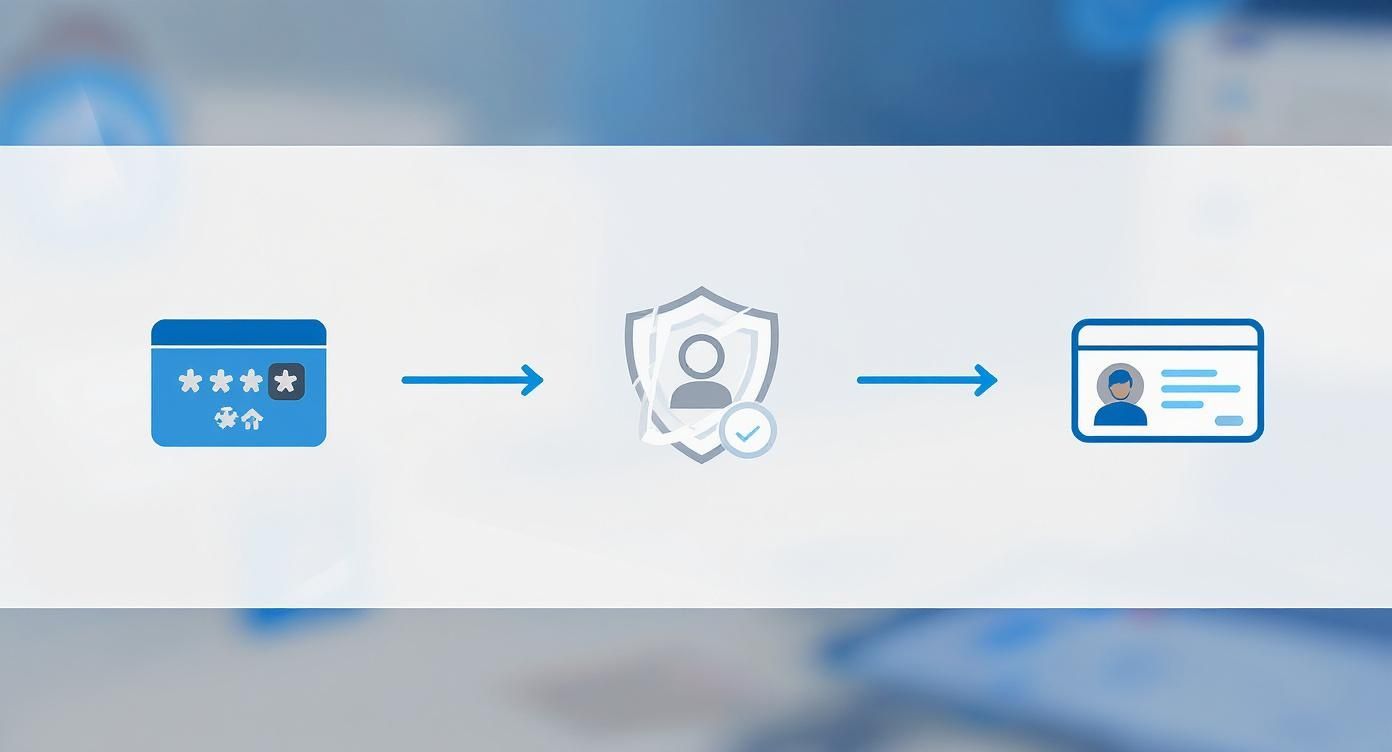
This kind of multi-layered defense is what stands between your assets and any potential threats, safeguarding every click you make on the exchange.
Post-Purchase Verifications
Don't close the tab just yet. After you hit that "confirm" button, you need to double-check that everything went smoothly. Head over to your exchange's portfolio or wallet section to see if the correct amount of Bitcoin is there.
Pro Tip: Make it a habit to review every transaction receipt. Check the final price you paid, the fees that were deducted, and the total amount of Bitcoin you received. This simple verification step is a cornerstone of safely buying Bitcoin.
You should see the transaction recorded in your account almost instantly. At this point, your new Bitcoin is sitting in your exchange wallet, which means the exchange is holding it for you. This brings us to the single most important step in securing your investment: moving it to a wallet that only you control.
Mastering Bitcoin Custody With Cold and Hot Wallets

Okay, you’ve bought some Bitcoin on an exchange. Congratulations. But the work isn't over yet—in fact, the most important part is just beginning.
That purchase marks your transition from buyer to owner, and ownership in crypto comes with one non-negotiable responsibility: securing your assets. This is where you’ll run into the single most important rule in this entire space: “not your keys, not your coins.”
It’s a simple phrase, but it’s the bedrock of self-sovereignty. When your Bitcoin sits on an exchange, you're trusting them to keep it safe. You don't actually hold the private keys that prove ownership and allow you to spend the funds. You're relying on their security, their solvency, and their goodwill. True ownership means taking control.
Understanding Your Wallet Options
To really own your Bitcoin, you need to move it to a wallet where you control the private keys. There are a few different types, each offering a distinct balance between security and convenience.
- Custodial Wallets (The Bank Vault): This is what you have on the exchange. It’s convenient for trading, sure, but the exchange is the custodian. They hold the keys, not you.
- Hot Wallets (The Everyday Wallet): These are software wallets, like apps on your phone or computer. Because they’re connected to the internet, they make sending and receiving Bitcoin easy. But that same connectivity makes them vulnerable to online threats like malware and phishing attacks.
- Cold Wallets (The Personal Safe): These are physical hardware devices that keep your private keys completely offline. Think of them as a specialized USB drive for your crypto. They are the gold standard for security, especially for storing any amount you can't afford to lose.
So, how do you choose? Let's lay it out clearly.
Bitcoin Wallet Comparison Security vs Convenience
Here’s a quick table to help you visualize the trade-offs between the main wallet types.
| Wallet Type | Security Level | Convenience | Who Controls the Keys | Best For |
|---|---|---|---|---|
| Exchange Wallet | Low | High | The Exchange | Active trading of small amounts |
| Software (Hot) Wallet | Medium | High | You | Small, everyday transactions |
| Hardware (Cold) Wallet | High | Low | You | Long-term holding of significant value |
As the table shows, if you’re serious about holding Bitcoin for the long term, a hardware wallet isn’t just a nice-to-have; it's essential. It isolates your private keys from your internet-connected computer, making it nearly impossible for online hackers to get to them. If you want a deeper dive, our guide on what is a hardware wallet explains the technology in more detail.
This isn't about being paranoid; it's about being prepared.
The Sacred Duty of Protecting Your Seed Phrase
When you set up your own wallet (hot or cold), the system will generate a recovery seed phrase—usually a list of 12 or 24 random words. This phrase is the master key to your entire wallet. If your phone breaks or you lose your hardware device, these words are the only way to restore your Bitcoin on a new device.
It also means that if anyone else gets ahold of this phrase, they can steal every last satoshi. Protecting it is your single most important job as a Bitcoin owner.
Crucial Warning: Never, ever create a digital copy of your seed phrase. Do not take a photo of it, type it into a notes app, save it in a password manager, or email it to yourself. A digital copy is a sitting duck for hackers.
Nearly every horror story you hear about someone losing their crypto traces back to a compromised seed phrase. A hacker gets into their cloud storage, or a keylogger on their PC finds a file named "BTC backup," and it's all over in an instant.
Follow these rules without exception:
- Write It Down Physically: Use the card that comes with your wallet, or better yet, etch the words into a fireproof and waterproof metal plate.
- Store It Securely: Think like you're protecting a priceless heirloom. A fireproof home safe or a bank's safe deposit box are good options. Some people even split the phrase and store the pieces in separate, secure locations.
- Never Speak It Aloud: Treat it like a state secret.
- Never Enter It Online: The only time you’ll ever use your seed phrase is during a wallet recovery on a brand-new, trusted device. No legitimate company or support agent will ever ask you for it.
By moving your Bitcoin into self-custody with a hardware wallet and obsessively guarding your seed phrase, you complete the journey. You're no longer just a user of a financial service; you're a sovereign owner of a digital asset.
Staying Safe with Regulations and Tax Awareness
Being smart with your Bitcoin goes way beyond just security. You also have to think about your financial and legal responsibilities. I know, regulations and taxes sound boring and complicated, but getting this right is crucial for protecting your investment in the long run.
Think of it this way: compliance isn't some obstacle. It's actually a sign that the crypto world is growing up, and that maturity brings benefits for all of us.
Regulations often get a bad rap, but they're what bring essential consumer protections to the table. Take the Know Your Customer (KYC) rules we covered earlier—they’re part of a bigger picture. This legal framework forces exchanges to get serious about security and anti-fraud measures, which ultimately makes the whole ecosystem safer for you and me.
Key Insight: Regulatory compliance isn't the enemy of crypto. It’s the foundation for building a trustworthy market where your assets are better protected from fraud and bad actors.
This push for compliance is exactly why the top exchanges now pour millions into their security systems. After a few high-profile hacks showed the world what happens when you cut corners, platforms started implementing things like automated transaction monitoring to flag suspicious activity instantly. You can find some fascinating reports on how exchanges are beefing up security over at Chainalysis.com.
Understanding Your Tax Obligations
Here's the single most important thing to know: the IRS (and most other tax agencies) treats Bitcoin as property, not as a currency. This distinction changes everything about how you handle taxes. You don't get taxed just for buying and holding Bitcoin. A taxable event only happens when you sell, trade, or spend it.
- Selling Bitcoin for cash: If you sell for more than you paid, that profit is a capital gain, and you'll owe tax on it.
- Trading Bitcoin for another crypto: This counts as a sale, too. You have to figure out the gain or loss on the Bitcoin you just traded away.
- Using Bitcoin to buy goods or services: Yep, buying a coffee with crypto is treated just like selling it for cash.
You absolutely must keep detailed records of every single transaction from day one. I'm talking about the purchase date, how much you paid (your cost basis), the date you sold or traded it, and the sale price. It can get messy fast.
To help you get your head around it all, we put together a guide on how to calculate crypto taxes. It breaks the process down and will help you get organized before tax season hits.
Common Questions on Buying Bitcoin Safely
As you get started, a few questions always pop up. Let's tackle the most common ones head-on to clear up any confusion and build your confidence.
How Much Bitcoin Should I Keep on an Exchange?
Think of your exchange account like a wallet you'd carry around town—it's for immediate use, not for storing your life savings. The rule of thumb is simple: only keep the amount of Bitcoin on an exchange that you plan to actively trade.
For any Bitcoin you intend to hold long-term, moving it to a personal hardware wallet is non-negotiable. This one habit dramatically cuts your risk from exchange-specific problems like hacks or unexpected account freezes. Remember, an exchange is a marketplace, not a bank vault.
Is It Safe to Buy Bitcoin on PayPal or Cash App?
Platforms like PayPal or Cash App are perfectly fine for dipping your toes in the water. They're generally secure and make your first small purchase incredibly easy.
The main catch? You often can't withdraw the Bitcoin to your own private wallet. This means you don't truly own the underlying asset—the platform does. They're a fantastic starting point, but for any serious investing, you'll want to use a proper cryptocurrency exchange that gives you full control and the ability to self-custody.
The Single Most Important Security Step
While a hardware wallet is your fortress, the master key to that fortress is your recovery seed phrase. This is the one thing you must protect above all else. Write it down—on paper or etched into metal—and store it somewhere safe and offline. Never, ever create a digital copy. That phrase is the ultimate backup for your Bitcoin; guarding it is everything.
Ready to start your journey with a platform that prioritizes your security and profitability? With vTrader, you get commission-free trading, advanced tools, and the peace of mind that comes with a regulated, secure exchange. Start trading with zero fees today at vTrader.

Steve Gregory is a lawyer in the United States who specializes in licensing for cryptocurrency companies and products. Steve began his career as an attorney in 2015 but made the switch to working in cryptocurrency full time shortly after joining the original team at Gemini Trust Company, an early cryptocurrency exchange based in New York City. Steve then joined CEX.io and was able to launch their regulated US-based cryptocurrency. Steve then went on to become the CEO at currency.com when he ran for four years and was able to lead currency.com to being fully acquired in 2025.