
The whole game of market maker versus market taker boils down to one thing: market makers create liquidity, while market takers consume it.
Think of a market maker as a shopkeeper carefully stocking their shelves with limit orders that won’t get filled right away. A market taker is the customer who walks in and buys an item right off that shelf using a market order. This one choice—to be the shopkeeper or the customer—directly impacts your trading fees and how your trade gets executed.
Understanding Your Role in Every Trade
Every trade needs a buyer and a seller, but more fundamentally, it needs someone to offer a price and someone to accept it. Most retail traders are market takers by default, but consciously choosing your role is a huge strategic advantage on platforms like vTrader. Are you willing to pay a premium for speed, or do you want a discount for being patient?
To really get this, you first need to get a handle on understanding the bid-ask spread. That tiny gap between the highest bid and the lowest ask is the cost of trading right now. It’s also what market makers earn for providing liquidity and what market takers pay for the convenience.
Market Maker vs Taker At a Glance
The two roles are opposite sides of the same coin, and both are critical for a healthy market. A market maker’s goal is to profit from the spread by placing passive orders. A market taker’s goal is to get in or out of a position immediately.
A healthy market needs a constant balance between participants willing to wait (makers) and those willing to act now (takers). Without makers, there would be no liquidity; without takers, there would be no trading volume.
The table below gives you a quick rundown of the core differences. If you want to dive deeper into specific trading strategies and fee structures, the vTrader Academy is a great place to start.
| Characteristic | Market Maker | Market Taker |
|---|---|---|
| Primary Goal | Profit from the bid-ask spread | Immediate trade execution |
| Typical Order Type | Limit Order | Market Order |
| Action | Adds liquidity to the order book | Removes liquidity from the order book |
| Trading Fees | Lower (or receives a rebate) | Higher |
| Execution | Slower, not guaranteed | Instant, guaranteed |
| Strategic Focus | Patience and price control | Speed and certainty |
The Market Maker Role: Creating Liquidity
Whether you’re in traditional stocks or the fast-paced crypto world, market makers are the bedrock of the entire system. These aren't your average traders; they are typically large financial institutions or high-frequency trading firms that serve as wholesale liquidity providers. Their main job is simple but critical: always be ready to buy and sell a specific asset.
By constantly placing orders on both sides of the book, they make sure there's always a way for other traders to get their orders filled. Think of them as the reliable merchants in a financial marketplace, keeping their shelves stocked so anyone can transact smoothly and without delay. This activity is what keeps a market orderly and prevents a single large order from causing wild price swings.
The Power of the Bid-Ask Spread
Market makers don’t make their money by betting on where an asset’s price is headed in the long run. Instead, their entire business model is built around capturing the bid-ask spread—that tiny difference between the price they’re willing to pay for an asset (the bid) and the price they’re willing to sell it for (the ask).
If a maker sets a bid at $50 and an ask at $51, that $1 gap represents their potential profit for facilitating a trade. This margin is their reward for taking on the risk of holding assets and providing that constant, two-sided liquidity. A great resource on this is CME Group's overview of market participants.
The whole point of a market maker is to maintain a two-sided market. By offering to both buy and sell at the same time, they guarantee that other traders can always find someone to trade with, which is the foundation of a confident market.
This is a game of volume, not margins. The profit on any single trade is often just fractions of a cent, but by executing millions of trades, those tiny gains add up to serious revenue. Their success hinges on complex algorithms and risk management systems that are constantly adjusting their quotes based on real-time market action.
Why Exchanges Reward Market Makers
Exchanges have a huge incentive to keep market makers happy. Why? Because high liquidity is what attracts more traders. A market with tight spreads and a deep order book feels efficient, reliable, and trustworthy.
To encourage this vital role, exchanges like vTrader often use a maker-taker fee model. Here’s how it works:
- Market Makers get rewarded with lower trading fees—or sometimes even a cash rebate—for adding liquidity to the order book with their limit orders.
- Market Takers, who remove that liquidity with market orders, pay a slightly higher fee for the benefit of getting their trade executed instantly.
This fee structure is a direct incentive for participants to place limit orders, which helps build a deeper, more stable market for everyone involved. To see how these dynamics are shaping the crypto markets right now, check out the latest updates in our vTrader news section.
The Market Taker Role: Consuming Liquidity
If market makers are patiently setting up the game board, market takers are the ones making the decisive moves. A market taker is a trader who needs to get in or out of a position now. Speed and guaranteed execution are their top priorities, so they accept the best available price on the spot.
Instead of placing an order and waiting for a counterparty, a taker actively removes liquidity from the order book. They achieve this with a market order—a direct command to buy or sell immediately at the current market rate. This action instantly consumes the limit orders that makers have set, completing the trade.
The Cost of Immediacy
This convenience isn’t free; there are clear trade-offs. The most obvious cost is paying the bid-ask spread. By buying at the higher ask price or selling at the lower bid price, the taker pays a premium for not having to wait for the market to come to them.
Exchanges like vTrader also build their fee structures around this dynamic. Taker fees are almost always higher than maker fees because you’re using up the valuable liquidity that keeps the market running smoothly. This fee difference is a fundamental part of the market maker vs market taker model, which incentivizes a deep and stable order book.
A market taker's mindset is all about action. They're willing to pay a little extra—through the spread and higher fees—to ensure their trade executes instantly. This is absolutely critical when you're reacting to breaking news or a fast-moving chart.
The Hidden Risk of Slippage
One of the biggest risks for a market taker, especially when trading larger amounts, is slippage. This happens when your order is so large that it chews through all the liquidity at the best price, forcing the rest of your order to be filled at progressively worse prices.
Let's say you place a market order to buy 10 Bitcoin. The order book only has 1 BTC available at the best ask price of $60,000. Your order will grab that one coin and then move to the next price level—say, $60,010—to fill the rest. That gap between your expected price and the final average price is slippage.
- Thin Markets: Slippage is a major problem in markets with low liquidity where there just aren't many orders sitting on the book.
- Volatile Conditions: During big news events or market crashes, liquidity can evaporate in seconds, widening spreads and making significant slippage a real danger.
Choosing to be a market taker is a strategic decision, not a rookie mistake. It's the go-to role for traders who need to act decisively, whether they're jumping on a breakout or hitting a stop-loss to manage risk. The key is understanding that you are paying for the privilege of immediate, guaranteed execution.
Comparing Maker and Taker Strategies
Knowing the difference between a market maker and a market taker is one thing, but understanding their strategies is where the real edge lies. Your choice isn't just about picking an order type; it’s about aligning your actions with your trading goals, how much risk you’re willing to take, and what you think the market is about to do. A head-to-head comparison makes it crystal clear when to choose one approach over the other.
Let’s break down the maker vs. taker strategies beyond the basic definitions. We'll get into the mechanics, costs, risks, and goals that shape how each one operates in the market.
Core Order Types and Execution
The most obvious difference is the tools they use. Market makers live and breathe limit orders. By setting an order to buy below the current price or sell above it, they’re essentially waiting for the market to come to them. This adds liquidity to the order book, but there's no guarantee the trade will ever execute.
On the other hand, market takers are all about speed and certainty. They use market orders to buy or sell right now at the best available price, which consumes liquidity. A taker’s trade is guaranteed to fill, but the final price isn’t, which can be a real problem in a fast-moving market.
Cost Structure Fees and Spreads
The financial side of things is where the two roles really diverge. Exchanges actively reward market makers for creating a stable trading environment.
- Makers: They often pay much lower fees and can even get a rebate from the exchange. Their main "cost" is the opportunity cost of having capital tied up and the risk of the asset's price moving against them.
- Takers: They pay higher "taker" fees for the convenience of instant execution. They also eat the cost of the bid-ask spread—the gap between the best buy and sell prices—which is a direct hit to their bottom line on every trade.
The maker-taker fee model is basically an incentive program. Exchanges pay people who build the market (makers) and charge people who use it for instant trades (takers). It’s what keeps the order book deep and liquid for everyone.
Strategic Objectives and Market Impact
Each role has a completely different end game. Market makers are usually trying to pocket small, consistent profits by capturing the bid-ask spread across thousands of trades. Their activity helps stabilize the market by tightening spreads and smoothing out small price jumps. They are passive by nature, letting the action come to them.
Market takers are the active players. They’re directional traders who want to get in or out of a position fast because of a news event, a chart pattern, or a change in sentiment. When you see prices move, it's because a wave of taker activity is consuming liquidity and pushing the market one way or the other.
Primary Risk Exposure
The risks couldn't be more different, forcing you to decide which kind of uncertainty you're more comfortable with.
A market maker has to worry about inventory risk. If they buy an asset to provide liquidity, they’re stuck holding it, and its price could drop before they find a buyer. Their biggest challenge is managing their holdings while waiting for their orders to fill.
A market taker faces execution risk, which usually shows up as slippage. When you place a big market order, you risk getting a worse price than you expected as your order chews through multiple levels of the order book. The main challenge here is managing the cost of immediacy, especially when the market is thin or moving like crazy.
How Makers and Takers Influence the Market
The push and pull between market makers and takers isn't just a collection of individual trades—it's the very engine that powers the market. For any market to be healthy, it needs a good balance of both. Their actions together dictate everything from trading costs to price stability, creating a living, breathing financial ecosystem.
Makers are the bedrock of a stable market. By constantly setting limit orders, they build up the order book, which in turn tightens the bid-ask spread. A tighter spread means lower transaction costs for everyone involved and helps absorb the routine ebbs and flows of buying and selling without causing wild price swings.
The Impact on Market Stability
The presence of active market makers is one of the clearest signs of an efficient market. Data from global exchanges shows that maker activity can squeeze bid-ask spreads down to a few basis points, often below 0.05%, during normal conditions. This creates a predictable, low-cost environment where traders can operate with confidence. You can get more details on how makers impact trading costs on b2broker.com.
On the flip side, a sudden flood of taker activity tells a completely different story. Picture a panic sell-off triggered by bad news. A wave of market sell orders—all from takers—starts eating through the buy-side liquidity that makers have patiently built up. This sudden imbalance depletes the order book, causing spreads to blow out and prices to nosedive.
A market’s true strength is revealed under pressure. When makers pull their orders to protect themselves, the entire price discovery mechanism can seize up, leading to extreme volatility and flash crashes.
This is exactly what happens in a flash crash. Fearing massive losses, market makers yank their quotes, and the liquidity that was just there vanishes in an instant. Without makers to absorb the selling pressure, taker orders cascade through the now-hollowed-out order book, making the price drop even faster. It’s a perfect illustration of why both roles are critical: makers lay the foundation, and takers drive the price action that reflects what the market is truly feeling.
This dynamic is especially important when you explore crypto markets on vTrader, where volatility is a given. Watching how maker and taker activity shifts gives you a bigger-picture view, helping you anticipate how the market might move beyond just your own trades. A healthy market needs both the steady hand of the maker and the decisive action of the taker to work properly.
When to Be a Maker and When to Be a Taker
Knowing the difference between a market maker and a market taker is one thing. Knowing exactly when to be one or the other is where the real strategy kicks in. This isn't just about picking an order type; it’s about matching your actions to the market's pulse and what you're trying to accomplish right now.
Your choice here directly hits your execution speed and, just as importantly, your trading costs. A smart trader knows when to be patient and when to be decisive. Are you looking to grind out a small, predictable profit in a calm market, or are you reacting to a sudden event that could change everything? Your answer tells you whether to provide liquidity or grab it.
Scenarios Favoring a Maker Strategy
Stepping into the market maker role is the right call when you have time on your side and keeping costs low is a top priority. This approach works best in stable, liquid markets where you can afford to let the price come to you.
Here are a few situations where being a maker just makes sense:
- Trading a Range-Bound Asset: If a crypto is just bouncing between a clear support and resistance line, you can set your trap. Place buy limit orders near the support and sell limit orders near the resistance. This lets you patiently trade the channel while potentially earning maker rebates.
- Accumulating a Position: Let's say you want to build a large position without sending the price to the moon. Placing a series of small limit orders below the current market price is a textbook move. It lets you average into your position, reduces your market impact, and cuts down on fees.
You can dig deeper into how vTrader's fee structure actually rewards makers, which can make these strategies even more profitable.
The decision tree below maps out the strategic thinking: makers play the long game for stability and lower costs, while takers are all about momentum.
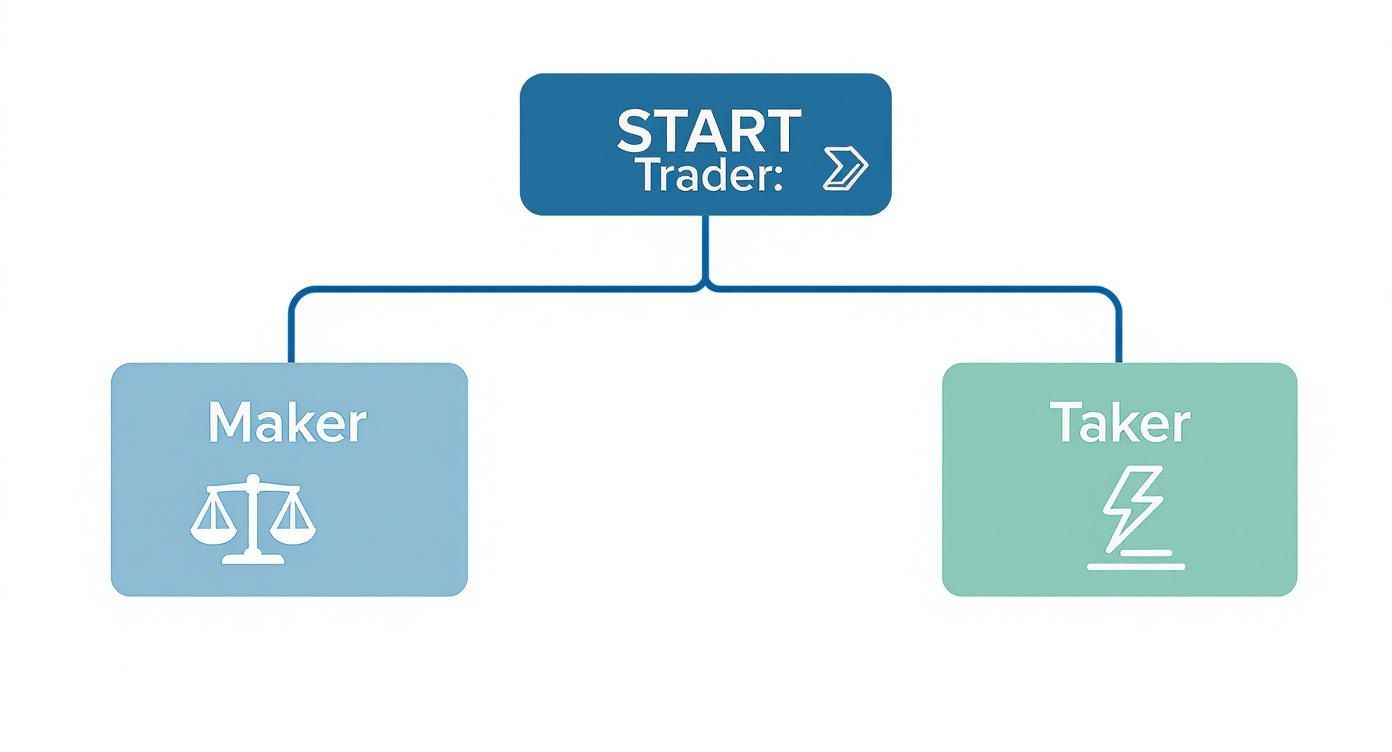
This visual guide is a great reminder that the maker role is methodical and cost-conscious, whereas the taker role is built for pure speed and reaction.
When to Immediately Take Liquidity
On the flip side, being a market taker is absolutely essential when speed and certainty are everything. In these moments, paying a slightly higher taker fee is a small price for getting your order filled instantly.
Choosing to be a taker is a deliberate strategic move. You are paying a premium for the certainty of execution, which is invaluable when managing risk or capturing a fleeting opportunity.
You'll need to be a taker when:
- Reacting to Breaking News: A surprise economic report or some other huge announcement can send prices flying. A market order gets you in or out now, before the opportunity is gone.
- Executing a Breakout Trade: When an asset's price smashes through a key resistance level, you have to get in immediately. If you wait around with a limit order, you could miss the entire move.
- Managing Risk with a Stop-Loss: Every stop-loss order is, at its core, a taker action. It's designed to trigger a market order to sell your position and cut your losses before they get worse. It’s your safety net.
Frequently Asked Questions
Can a Retail Trader Be a Market Maker
Absolutely. While the term "market maker" often brings to mind big financial institutions, any retail trader can act as one. It happens the moment you place a limit order that doesn’t get filled right away.
By setting a buy order below the current market price or a sell order above it, you’re adding an order to the book and providing liquidity. If another trader comes along and fills your order, you’ve just acted as a market maker—and you'll often be rewarded with lower fees for doing so.
Are Market Makers Trading Against Me
It’s a common misconception, but no, they aren’t directly trading against you. A market maker’s business model is built on profiting from the bid-ask spread, not on whether your individual trade wins or loses.
They aim to buy at the bid and sell at the ask, capturing the tiny difference between the two prices. Their biggest concern is inventory risk—the danger of being stuck with an asset while its price moves against them—not betting on the direction of your trade.
Why Are Taker Fees Higher Than Maker Fees
It all comes down to incentivizing a healthy market. Exchanges need liquidity to function, and they reward the traders who provide it (the makers) with lower fees or even rebates.
Market takers, on the other hand, consume that liquidity for the convenience of an instant trade. They pay a slightly higher fee for that privilege. This structure ensures there are always orders on the book, which creates a stable and efficient trading environment for everyone.
To see a full breakdown of the fee structure, check out the comprehensive vTrader FAQ section.
Unlock your trading potential with vTrader, where you can strategically switch between maker and taker roles with zero commission fees. Start trading for free today.

Steve Gregory is a lawyer in the United States who specializes in licensing for cryptocurrency companies and products. Steve began his career as an attorney in 2015 but made the switch to working in cryptocurrency full time shortly after joining the original team at Gemini Trust Company, an early cryptocurrency exchange based in New York City. Steve then joined CEX.io and was able to launch their regulated US-based cryptocurrency. Steve then went on to become the CEO at currency.com when he ran for four years and was able to lead currency.com to being fully acquired in 2025.